
Reviewed · GOLF CART TOURS
Krakow: City Sightseeing Tour Eco Electric Buggy Golf Cart
Krakow’s electric buggy tour is really a fast-moving lesson in Kazimierz and Podgórze, not a full tour of every major sight in the city. In about 90 minutes, you pass churches, nearly every historic synagogue in the old Jewish quarter, the former ghetto, Schindler’s Factory, and the old ghetto wall. It is an easy way to cover ground without wearing out your legs.
I like the warm, covered buggy, especially in cold or wet weather, and I like the guides’ practical approach. Olivia, Natalie, Philip, Jacob, and Oskar are among the guides praised for clear English, humor, careful driving, and strong local knowledge. The main drawback is that the route focuses heavily on Jewish Krakow and usually passes Schindler’s Factory rather than taking you inside.
Key points to know
- About 24 sights in 90 minutes: You cover a wide stretch of Kazimierz and Podgórze quickly.
- A strong Jewish Krakow focus: The route includes Tempel, Kupa, Izaak, High, Old, Wolf Popper, and Remah synagogues.
- Mostly an outside viewing tour: You may enter a church, but the synagogues, Eagle Pharmacy, and Schindler’s Factory are generally seen from outside.
- Warm in winter: Blankets and heating make the buggy useful on cold days, though the ride can feel cramped when full.
- Best early in your stay: The tour gives you a map in your head and helps you choose where to return on foot.
- Good value at $28.88: It costs less than many longer guided tours and saves a great deal of walking.
What This Krakow Buggy Tour Actually Covers
I would think of this as a city orientation ride with a strong historical theme. You are not sitting in one square while a guide gives a long talk. The buggy keeps moving, stopping briefly at important places while your driver-guide explains what you are seeing.
The route links two parts of Krakow that can feel separate when you explore on foot. First comes Kazimierz, the former Jewish quarter south of the Old Town. Then the buggy crosses toward Podgórze, where the Krakow ghetto operated during the Second World War.
That route gives the tour emotional weight. It is not just a parade of attractive buildings. You hear about religious life, medieval city government, Jewish culture, Nazi persecution, and the people who tried to help under terrible conditions.
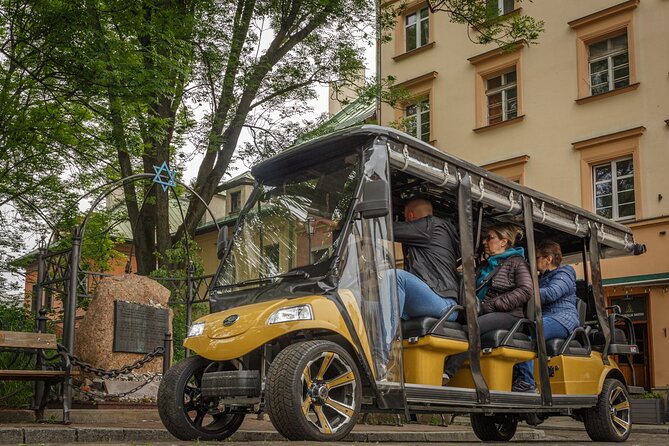
The trip is sold as an eco electric buggy tour. It is quieter than a standard sightseeing bus and small enough to move through streets that are awkward for larger vehicles. You still get a vehicle ride rather than a walking tour, so it works well when the weather is cold or when your legs need a rest.
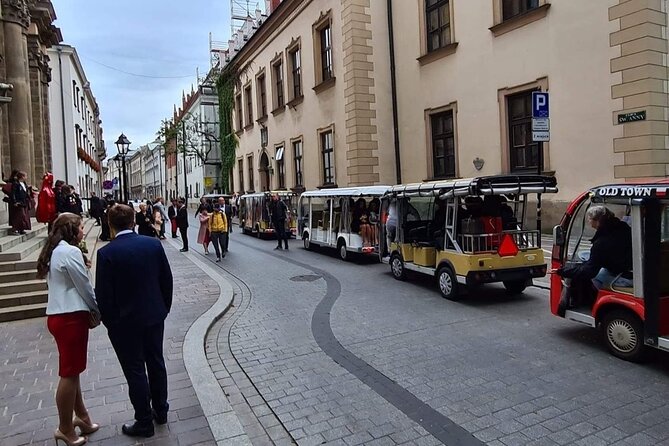
The group can be large, with up to 50 people allowed on the activity. The actual buggy arrangement matters. One report described 12 adults and children packed tightly into one vehicle, with winter clothing making the space even smaller. That appears to be an exception rather than the normal experience, but I would still ask how the group will be divided if the booking is busy.
More golf cart tours in Kraków:
- Krakow: City Sightseeing Tour by Electric Golf Cart
★ 4.5 · 3,264 reviews - Krakow: City Sightseeing Tour Eco Electric Buggy Golf Cart
★ 4.7 · 3,143 reviews - Krakow: Extended City Sightseeing Tour – Eco Buggy Golf Cart
★ 4.7 · 794 reviews
Beginning at Skałka and Plac Wolnica
The first listed stop is the Church on the Rock, known in Polish as Kościół na Skałce. Its full name is the Basilica of Saint Michael the Archangel and Saint Stanislaus the Bishop and Martyr.
The church sits on a small rocky rise beside a Pauline monastery. The place is tied to Saint Stanislaus, the Bishop of Krakow, who was killed here in 1079 on the orders of King Bolesław II the Bold. The murder helped bring about the king’s exile, while Stanislaus later became a saint.
You get about 10 minutes here, with free admission listed. That is enough for a quick look and photographs, but not enough for a long examination of every chapel or work of art. The church is one of the more rewarding early stops because it gives you a clear piece of medieval Krakow before the tour shifts toward Jewish history.
The buggy then reaches Plac Wolnica, the former market square of Kazimierz. When Kazimierz was founded in 1335, this square was as large and important as Krakow’s main market square. Trade took place here, and the town hall once housed the city’s leading administrative and judicial offices.
The name comes from forum liberum, linked to the old right to sell meat outside the regular stalls. That small detail helps you picture the square as a working civic center, not simply an open space surrounded by restaurants and historic façades.
Churches Along the Kazimierz Route
The route includes another historic church, later identified in the tour information as Corpus Christi Basilica. It was built in stages from about 1340 into the middle of the 15th century and was intended as a monastery church.
That purpose explains its large site and the former monastic cemetery beside it. In 1404, King Władysław II Jagiełło gave the church to the Canons Regular of the Lateran, whom he brought from Kłodzko.
The church visit is one of the places where the tour can move beyond quick exterior viewing. Several people especially valued the two church visits, and Corpus Christi is a useful counterpoint to the nearby synagogues. Kazimierz developed through overlapping Catholic and Jewish communities, and seeing both traditions close together makes the district easier to understand.
You should not expect a long guided visit inside every religious building. The tour moves on a schedule, and the amount of time inside depends on the traffic, the group, and the guide. If church interiors are a priority, use this ride to identify places you want to revisit later.
The Synagogues of Kazimierz
The strongest part of the route is the run through the historic Jewish quarter. You pass several synagogues and learn how Kazimierz became a major center of Jewish life in Krakow.
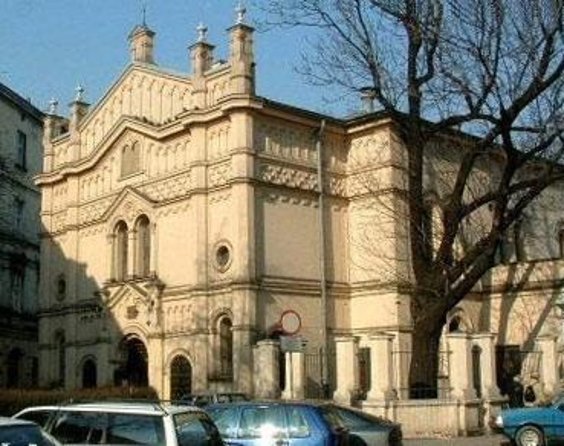
The Tempel Synagogue is still an important place of worship and also hosts concerts, meetings, and events connected with Jewish culture. Its role today helps connect the building’s history with the living cultural life of the district.
Kupa Synagogue dates from the 17th century. It serves as a venue for religious ceremonies and cultural events, including Krakow’s annual Jewish Culture Festival. I like this stop because it shows that the quarter is not only a preserved memorial district. Some of its buildings still have a place in the city’s Jewish community.
Izaak Synagogue was built in 1644. It was funded by Izaak Jakubowicz, also known as Isaac the Rich, a banker connected with King Władysław IV. The building was designed by the Italian-born architect Francesco Olivierri.
The High Synagogue is also called the Tall Synagogue. Its name refers either to its height or to the fact that the prayer hall was upstairs. It is an example of late Renaissance architecture and is the tallest synagogue in Krakow, although it is no longer active.
The Old Synagogue is one of the most important stops. It is the oldest surviving synagogue building in Poland and was once the central religious, social, and organizational center of Krakow’s Jewish community. Today, its importance is tied both to Jewish architectural history and to the destruction of Krakow’s Jewish life during the Second World War.
The Wolf Popper Synagogue once had richly decorated porches, annexes, furnishings, and an ornate entrance. It was founded by Wolf Popper in the early 17th century. Today, the building is used as a bookshop and art gallery rather than as an active synagogue.
The route also includes the Remah Synagogue, named for Rabbi Moses Isserles. It is the smallest of the historic synagogues in Kazimierz and one of only two active synagogues in the city. Its name refers to the rabbi’s initials, ReMA, associated with his important commentaries on Jewish law and Ashkenazi customs.
You also pass the former Jewish hospital area near Kupa Synagogue and streets whose present shape developed through 19th-century rebuilding. These smaller details matter because Kazimierz was not created as a museum. It was a functioning town with hospitals, markets, religious buildings, homes, and civic institutions.
Same base, a different kind of day:
- From Krakow: Auschwitz-Birkenau Guided Tour & Hotel Pickup
★ 4.5 · 33,358 reviews - From Krakow: Auschwitz-Birkenau Guided Tour & Hotel Pickup
★ 4.5 · 29,340 reviews - Krakow: Auschwitz Guided Tour with Optional Hotel Pickup
★ 4.5 · 15,280 reviews - Krakow–Zakopane: Cable Car, Chocholow Baths, Cheese & Vodka
★ 5.0 · 10,720 reviews
Jewish Life and the Story of Helena Rubinstein
One stop connects the district with Helena Rubinstein. She was born in Krakow to Polish Jewish parents and became a major figure in the cosmetics industry. Her father kept a shop in Krakow, and she was also related to the philosopher Martin Buber.
This is a brief biographical detail rather than a full museum visit. Still, it gives you a glimpse of the many kinds of people who came from this community. Kazimierz produced religious leaders, shopkeepers, artists, business owners, and international figures.
The guide’s spoken explanations and recorded narration work together here. One voice may provide the main account while an audio system adds more background. Check your earphones early, because one complaint involved several headsets not working. A quick check at the start can prevent you from missing key parts of the ride.
Crossing to Ghetto Heroes Square
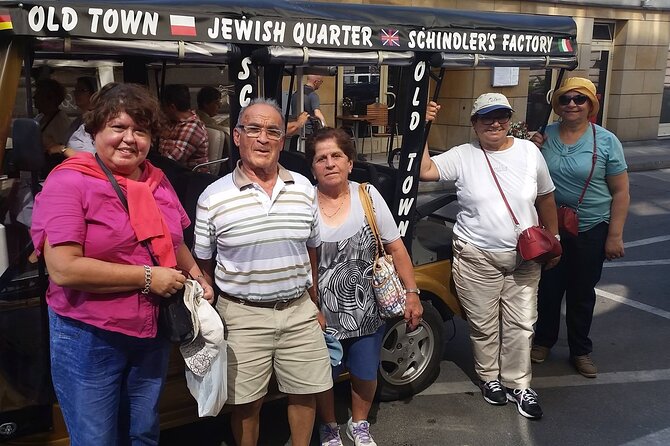
The buggy then heads toward Podgórze and Ghetto Heroes Square. The square was inside the Krakow ghetto from 1941 to 1943. Jewish residents were concentrated here before being sent to concentration and extermination camps.
This is the point where the tour’s tone becomes more serious. The square is not simply another photo stop. It was a place of forced movement, fear, and separation from the rest of Krakow.
At number 18, the Eagle Pharmacy operated under Tadeusz Pankiewicz. It was the only pharmacy inside the ghetto, and Pankiewicz was the only Pole allowed to remain there with rights to stay. The pharmacy served Jewish residents before and during the ghetto period.
Today, the Eagle Pharmacy is a museum. The buggy passes the location, but you should not assume the tour includes a full museum visit. If you want the detailed personal stories connected with Pankiewicz and the pharmacy, plan a separate visit.
This is one reason I recommend taking the buggy early in your stay. It introduces places that deserve more time. You can return to Ghetto Heroes Square, the Eagle Pharmacy, or the synagogues when you are ready for a slower visit.
Schindler’s Factory and the Old Ghetto Wall
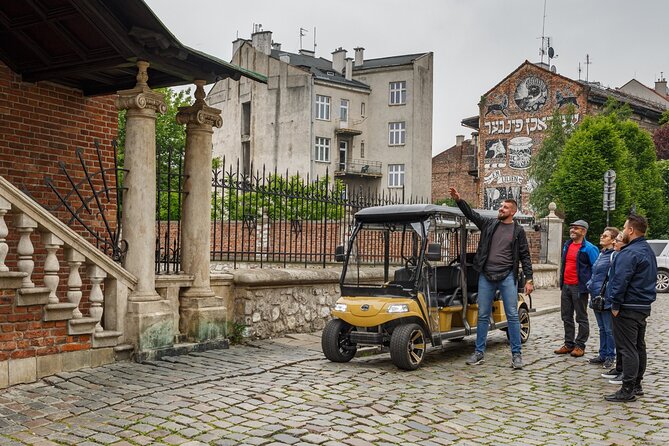
The route continues to Oskar Schindler’s Enamel Factory at Lipowa 4. The former factory now contains two museums: the Museum of Contemporary Art in Krakow and a branch of the Historical Museum of the City of Krakow.
The site is associated with Oskar Schindler’s Deutsche Emailwarenfabrik and with the film Schindler’s List. The factory itself existed before Schindler’s operation, beginning as an enamelware and metal products company in 1937.
The important practical point is this: the buggy usually passes the factory but does not provide a museum entry. One person expected a stop inside and was disappointed. If the factory museum is high on your list, book time for it separately.
The old ghetto wall is another brief but powerful sight. Very little needs to be said to understand its purpose. A surviving section makes the physical boundary of the ghetto easier to grasp than a map or a paragraph in a guidebook.
The final listed stop is St. Joseph’s Church in Podgórze, on Podgórski Square below the Krzemionki foothills. Its tall, Gothic Revival appearance gives the tour a striking final church view and brings you back to the broader story of Krakow’s Catholic neighborhoods.
What the Ride Feels Like in Different Weather
The electric buggy is one of the tour’s practical strengths. Blankets are available, and heating has been reported on the vehicles. The covered seating can make a major difference on a cold winter day, and one ride was described as warm even in poor weather.
Rain is manageable, though visibility and photography become less pleasant. At night, the ride can be atmospheric, but you may have trouble seeing architectural details. I would choose daylight if you want to study façades, signs, and synagogue entrances.
The road can be bumpy. This is still a small vehicle moving over city streets, not a smooth coach. If you have back problems or dislike close seating, a walking tour with a smaller group may suit you better.
The driver’s skill also matters. Several guides were praised for careful driving, clear English, helpful explanations, and good timing. Olivia was repeatedly singled out for her humor and sensitive treatment of difficult history. Natalie was praised for combining safe driving with useful explanations, while Philip, Jacob, and Oskar were also noted for clear and interesting commentary.
Price, Timing, and Who Gets the Most Value
At $28.88 per person, this is a sensible price for a 90-minute orientation ride. You are paying for transport, a guide, narration, and the chance to see a large section of the city without walking between every stop.
The value is strongest if you are visiting Krakow for a short time, arriving with limited mobility, traveling in winter, or trying to decide which areas deserve a longer return visit. I would also consider it for families or mixed-age groups who may not manage several hours on foot.
The value is weaker if you expect a detailed Old Town tour, Wawel Castle, or museum entry. The route focuses on Kazimierz and Podgórze, and one person was disappointed that it did not cover the castle and Old Town. The buggy is best seen as a focused district tour, not a complete Krakow sightseeing circuit.
The listed meeting point is the 24-hour Krakow Old Town car park at Mikołaja Zyblikiewicza 2. It can be easy to miss if you are looking only for a major landmark. One useful orientation tip is to find the busy Westerplatte street first, then look for Zyblikiewicza Street nearby, across from a Żabka shop.
Pickup may be offered, but the stated start and end point is this car park, so confirm the exact arrangement when booking. Confirmation arrives at booking, the tour is offered in English, and service animals are allowed. Most people can take part, and the maximum group size is 50.
Should You Book This Krakow Buggy Tour?
Book it if you want a warm, efficient introduction to Kazimierz and Podgórze, especially at the start of your visit. You will see far more in 90 minutes than you could comfortably cover on foot, and the route gives useful context for the Jewish quarter, the ghetto, and Schindler’s Factory.
Do not book it as your only Krakow tour if you want Wawel Castle, the Main Market Square, or extended museum visits. Also think twice if you dislike close seating or need a quiet, slow-paced experience.
For most visitors, the best plan is to take the buggy early, in daylight, then return on foot to the places that catch your interest. At $28.88, it is a practical first look at a complicated and important part of Krakow.
FAQ
How long is the Krakow electric buggy tour?
The tour lasts approximately 1 hour and 30 minutes.
What language is the tour offered in?
The tour is offered in English.
Where does the tour start?
The stated meeting point is the 24-hour Krakow Old Town car park at Mikołaja Zyblikiewicza 2, 31-029 Krakow, Poland.
Where does the tour end?
The activity ends back at the meeting point.
How many sights does the buggy tour visit?
The tour is described as stopping at nearly 24 different sights across Krakow.
Does the tour visit Krakow’s synagogues?
The route passes several historic synagogues, including Tempel, Kupa, Izaak, High, Old, Wolf Popper, and Remah Synagogues.
Does the tour enter Oskar Schindler’s Factory?
The tour passes Schindler’s Factory, but it does not include a museum visit inside the factory.
Is the buggy heated?
Heating and blankets are available on the vehicles, making the tour suitable for cold weather.
Is the tour suitable for service animals?
Yes. Service animals are allowed.
How many people can join the tour?
The maximum group size is 50 people. The number of people in each individual buggy may vary.
Can I cancel for a full refund?
Yes. You can cancel at least 24 hours before the local start time for a full refund. Cancellations or changes made within 24 hours are not refunded.
Just added in Kraków
- From Krakow: Guided Tour of Zalipie★ 4.6 · 30 reviews
- From Krakow: Zalipie Village Day-Tour★ 4.9 · 74 reviews
- Krakow: Zalipie Village Tour★ 4.6 · 8 reviews
- ZALIPIE – painted village, unique PRIVATE tour from Krakow★ 5.0 · 20 reviews
- Dunajec River Gorge and Zakopane: Full-Day Trip from Krakow★ 4.6 · 57 reviews
- Zator: Energylandia Amusement Park Entry Ticket★ 4.6 · 58 reviews
- From Krakow: Full-Day Wadowice & Czestochowa Tour★ 4.9 · 77 reviews
- From Krakow: Ojców National Park & Ogrodzieniec Castle Tour★ 4.9 · 64 reviews
Golf Cart Tours, compared.
Extended City Sightseeing Tour – Eco Buggy Golf Cart
Read the review →
Jewish Quarter and Ghetto Electric Golf Cart Tour
Read the review →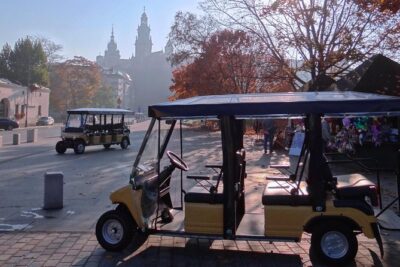
Krakow Grand City Tour by golf cart – All 3 districts
Read the review →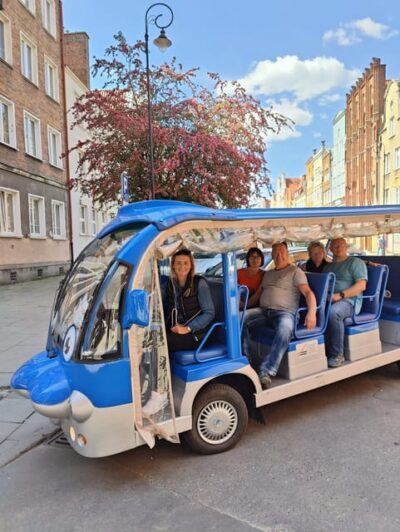
Shared or Private City Tour Sightseeing By Golf Cart
Read the review →
City Sightseeing Tour by Buggy/Golf Cart LIVE GUIDED 1H
Read the review →Browse the lists this tour appears in