
Reviewed · CITY TOURS
Main City in Gdańsk – tour in Polish
Gdańsk’s old center is best understood as a city built by trade, war, politics, and stubborn independence. This 150-minute Polish-language walk connects grand buildings with the people and events behind them, from amber merchants and port wealth to World War II and the Solidarity movement.
I like two things here. First, the route covers the main sights without wasting time on transport. Second, the guides bring different tones to the story. Kasia is known for her lively delivery, while Marcin and Klaudia are praised for clear, colorful explanations and good contact with the group. The main consideration is simple: this tour is in Polish, and the pay what you see fit model means the $26 booking payment functions as a guide tip rather than a standard admission fee.
Key points to know before you go
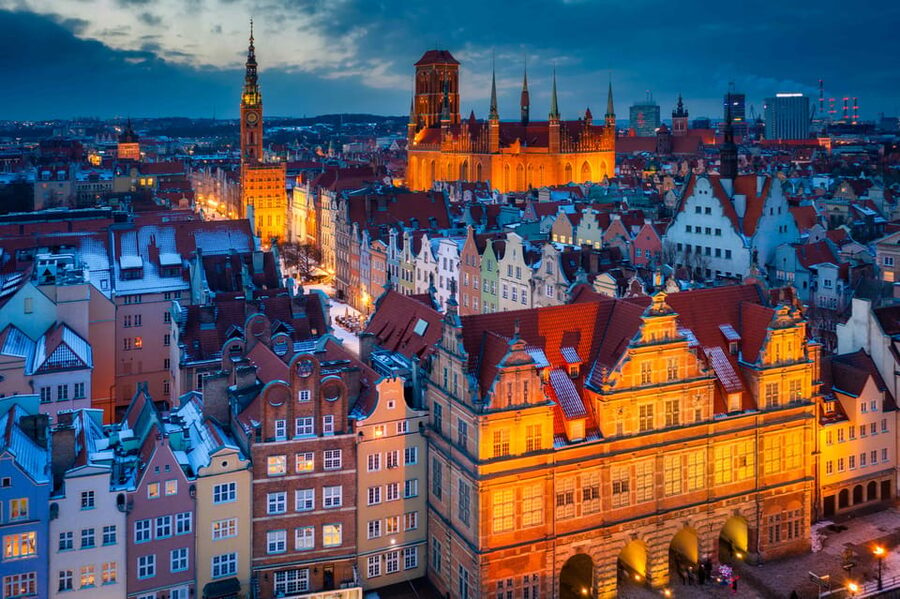
- Golden Gate meeting point: Look for the yellow umbrellas at Złota Brama, a clear starting point in the center.
- Five major sights in one walk: The route includes the Prison Tower and Torture Chamber, Great Armory, Artus Court, and Main Town Hall.
- A city story with wide reach: You’ll hear about Baltic trade, amber, Napoleon, World War II, Nazi rule, and the end of communism.
- Polish-speaking guides: Guides such as Kasia, Marcin, and Klaudia are praised for humor, energy, and detailed storytelling.
- Two and a half hours on foot: The 150-minute length gives the guide time to explain the city instead of rushing from facade to facade.
- Flexible booking: You can cancel up to 24 hours before the start for a full refund and reserve now while paying later.
Starting beneath the Golden Gate in Gdańsk
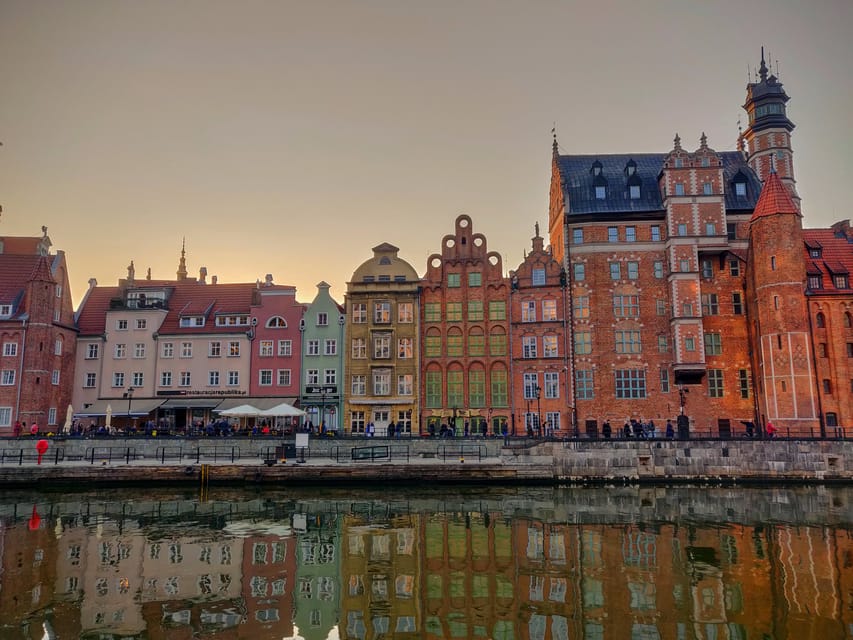
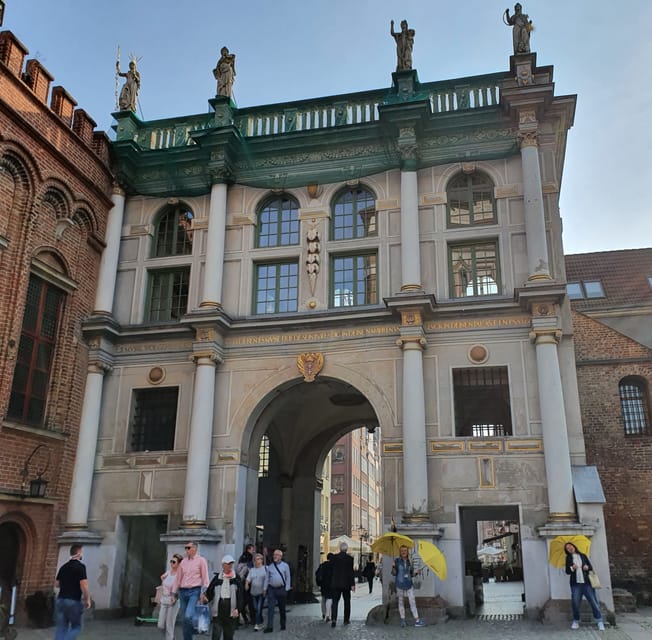
The tour begins at the Golden Gate, or Złota Brama, one of the most useful landmarks in central Gdańsk. Look for the yellow umbrellas. That small visual cue matters in a busy historic center, especially if you arrive close to the starting time.
From here, you are already in the part of Gdańsk most people want to understand first: the Main Town. The name can be confusing because this area is often casually called the old town, but Gdańsk has several historic districts and the Main Town is the heart of the sightseeing route.
The opening setting also gives the guide a chance to explain why Gdańsk feels different from many Polish cities. Its identity was shaped by merchants from several parts of Europe, and its names changed with language and politics: Gdańsk, Danzig, Dantzig, Dantzk, and Gdanzc all appear in its long story.
That is useful context, not just a list of old names. Gdańsk grew as a major Baltic port, handling grain, timber, and amber. The city’s wealth came from connections beyond Poland, and its buildings reflect that outward-looking past.
A few more things to do in Gdańsk worth a look
- Gdansk: City Cruise on Historical Polish Boat
★ 4.8 · 2,913 reviews - Gdańsk City Sights & History Guided Walking Tour in English
★ 4.8 · 876 reviews - Gdansk: City Sightseeing Tour by Golf Cart/Buggy Guided Tour
★ 4.9 · 510 reviews
The Prison Tower and Torture Chamber
The Prison Tower and Torture Chamber bring the route down from merchant wealth to the harsher side of civic life. This is where the guide can explain how authority was enforced and how punishment fit into the old city’s legal system.
You should expect the guide to focus on the meaning of the site rather than simply point out stone walls. The stop adds weight to the polished facades you see later. Gdańsk was not only a prosperous port with handsome townhouses. It was also a working city with courts, prisons, punishments, and strict systems of control.
This is one of the tour’s more serious sections. If you prefer only cheerful sightseeing, the subject may feel heavy. Still, I think it earns its place because it keeps the visit from becoming a parade of pretty buildings with no human cost behind them.
The 150-minute timing helps here. A shorter walk might mention the tower in passing. With more time, the guide can connect the building to the city’s wider political and social order.
The Great Armory and the look of merchant wealth
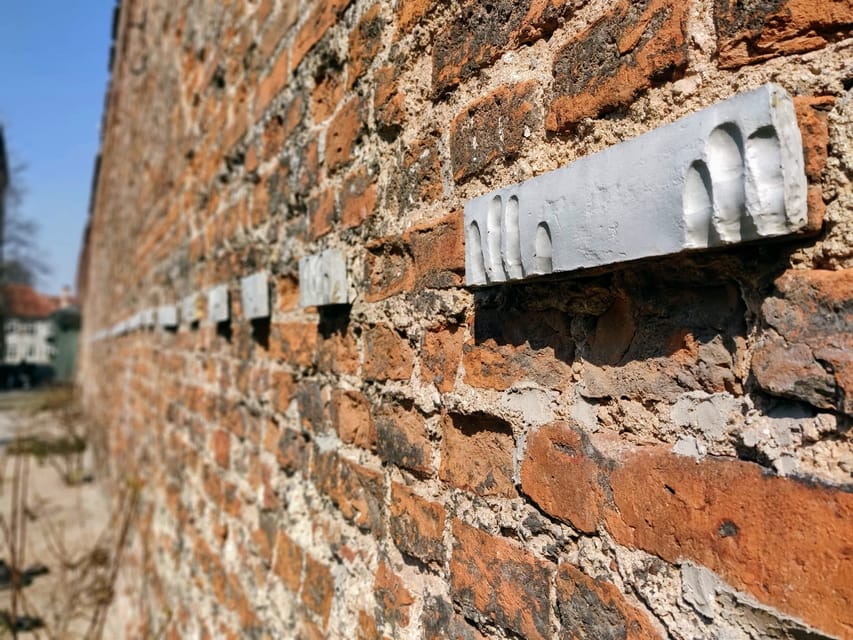
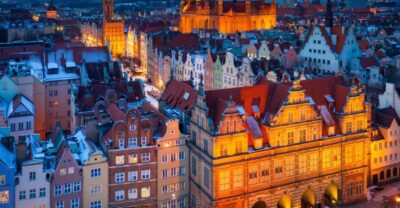
The Great Armory gives you a change of mood. Its elaborate design reflects the confidence of a city that had money, trade, and a reason to display both.
This is a good place to pay attention to the contrast between practical purpose and decorative ambition. An armory existed for military needs, yet the building’s appearance tells you that Gdańsk’s civic leaders cared deeply about how their city looked. Wealth was not kept quiet. It was put into stone, ornament, and public space.
I like this stop because it helps you read the city as a merchant center rather than as a collection of isolated monuments. The buildings were part of a civic message: Gdańsk mattered, and its residents wanted visitors to know it.
Your guide may also use the armory to explain how the city’s independent character developed. The supplied information presents Gdańsk as a city shaped by wealthy traders known as Danzigers, or residents of Gdańsk. That local identity is a useful thread to follow throughout the walk.
Artus Court and the city’s public life
Artus Court is one of the tour’s essential stops. Its name points to the European tradition of King Arthur and the ideal of a noble gathering place, but in Gdańsk it became closely tied to the city’s wealthy civic and trading world.
Here, listen for the connection between architecture and social power. This was not simply a private residence. Artus Court belonged to the public face of the city and helps explain how merchants and civic leaders presented themselves.
The building also gives the guide room to discuss the many cultures that passed through Gdańsk. The city’s location on the Baltic brought trade, money, goods, and people from different places. That mix is part of what makes Gdańsk feel unlike a town built around one single national story.
This stop should suit you if you enjoy stories about people and institutions as much as buildings. It is less about checking off another facade and more about understanding who had influence in the city and how they displayed it.
Same base, a different kind of day:
- Gdańsk: Sunset Cruise on a Historic Polish Boat
★ 4.9 · 977 reviews - Gdansk: Firearm Shooting Experience with Instructor
★ 4.8 · 866 reviews - Gdansk: Guided Round-Trip Cruise to Westerplatte
★ 4.3 · 865 reviews - Gdańsk: Sightseeing EcoCruise around the Old Town of Gdansk
★ 4.6 · 719 reviews
The Main Town Hall and Gdańsk’s changing identity
The Main Town Hall is another major anchor of the route. Town halls are often the best places to discuss how a city governed itself, and here the building helps frame Gdańsk’s complicated political identity.
Gdańsk has been described and ruled through different national and political arrangements. Napoleon’s creation of the first Free City of Danzig is part of that story, as is the city’s later role under Nazi rule. The tour does not reduce Gdańsk to one label. Instead, it shows how the city’s name and political status shifted over time.
That approach matters because Gdańsk can be confusing if you expect a simple timeline. The city has Polish, German, Baltic, and international layers. A good guide can make those layers easier to follow without turning the walk into a lecture.
The Main Town Hall also provides a natural place to connect past politics with the twentieth century. Gdańsk was one of the locations where the tensions that led to World War II became especially sharp. The Polish Post Office defense was among the early armed clashes of the war, and the city later became central to the end of communism in this part of Europe.
From World War II to the Solidarity movement
The strongest part of this tour may be its broad sweep across modern history. Gdańsk is not only a medieval or early modern port. It played a major role in some of Europe’s defining twentieth-century events.
The city was tied to Nazi ambitions and became one of the major Nazi centers in Europe, with the headquarters of the NSDAP there. The defense of the Polish Post Office in the Free City of Gdańsk became one of the first armed confrontations of World War II. Those facts can make a city walk feel more immediate, because the streets you see are linked to events that changed Europe within living memory.
Later, shipyard workers in Gdańsk went on strike under the leadership of Lech Wałęsa. That movement helped begin the end of communism in this part of Europe. You do not need a specialist background to appreciate the importance of this story. It gives the city a second modern identity, one tied to workers, political pressure, and change from below.
I would pay close attention when the guide moves between the older monuments and these newer events. The value of the walk is not simply that it shows famous buildings. It explains why Gdańsk became a place where outside powers, local residents, workers, and political movements repeatedly collided.
The people connected with Gdańsk
The tour also gives you a chance to place famous names within the city’s wider story. Daniel Fahrenheit, Arthur Schopenhauer, and Günter Grass were born in Gdańsk.
These figures represent very different fields and periods, which is exactly the point. The city’s influence was not limited to trade or politics. It also produced scientists, philosophers, and writers.
You may find these personal stories easier to remember than dates alone. A guide who tells you who was born here, who traded here, and who fought for the city can make the streets feel more human.
The guides named in the feedback bring different styles to that task. Kasia, nicknamed Dynamit, is described as mixing humor with serious material. Marcin is praised for being colorful and precise. Klaudia is noted for her expressive style, positive energy, and ability to keep contact with the group. These are not guaranteed guide assignments, but they give you a sense of the tone you may encounter.
How the guide-led format affects the visit
A guided walk is especially useful in Gdańsk because many important details are easy to miss from the street. A grand facade tells you that money was spent, but it does not explain who paid for it, why it mattered, or what happened when the city’s political status changed.
The live guide format also lets you ask questions. One January group continued despite snow and strong wind, and the guide handled many questions with detailed answers. That suggests the walk can work well for people who want conversation rather than a memorized speech.
At the same time, your enjoyment will depend heavily on your comfort with Polish. The tour is conducted in Polish, and no other language is stated. If you understand Polish well, you should be able to follow the historical connections and humor. If you do not, this is not the right choice simply because the route includes famous sights.
The walking format is wheelchair accessible, which is helpful for many visitors. The supplied details do not explain the exact pavement conditions or indoor access at each stop, so you may want to confirm specific mobility needs before booking.
Is $26 good value for 150 minutes?
At $26 per person, the value depends on what you want from a city walk. You are paying for a two-and-a-half-hour guided introduction to the Main Town, not for entry to a series of paid attractions.
The route includes several of Gdańsk’s signature sights in one sitting: the Prison Tower and Torture Chamber, Great Armory, Artus Court, and Main Town Hall. It also adds political and social context that would take considerable reading to assemble on your own.
The pay what you see fit model needs careful attention. When you reserve through GetYourGuide, the payment is described as a tip for the guide. That means you should not read the $26 price as a conventional fixed admission fee. You are supporting the guide’s work within a flexible tipping structure.
For me, the value is strongest if you are new to Gdańsk and want a clear orientation before exploring on your own. It is less useful if you already know the Main Town well or want a museum-heavy tour with extended indoor visits.
You can reserve now and pay later, and cancellation is available up to 24 hours before the start for a full refund. Those terms are useful if your Gdańsk schedule may change.
Weather, pace, and what to bring
The tour runs outdoors for 150 minutes, so weather matters. A winter walk in snow and wind can still work, but you should dress for standing outside and moving between stops. Comfortable shoes are sensible at any time of year.
The yellow umbrella should make the meeting point easier to find, but arrive at the Golden Gate with enough time to locate the group. The center has many eye-catching buildings, and it is easy to stop for a photograph just when the group is gathering.
The pace should suit you if you want a steady historical walk rather than a quick photo circuit. The duration allows for explanations and questions, but it also means you will be on your feet for a substantial part of the morning or afternoon.
If you have a tight schedule, keep the full 150 minutes free. The walk may run over slightly in spirit even if it follows the stated duration, especially when the group asks questions. A little breathing room afterward is wise.
Who should book this Gdańsk walk?
I would recommend it first to Polish-speaking visitors who are seeing Gdańsk for the first time. You get the city’s major central sights, but you also get the connections that make those sights meaningful.
It should suit you if you enjoy:
- City history told through buildings and people
- Stories about trade, politics, war, and social change
- A guide who welcomes questions
- A walk with a clear central meeting point
- A flexible pay what you see fit arrangement
It may not suit you if you need an English-language tour, dislike outdoor walking, or prefer to spend most of your time inside museums. The route is also not designed as a specialist tour focused only on amber, World War II, architecture, or the Solidarity movement. It gives you a broad introduction instead.
Should you book the Main City in Gdańsk tour?
Book it if you want a lively Polish-language introduction to Gdańsk’s central story, especially if you appreciate guides who mix facts with humor and personal energy. Kasia, Marcin, and Klaudia have each been praised for making the material clear and engaging, though your assigned guide may differ.
Skip it if Polish is not comfortable for you or if you already have a strong grasp of the Main Town. For the right audience, the $26 tip-based format offers a useful first look at a city shaped by Baltic trade, political upheaval, war, and the Solidarity movement. It gives you a solid map of what to explore next, both on the streets and in your own reading.
FAQ
Where does the tour meet?
The meeting point is at the Golden Gate, called Złota Brama in Polish. Look for the yellow umbrellas.
How long does the tour last?
The stated duration is 150 minutes, or two and a half hours.
What language is the tour conducted in?
The tour is conducted in Polish and includes a live Polish-speaking guide.
Which sights are included?
The route includes the Prison Tower and Torture Chamber, Great Armory, Artus Court, and Main Town Hall in Gdańsk.
Is the tour wheelchair accessible?
Yes, the activity is described as wheelchair accessible.
What does the $26 payment cover?
The tour uses a pay what you see fit model. When booking through GetYourGuide, the payment is described as a tip for the guide.
Can I cancel or pay later?
You can cancel up to 24 hours in advance for a full refund. Reserve now and pay later is also available.
Just added in Gdańsk
- Gdansk, Gdynia, and Sopot: 8-Hour Private Sightseeing Tour★ 4.9 · 13 reviews
- Undercover City Games: Gdynia★ 5.0 · 34 reviews
- Private WW2 Tour of Westerplatte,Gdansk and Stutthof Including Lunch★ 5.0 · 12 reviews
- Whisky Tasting in Gdańsk★ 5.0 · 3 reviews
- Westerplatte private tour led by Expert-Guide (door to door)★ 5.0 · 5 reviews
- Gdansk EVERYDAY Vodka Tasting Tour★ 5.0 · 6 reviews
- Torun – City of Copernicus Private Tour★ 4.5 · 5 reviews
- TriCity Tour (Gdansk, Gdynia, Sopot) – PRIVATE (8h)★ 5.0 · 4 reviews
City Tours, compared.
Gdańsk City Sights & History Guided Walking Tour in English
Read the review →
Extended City Sightseeing Tour – Eco Buggy Golf Cart
Read the review →
Private Tour: Warsaw City Sightseeing by Retro Fiat
Read the review →Browse the lists this tour appears in