
Reviewed · GOLF CART TOURS
Gdansk: 2H City Sightseeing Tour LIVE GUIDED by Buggy/Golf cart
Gdańsk packs centuries of history into a compact center, but its most important sights are spread beyond the postcard streets. This electric golf-buggy tour links the old town, medieval churches, shipyard, Solidarity landmarks, and World War II sites in about two hours. It is a smart way to get your bearings before choosing where to return on foot.
I like the easy reach and the local storytelling. You can cover streets you probably would not walk to, then hear personal insight from guides such as Michael, Maciej, or Noris. The included drink, with a choice of water, coffee, or beer, is another welcome touch. The main caution is that this is a fast overview: many stops last only one or two minutes, so you will see more than you can properly explore.
Key points at a glance
- Thirty-two sights in roughly two hours: Expect a broad city overview rather than long visits inside museums and churches.
- A rare look beyond the old town: The route reaches the Gdańsk Shipyard, Solidarity Square, the European Solidarity Centre, and the World War II Museum.
- The Amber Altar gets real time: St. Bridget’s Church includes a 15-minute visit, with admission included.
- Local guides shape the experience: Michael, Maciej, and Noris are among the guides praised for history, humor, and personal stories.
- Pickup is useful but limited: Pickup and drop-off are available within 2 km of Neptune’s Fountain, not at the ports.
- Weather matters: The open buggy can feel chilly in autumn, and poor weather may lead to a new date or refund.
Why a golf buggy makes sense in Gdańsk
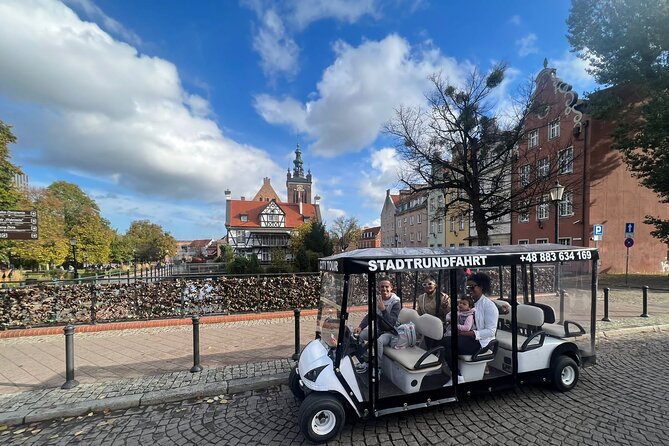
Gdańsk’s historic center is easy to walk, but the city’s story extends far beyond Długi Targ. The old town, railway station, Great Mill, shipyard, Solidarity Square, and riverfront sights do not all fit neatly into a short stroll.
The buggy solves that problem. It can use smaller streets and cover ground quickly, saving your legs for the places where you want to stop. If walking is difficult, this format is especially useful. One visitor specifically praised the easy access to narrow streets and the way the tour brought the port’s history within reach.
The ride is electric, which keeps the experience relatively quiet and avoids adding exhaust to the historic center. You sit outdoors, though, so bring an extra layer in cooler weather. A blanket is a sensible idea in autumn, particularly if the buggy is moving between stops.
The vehicle can hold up to 30 people, although the experience may also operate with a much smaller party. One booking went ahead with only one person, which is useful to know if you are visiting outside the busiest season. The exact feel of your tour will depend on the group and the vehicle arrangement.
More golf cart tours in Gdańsk:
- Gdansk: City Sightseeing Tour by Golf Cart/Buggy Guided Tour
★ 4.9 · 510 reviews - Gdansk: Shared or Private City Tour Sightseeing By Golf Cart
★ 4.8 · 233 reviews - Gdańsk: City Sightseeing Tour by Buggy/Golf Cart LIVE GUIDED 1H
★ 5.0 · 208 reviews
Neptune’s Fountain and the Royal Road
The tour begins at Neptune’s Fountain on Długi Targ, the most recognizable meeting point in central Gdańsk. Neptune points to the city’s long connection with the sea, and the fountain is one of the places where you will see people stopping for photographs throughout the day.
From there, the buggy passes the Main Town Hall, Arthur’s Court, and Long Market. These buildings frame the city’s ceremonial center. The Main Town Hall dates from the 14th century and now forms part of the Museum of Gdańsk. Arthur’s Court began as a meeting place for merchants and later served as the city’s stock exchange.
The Green Gate follows. Built between 1564 and 1568 as a royal residence, it now belongs to the Museum of Gdańsk. You then pass the Gdańsk Shakespeare Theatre, which has a folding roof. These stops are brief, so listen carefully and take photographs from the buggy rather than expecting a full visit.
The route continues to Katownia, the old Prison Tower, Neck, and Torture Chamber. Then come the Golden Gate and Highland Gate, which mark the historic Royal Road. The Great Armoury adds a grand piece of Dutch Mannerist architecture before the buggy reaches the Millennium Tree and the monument to King John III Sobieski.
This opening section gives you the visual language of Gdańsk: decorated facades, gates, brick Gothic buildings, and a city shaped by trade and royal ceremony. The drawback is simple. You will not have time to study the details on the buildings or enter the museums, so plan to return later if architecture is your main interest.
The Old Town beyond the postcard center
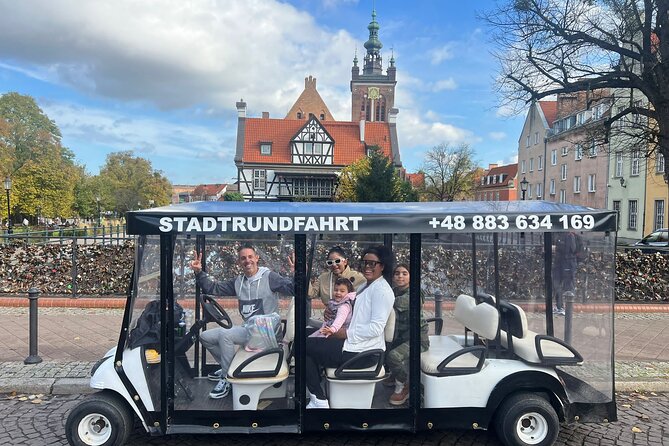
The route then moves toward Gdańsk Główny railway station, which opened in 1900. Its historic exterior makes a useful contrast with the medieval and Renaissance buildings of the Main Town.
You pass St. Joseph’s Church and St. Elizabeth’s Church, both rebuilt after severe wartime damage. The Old Town Hall is another important stop. About 400 years old, it is one of the few historic buildings in Gdańsk to survive the war damage.
At the Great Mill, you encounter a building with an industrial past. It was once the largest industrial plant in medieval Europe and now houses the city’s Amber Museum. St. Catherine’s Church, the oldest church in Gdańsk, follows. It was Protestant from 1545 until the end of World War II, when it returned to the Catholic Church.
This part of the tour is valuable because it shows that Gdańsk is not only Długi Targ and the Motława waterfront. You see the older city’s churches, civic buildings, and working past. The short stop times mean the guide’s explanation does most of the work, so this section suits you if you want context more than detailed sightseeing.
St. Bridget’s Church and the Amber Altar
St. Bridget’s Church receives the longest dedicated visit on the route, about 15 minutes. That matters because the church contains the Amber Altar, one of the most unusual sights in Gdańsk.
The church also connects to the Solidarity movement. During martial law, it was a sanctuary for Solidarity leaders. It was almost completely destroyed during World War II and rebuilt in 1973.
Admission to the church is included. That makes this stop more than a quick look from the street, and it is one of the strongest reasons to choose this tour instead of a simple city drive. The Amber Altar is described as twice the size of the legendary Amber Room and more than three times as high. Even if you are not religious, the scale and material make it a memorable stop.
You should treat this as the tour’s main interior visit. Most other churches receive only one or two minutes, which generally means an exterior explanation or a very short look. At St. Bridget’s, you get enough time to appreciate the altar properly.
Same base, a different kind of day:
- Gdansk: City Cruise on Historical Polish Boat
★ 4.8 · 2,913 reviews - Gdańsk: Sunset Cruise on a Historic Polish Boat
★ 4.9 · 977 reviews - Gdańsk City Sights & History Guided Walking Tour in English
★ 4.8 · 876 reviews - Gdansk: Firearm Shooting Experience with Instructor
★ 4.8 · 866 reviews
From the Polish Post Office to Solidarity Square
The next section changes the tone. At the Museum of the Polish Post Office, the guide explains the defense of the Polish Post Office on September 1, 1939, one of the first acts of World War II in Europe. You also see the monument honoring the defenders.
The route continues to the European Solidarity Centre and the Three Crosses Monument. The center preserves the memory of Solidarity, while the monument commemorates shipyard workers killed during the December 1970 events. Its three steel crosses, each with an anchor, rise 42 meters and weigh about 140 tons in total.
The monument sits near historic Gate No. 2 of the Gdańsk Shipyard. That setting gives the story some physical scale. This is not a remote historical episode explained from a distance. You are looking at the place where workers organized, protested, and helped shape modern Poland.
You also pass Sala BHP, where the August strike took place and where Lech Wałęsa signed the 1980 agreements connected with the birth of Solidarity. Then comes the Gdańsk Shipyard itself, formerly known as the Lenin Shipyard.
This is the part I would value most if you are interested in 20th-century European history. The guide can connect the shipyard’s role in Solidarity with the city’s wartime destruction and later reconstruction. Michael has been praised for explaining the Nazi and Soviet eras through his own family’s experiences, which can make this history feel more personal.
The limitation is that the tour does not provide extended museum visits. You may want to return to the European Solidarity Centre or the Museum of the Second World War if you have more time. The buggy gives you the map and the setting, not a full museum education.
The riverfront, Crane, and Gothic churches
The Museum of the Second World War appears next on the route, followed by the Baltic Symphony Hall on Ołowianka Island. The philharmonic occupies restored and extended buildings of a former municipal power plant, giving the waterfront a useful mix of industrial and cultural history.
You then pass St. John’s Church, a 14th-century Gothic church that is also a cultural center. Like much of Gdańsk, it has been rebuilt after World War II. The city’s story is not just about surviving destruction. It is also about deciding what to rebuild, how to rebuild it, and what older layers to preserve.
At the Motława River, the Great Crane provides one of the tour’s most recognizable views. It is the defining symbol of Gdańsk’s old port and the largest medieval port crane in Europe. The Crane makes sense from the riverfront, where you can see how the city’s wealth depended on maritime trade.
The final church section includes St. Mary’s Church, the Royal Chapel, and St. Nicholas Church. St. Mary’s is the most famous heritage building in the city and the largest Gothic brick building in the world. The Royal Chapel, built in the 17th century, adds a Baroque contrast with its decorated facade and central dome.
St. Nicholas Church is one of the oldest churches in Gdańsk, with a history beginning in the 12th century. It also survived World War II, unlike so many buildings nearby.
Again, the schedule is tight. St. Mary’s, the Royal Chapel, and St. Nicholas each receive only a few minutes in the stated route. If you want to climb, attend a service, study the interiors, or explore the museums, use this tour to decide where to return rather than treating it as your full visit.
What the guides add
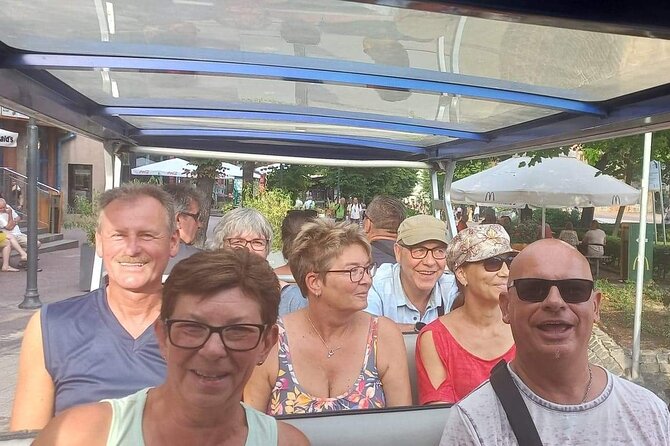
The strongest part of this experience is the live commentary. The guides do more than point at facades. They explain wartime destruction, reconstruction, the port, Solidarity, and the changes that shaped modern Gdańsk.
Michael is often singled out for his detailed history and personal connection to the city. Maciej is praised for answering questions and sharing places that visitors might otherwise miss. Noris is described as animated and entertaining, with a continuous stream of facts and stories.
English is offered, and the tour also advertises a live guide in your language. If you have difficulty understanding a guide’s pace or accent, say so during the ride and ask for a slower explanation. One complaint involved fast speech and an accent, while the wider feedback describes strong communication and friendly guidance. That makes it wise to speak up early rather than wait until the end.
The amount of information can be substantial. If you prefer a light, quiet ride, this may feel talk-heavy. If you want a city orientation packed into two hours, the steady commentary is exactly the point.
Price, pickup, and timing
At about $51.97 per person, this is not the cheapest way to look around Gdańsk. The value depends on how much you would otherwise spend on taxis, walking time, and a separate guide.
I think the price makes the most sense for a first visit, a short stay, or anyone who cannot comfortably cover several kilometers on foot. It also includes a drink, all fees and taxes, the live guide, and access to St. Bridget’s Church with the Amber Altar. You are paying mainly for time saved and for the historical explanation that links distant parts of the city.
Pickup and drop-off are available within a 2 km radius of Neptune’s Fountain. You can give the exact address of your hotel or accommodation, but some streets have restricted access. In that case, the guide will arrange a nearby meeting point.
This service does not pick up at the ports. If you arrive by cruise ship, allow time to reach central Gdańsk yourself. One group arrived late from the port area, and the operator waited, but that should not be treated as a normal transfer arrangement. The port and Gdańsk city center are separate locations, and the tour is not designed to solve that transport connection.
Meet at the pickup point 10 minutes before departure. Traffic can cause a slight delay, particularly because the buggy is sharing city roads with other vehicles.
The tour is free to cancel up to 24 hours before the start time. Poor weather may lead to a new date or full refund, and a minimum number of participants applies. The buggy format is weather-sensitive, so check the forecast and dress for an open-air ride.
Who should book this Gdańsk tour?
I would choose this tour if you are visiting Gdańsk for the first time and want a quick mental map. It is also a good fit for a short city break, a port day with your own transport into town, or anyone who finds long walks tiring.
History fans will get the most from the Polish Post Office, shipyard, Solidarity sites, and wartime reconstruction stories. Architecture lovers will appreciate the route, but should plan extra time for the buildings that catch their eye.
I would not choose it as your only sightseeing activity if you want long museum visits, quiet church interiors, or detailed photographs. The route covers 32 named sights, yet many stops last just one or two minutes. That is the trade: broad reach instead of depth.
My booking verdict
Book this tour if you want to see the shape of Gdańsk quickly, hear the city explained by a local guide, and reach the shipyard and older neighborhoods without wearing out your feet. The Amber Altar, the Solidarity district, the Great Crane, and the historic center give the ride a strong range.
Skip it if you are staying long enough to walk everywhere at your own pace or if your main goal is extended time inside museums. For most first-time visitors, though, it works well as an opening tour. Take notes on the places that interest you, then return on foot for the interiors and longer visits.
FAQ
How long does the Gdańsk buggy tour last?
The tour lasts approximately two hours to two hours and 15 minutes.
Where does the tour begin?
It begins at Neptune’s Fountain on Długi Targ in central Gdańsk.
Where does the tour end?
It can end at Neptune’s Fountain or at another location chosen by you within 2 km of the fountain.
Is hotel pickup available?
Pickup is available within a 2 km radius of Neptune’s Fountain. You must provide the exact address, and restricted streets may require a nearby alternative meeting point.
Does the tour pick up at the port?
No. Port pickup is not offered.
What drink is included?
You can receive water, coffee, or beer. The tour includes one drink for each tourist.
Is the tour offered in English?
Yes. English is one of the offered languages, and the experience includes a live guide.
Is admission to the Amber Altar included?
Yes. The visit to St. Bridget’s Church and its Amber Altar includes admission.
How many people can join the tour?
The maximum group size is 30 people.
What happens if the weather is poor?
If poor weather causes cancellation, you will be offered another date or a full refund. The tour also requires a minimum number of participants.
Just added in Gdańsk
- Gdansk Sopot and Gdynia 3 Cities Private Full-Day Tour★ 5.0 · 56 reviews
- Highlights of Gdańsk, Gdynia and Sopot 1-day Private Tour★ 4.9 · 59 reviews
- Gdansk Traditional Food Tour with Old Town Sightseeing★ 4.5 · 27 reviews
- Gdansk Private Bike Tour★ 5.0 · 36 reviews
- Gdansk: 4-Hour Polish Food Tour★ 4.9 · 35 reviews
- Delicious Gdańsk Food Tour in Poland★ 4.5 · 59 reviews
- Malbork Castle Tour from Gdansk★ 4.5 · 52 reviews
- Gdansk: Polish Beer Tasting Tour★ 4.7 · 81 reviews
Golf Cart Tours, compared.
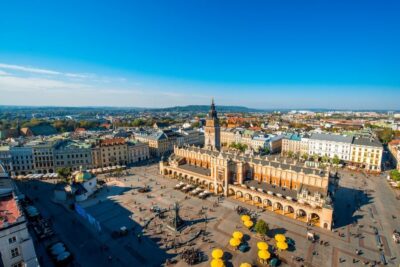
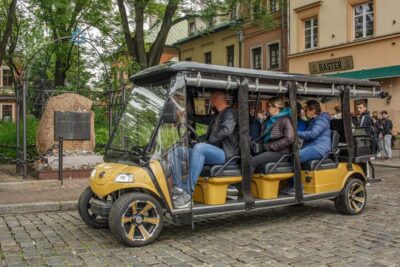
Extended City Sightseeing Tour – Eco Buggy Golf Cart
Read the review →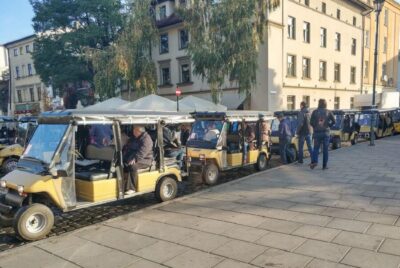
Jewish Quarter and Ghetto Electric Golf Cart Tour
Read the review →
Krakow Grand City Tour by golf cart – All 3 districts
Read the review →
Shared or Private City Tour Sightseeing By Golf Cart
Read the review →
City Sightseeing Tour by Buggy/Golf Cart LIVE GUIDED 1H
Read the review →Browse the lists this tour appears in