
Reviewed · OLD TOWN TOURS
Old Town Wrocław Walking Tour
Wrocław’s story is unusually complicated: the city has been ruled by five different countries, rebuilt after World War II, and shaped by both Polish and German culture. This walking tour turns that complicated past into a clear route from the Market Square to Cathedral Island, with Gothic churches, Baroque buildings, city dwarfs, and a few good jokes along the way.
I like the way the tour combines big historical events with small details, such as medieval graffiti, the old pillory, the cloth hall passages, and the dwarfs near St. Elizabeth’s Church. I also like the practical help at the end, including restaurant and museum suggestions, and in some cases a QR code with local recommendations.
The main caution is group size. The tour is described as a small-group experience of up to 15 people, but the operating information also allows as many as 35. A large group without a microphone can make it hard to hear, so check the expected group size and stay close to the guide.
Key points to know before booking
- A history-first route: Learn how Wrocław changed hands five times and how Polish-German relations shaped the city.
- Five strong stops: The route covers Town Hall, Rynek, St. Elizabeth’s Church, Wrocław University, and Cathedral Island.
- Excellent first-day choice: The tour helps you get your bearings before returning to museums, churches, and neighborhoods on your own.
- Guide quality matters: Guides such as Łukasz, Susanna, Simon, Matt, Michael, Peter, and Adam have been praised for clear English, humor, and useful local advice.
- An easy city walk: No admission fees are included or needed at the listed stops, but you should wear shoes suited to about two and a half hours outdoors.
- A one-way finish: The tour ends at Ostrów Tumski, about 15 minutes on foot from the starting point, rather than returning to the Market Square.
Why this is a smart first look at Wrocław
Wrocław can feel confusing at first. It has a large central square, several historic districts, islands in the Oder River, and layers of Polish, German, Bohemian, Austrian, and Prussian rule. A map shows you where things are, but it does not explain why the city looks the way it does.
That is where this walking tour earns its price. For $26.60, you get about two and a half hours with an English-speaking guide who links the buildings to the city’s past. I see the tour as an orientation walk with real historical substance, not simply a parade of façades.
The route also gives you useful clues for later sightseeing. You can note which church interiors deserve a return visit, ask where to eat, and decide if you want to book a separate tour about Jewish Wrocław or World War II. Several guides have offered recommendations based on personal interests, which is especially helpful if you have only a short stay.
The biggest variable is the guide and group size. Many guides have been singled out for clear English, warmth, humor, and strong answers to questions. One particularly poor experience involved a late start, more than 30 people, no microphone, and a guide who focused too much on jokes. That is not a reason to dismiss the tour, but it is a good reminder to remain near the front and ask for help if you cannot hear.
More old town tours in Wrocław:
- Wrocław: Old Town and Ostrów Tumski Walking Tour in English
★ 4.8 · 311 reviews - Wroclaw: Private Old Town Guided Walking Tour (2 hours)
★ 4.8 · 275 reviews - Wroclaw Old Town Guided Walking Tour
★ 5.0 · 100 reviews
Starting at the Fredro Monument and Town Hall
The meeting point is the Monument of Alexander Fredro in the Market Square, at Rynek, 50-438 Wrocław. This is a practical place to begin because you are immediately in the heart of the Old Town, surrounded by some of Wrocław’s best-known architecture.
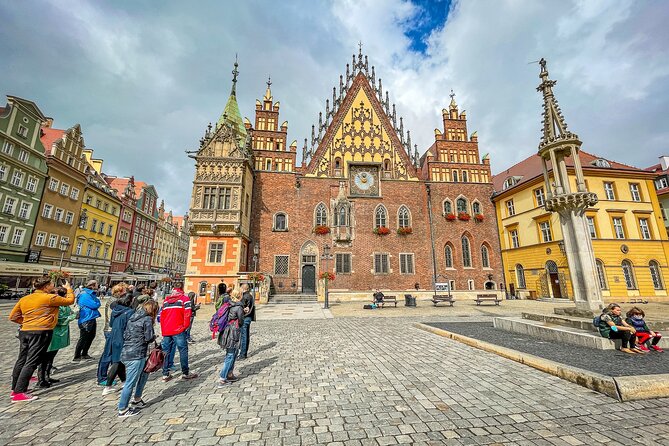
The first major stop is Wrocław Town Hall, a Gothic building with a striking exterior and a long civic story. Your guide explains the city’s changing rulers and the famous beer cellar beneath the building, described as the oldest beer cellar in Europe.
You will not pay an admission fee for this stop, and the tour focuses on the outside. That is useful for a first visit because the guide can explain how the Town Hall fits into the Market Square before you decide if you want to return for a closer look.
I like this opening because it gives you a reason to look beyond the building’s decorative stonework. The Town Hall is not just a pretty landmark. It introduces the central idea of the walk: Wrocław has repeatedly changed language, government, and identity while keeping traces of each period.
Reading the Market Square, one façade at a time
The next 20 minutes are spent around Rynek, Wrocław’s Market Square. This is the visual center of the tour, with a mix of Baroque houses, modernist buildings, colorful façades, and the old cloth hall with its small passages.
A guide can make a square like this far easier to read. Instead of seeing one broad plaza, you begin to separate the buildings by period and purpose. You also learn about the pillory, a reminder that public squares once served civic and judicial functions as well as commercial ones.
This is a good place to ask questions. Guides such as Łukasz, Susanna, Matt, Simon, and Michael have been praised for explaining the city in clear English and for handling questions during the walk between stops. That matters here because the square offers more visual detail than a short stop can cover.
You should also look down and around, not only up at the façades. Wrocław is famous for its small dwarf sculptures, and the tour uses them as a light way to introduce modern city culture. The dwarfs are fun to spot, but the deeper point is that Wrocław’s public spaces hold both serious memory and playful contemporary art.
St. Elizabeth’s Church and Wrocław’s dwarfs
St. Elizabeth of Hungary is described as the most important church in the Old Town, with a tower reaching 91 meters. The tour spends about 15 minutes here, discussing the church, nearby modern art, and the dwarfs around it.
This stop works well for mixed interests. If you care about architecture, the tower and church history give you plenty to notice. If you prefer modern city life, the art and dwarf figures keep the discussion from becoming a list of dates and names.
The church is also a useful example of Wrocław’s layered identity. The building belongs to an older European religious tradition, while the public art nearby reflects the city as it is today. A good guide connects those two sides instead of treating them as unrelated sights.
Do not expect a long interior visit or a formal church tour. The schedule allows about 15 minutes, so the stop is mainly about context and orientation. If you want more time with the church, make a note to return later.
More walking tours in Wrocław:
- Group city tour (walking tour) through Wroclaw in German
★ 4.9 · 89 reviews - Wrocław: Long City Walk and River Cruise
★ 4.8 · 68 reviews - Wrocław: Short City Walk and Boat-Cruise
★ 4.8 · 38 reviews - Wrocław: city walk with a professional guide and cruise
★ 4.8 · 19 reviews
Wrocław University and the Baroque city
The route continues to Wrocław University, a Baroque complex that has been linked with as many as 10 Nobel Prize winners. The stop lasts about 10 minutes, making it one of the shortest parts of the tour.
That short timing is enough to explain the university’s role in the city and its connection to education and public life. It also gives you another architectural contrast after the Gothic Town Hall and medieval church.
I would treat this as an introduction rather than a full university visit. If the building interests you, ask your guide what can be visited separately and how to fit it into your schedule. The tour is designed to show you the city’s main pieces, not to spend a full hour inside each one.
Crossing to Ostrów Tumski, the oldest part of the city
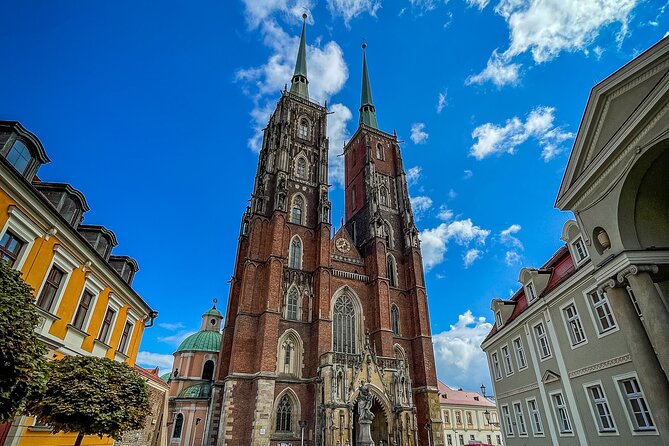
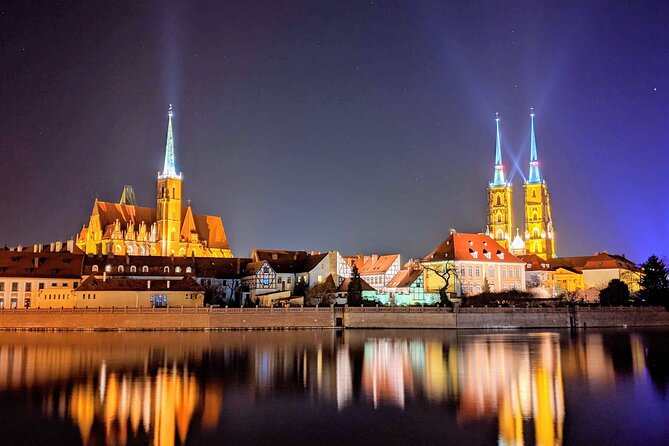
The final major section takes you across several bridges to Ostrów Tumski, also called Cathedral Island. This is the oldest part of Wrocław, dating back to the 10th century, and the tour allows about 30 minutes here.
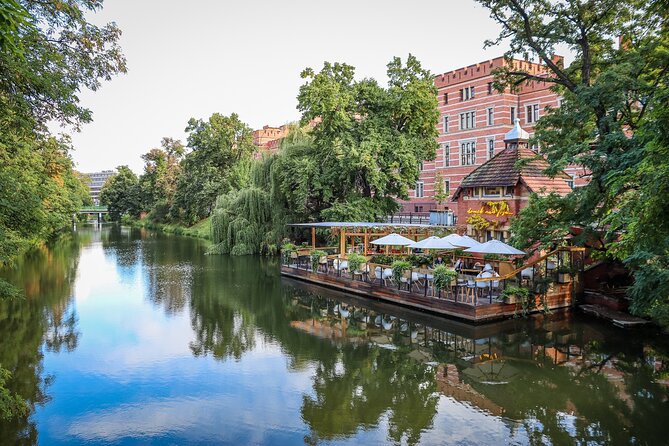
The setting changes noticeably as you leave the Market Square. You encounter Gothic churches, palaces, bridges, and broad views along the Oder River. The walk becomes less about one central plaza and more about how the city grew around water, religion, and political power.
This is where the tour’s historical theme comes together. The guide returns to Polish-German relations and explains why Wrocław’s past cannot be reduced to a single national story. The city’s identity changed as borders and governments changed, and Cathedral Island gives you a strong physical setting for that discussion.
I especially like the fact that the tour ends here. The finish feels purposeful rather than arbitrary, and you can continue exploring the island after the guide leaves. You may also choose to walk back toward the Market Square, which takes about 15 minutes.
The tradeoff is that the route is one-way. If you have a timed reservation immediately afterward near Rynek, allow extra time. The tour does not finish where it begins.
The guides make or break the experience
Guide quality is the strongest theme in the available feedback. Łukasz is praised for excellent English, local knowledge, and an easy way with questions. Susanna is described as clear, witty, and good at mixing history with restaurant and museum suggestions. Simon, Matt, Michael, Peter, and Adam also receive praise for humor, enthusiasm, and strong explanations.
A few details are especially useful. One guide provided a QR code with a map of places to eat and spend time. Another continued beyond the two-and-a-half-hour schedule, which was a welcome bonus. A guide also made a brief coffee stop at a local market during one walk, showing that the experience can sometimes feel flexible rather than tightly scripted.
You should not assume every departure will be identical. The tour company may assign different guides, and the tone can range from serious history to frequent jokes. Most of the strongest experiences balance both. The best guides use humor to keep the walk lively, then return to clear explanations of the buildings and events around you.
If you cannot hear, move toward the front and say so. This is especially important if the group is closer to 30 or 35 people. The tour information gives two different group limits, 15 in the main description and 35 in the additional details, so the smaller number should not be treated as guaranteed.
Price, pace, weather, and practical value
At $26.60 per person, the tour is reasonably priced if you want an organized introduction to Wrocław. You are paying for the guide’s route, explanations, and local suggestions rather than entry tickets. Since the listed stops are viewed from public spaces, there are no attraction admissions included.
The walk lasts about two and a half hours and is described as suitable for most people. It is an outdoor activity, so rain or cold can affect your enjoyment. The tour operates in all weather, and one group completed it in the rain, but you should dress for the forecast and wear comfortable shoes.
Food is not included. That is not a problem for most people, since the tour is short, but you should eat beforehand if you need a full meal during the morning or afternoon. A coffee stop may happen with some guides, but you should not count on food or drinks being part of the tour.
The tour is offered in English and uses a mobile ticket. It is near public transportation, and service animals are allowed. Free cancellation is available until 24 hours before the start time. After that point, the payment is not refunded, and changes are not accepted.
The activity requires a minimum number of participants. If the company cancels because that minimum is not met, you receive the choice of another date or experience, or a full refund.
Who should book this Wrocław walk?
I would choose this for a first day in Wrocław, especially if you want the city’s history explained before exploring on your own. It suits people who like architecture, political history, city legends, and practical restaurant advice in one package.
It is also a good fit if you are comparing Wrocław with Warsaw or other Polish cities. Wrocław has a distinct story, and the route makes that difference clear through its German, Polish, Central European, and postwar layers.
You may want something else if you dislike group walks, need a guaranteed small group, or want long interior visits. The schedule gives most stops 10 to 30 minutes, so it cannot replace a dedicated church, museum, or university tour.
Should you book it?
Yes, if you want a well-priced introduction to Wrocław and can accept some uncertainty about group size and guide style. The route covers the essential historic center, gives you a strong first sense of Cathedral Island, and adds useful details such as dwarfs, medieval graffiti, the old beer cellar, and local food tips.
Book it early if your dates are fixed, since it is commonly reserved about 16 days ahead. On the day, arrive at the Fredro Monument early, stay close enough to hear, and leave time after the tour for Cathedral Island or the 15-minute walk back to Rynek.
FAQ
Where does the Old Town Wrocław Walking Tour start?
It starts at the Monument of Alexander Fredro in Rynek, Wrocław, Poland.
Where does the tour end?
It ends at Ostrów Tumski, also called Cathedral Island, in Wrocław.
How far is the end from the starting point?
The end is about a 15-minute walk from the starting point.
How long does the walking tour last?
The tour lasts approximately 2 hours and 30 minutes.
What language is the tour offered in?
The tour is offered in English.
What sights are included?
The route includes Wrocław Town Hall, Rynek, St. Elizabeth of Hungary Church, Wrocław University, and Ostrów Tumski.
Is food included?
No. Food is not included in the tour price.
How many people can join the tour?
The main description presents it as a small-group tour capped at 15 people, while the additional information allows up to 35 participants. Check the details for your chosen departure.
Does the tour operate in bad weather?
Yes. It operates in all weather conditions, so dress appropriately.
Can I cancel for a full refund?
Yes, if you cancel at least 24 hours before the experience start time. Cancellations made less than 24 hours before the start are not refunded.
Just added in Wrocław
- Wrocław: Short City Walk and Boat-Cruise★ 4.8 · 38 reviews
- From Wroclaw: Hiking Trail in Rock City Adrspach★ 4.8 · 38 reviews
- Adrspach Teplice Rocks Filming Site of The Chronicles of Narnia★ 5.0 · 42 reviews
- Boat Party in Wroclaw with Unlimited Drinks★ 5.0 · 42 reviews
- Wrocław: city walk with a professional guide and cruise★ 4.8 · 19 reviews
- Wrocław: Long City Walk and River Cruise★ 4.8 · 68 reviews
- Group city tour (walking tour) through Wroclaw in German★ 4.9 · 89 reviews
- Adršpach: The Chronicles of Narnia Tour with Guide★ 4.9 · 104 reviews
Old Town Tours, compared.
Bike Tour of Old Town, Jewish Quarter and the Ghetto
Read the review →
Sightseeing EcoCruise around the Old Town of Gdansk
Read the review →
Browse the lists this tour appears in