
Reviewed · TOURS IN WROCŁAW
Famous Islands of Wroclaw – Cathedral Island and Sand Island Private Tour
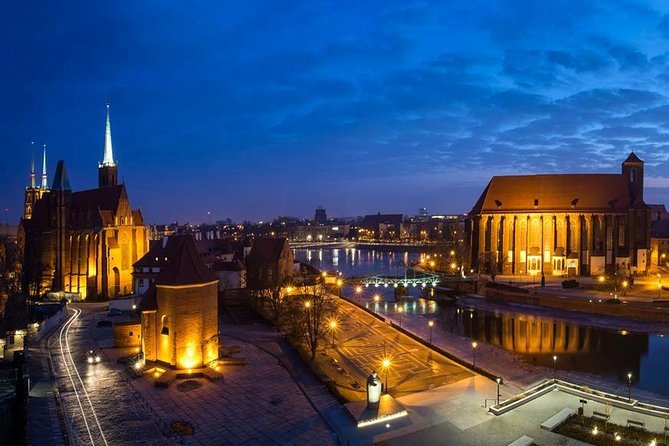
Wroclaw’s islands pack a surprising amount of history into a short walk. On this private tour, you move from the cathedral to medieval church grounds, old religious buildings, and Sand Island, hearing why dukes and clergy chose to live here, how wrongdoers could escape justice, and why Cathedral Island is no longer truly an island.
I like the small private format, which lets you ask questions instead of trying to hear a guide over a large crowd. I also like the mix of famous churches and odd details, from the Leaning Tower and Dumpling Gate to the story of a cardinal hiding 80 million zloty for the Solidarity movement.
The main consideration is that this is a focused walking tour, not a broad introduction to all of Wroclaw. It lasts about 1 hour 40 minutes to 2 hours, and most of the value comes from the guide’s stories and the historic exteriors rather than from a long series of interior visits.
Key points to know before you book
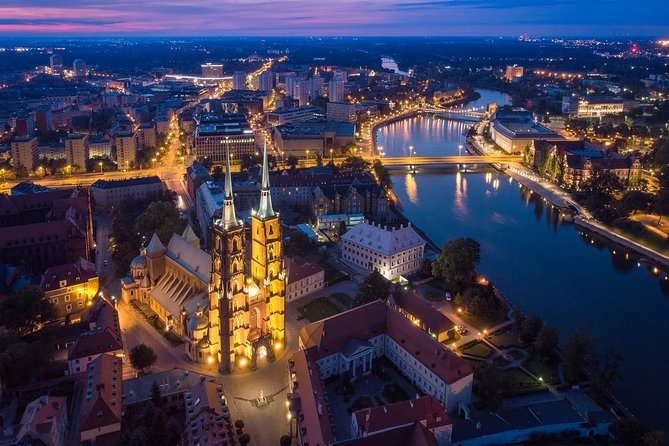
- Cathedral Island is the historical heart of the walk: You will hear why church leaders and dukes lived here and why the area changed from a true island.
- The route is easy to follow: It begins outside Wroclaw Cathedral and ends at Sand Bridge, with no return to the starting point.
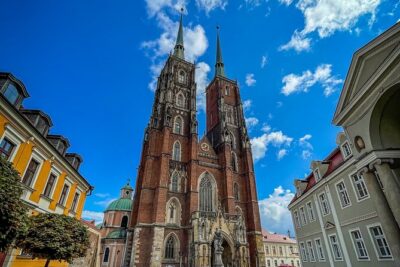
- The churches provide the main visual reward: Expect Gothic architecture, the Church of St. Giles, the Church of the Holy Cross and Bartholomew, and the Church of Our Lady on the Sand.
- The private guide makes the history personal: Your own group takes part, with the tour offered in English.
- The tour includes unusual local stories: Watch for the tale of the hidden Solidarity funds and the copy of the Turin shroud.
- The price reflects privacy: At $75 per person, this makes the most sense if you value questions, flexibility, and a quieter experience over a cheaper group walk.
Starting outside Wroclaw Cathedral
Your meeting point is outside the main entrance of Wroclaw Cathedral at Plac Katedralny 18. This gives the tour a strong beginning. You do not spend the first part of the walk searching for an obscure meeting spot in the city center. You start beside one of Wroclaw’s most important religious buildings and immediately enter the historic district.
The cathedral also gives you a useful sense of scale. Cathedral Island is not simply a collection of old churches. It was the center of religious power in Wroclaw, and its buildings help explain how clergy and dukes shaped the city.
Because the experience is private, you can ask for clarification when a name, date, or religious term is unfamiliar. That matters here. The walk moves through several churches and institutions, and the story is easier to follow when you can stop and ask how one building relates to the next.
The meeting point is near public transportation, and the tour is offered in English. Confirmation arrives at booking, so you have the basic details in hand before you reach the cathedral.
A few more things to do in Wrocław worth a look
- Wroclaw: 2-Hour Private Guided Tour by Electric Car
★ 4.8 · 805 reviews - Wroclaw: Private Old Town Guided Walking Tour (2 hours)
★ 4.8 · 275 reviews - 2-Hours Private Electric Car Tour with a Guide, Wroclaw
★ 4.5 · 87 reviews
Cathedral Island, where the waterline changed
The first section takes you around Cathedral Island. One of the more interesting facts is that it is not an island anymore, despite its name. Your guide explains how the waterways and city development changed the area over time.
You also hear why dukes and clergy selected this location hundreds of years ago. The setting was not accidental. The island offered separation from the rest of the city, a useful position for religious authority, and a place where important figures could control access and protect their institutions.
The tour also touches on an unusual medieval idea: wrongdoers could escape justice by reaching the island. That detail brings the old district to life better than a list of construction dates. You begin to see the area as a place with its own rules and boundaries, not just a pretty group of churches.
The route is a walking tour, but the supplied details describe it as easy. Still, wear sensible shoes. Even a gentle walk can feel tiring if you are moving across old streets and stopping often to look up at towers and facades.
St. Giles, the Leaning Tower, and Dumpling Gate
The Church of St. Giles is identified as the oldest existing church in Wroclaw. That makes it an important stop, even if its modest scale does not immediately impress you in the way a large Gothic church can.
Here, the age of the building is the point. You get a sense of how long the religious quarter has served the city and how later buildings grew around older foundations. A guide can make this kind of stop useful by explaining what you are seeing rather than simply pointing out the doorway.
The Leaning Tower of Wroclaw adds a lighter note to the route. It is the sort of landmark that can be easy to miss when you are rushing between major churches. Dumpling Gate brings another memorable name into the walk, giving you a small local detail to remember after the larger architectural sights begin to blend together.
Near this part of the route is an entrance to the 19th-century Botanical Gardens. The gardens are not presented as a main part of the tour, but they offer an option for anyone who wants to explore parks and plants after the walk. You should not assume that garden admission or a guided garden visit is included. The tour simply brings you close to the entrance.
The Archbishop’s Palace and the 80 million zloty story
The Archbishop’s Palace is one of the stops where the tour moves beyond medieval architecture. Your guide tells the story of a brave cardinal who hid 80 million zloty for the Solidarity movement in 1980, followed by what happened to the money.
This is exactly the sort of modern political story that gives an old district more meaning. Wroclaw’s church buildings were not frozen in the Middle Ages. They remained part of Poland’s public life, including the difficult years when the Solidarity movement challenged the communist government.
The amount involved is striking, but the real value of the story is the risk behind it. You are not just looking at a palace facade. You are hearing how church officials, political opposition, and personal courage could intersect in a tense period of Polish history.
If you prefer tours that explain how historic places connect to recent events, this stop will likely be one of the strongest parts of the walk. If your main goal is formal art history, you may find the political story a welcome change from architectural detail.
Same base, a different kind of day:
- Wroclaw: E-Car Tour and Audio Guide
★ 4.6 · 1,738 reviews - Wrocław: Old Town and Ostrów Tumski Walking Tour in English
★ 4.8 · 311 reviews - Old Town Wrocław Walking Tour
★ 5.0 · 249 reviews - Wroclaw: City Tour Sightseeing By Golf Cart Shared Or Privat
★ 4.8 · 189 reviews
The two-tier Church of the Holy Cross and Bartholomew
Across from the Archbishop’s Palace, you see a two-tier building containing the Church of the Holy Cross and Bartholomew. It is described as one of the most beautiful Gothic churches in Silesia, and its unusual stacked arrangement gives the building a distinctive profile.
The two levels are an important part of what makes this stop memorable. Rather than treating the structure as one more church on a route full of churches, your guide can help you understand why the building looks different from the surrounding religious sites.
Inside, a copy of the Turin shroud is hidden. The wording matters here: you are seeing a copy, not the original relic. That detail makes the stop especially suitable for people who enjoy the stories and traditions attached to historic churches, even when the most famous object connected with them is not authentic or original.
The nearby Orphanotropheum, a former orphanage, adds another layer to the neighborhood. It shows that the district was not only a place for worship and high church offices. Religious communities also cared for institutions serving children and other members of society.
Crossing Tumski Bridge to Sand Island
The walk finishes by passing over Tumski Bridge. The bridge represented the boundary of the church’s jurisdiction and now leads you toward Sand Island. That makes the crossing more than a convenient way to reach the next church. It marks a change from one historic district to another.
The route ending at Sand Bridge is practical. You do not have to return to the cathedral after the final stop, which can save time if you plan to continue exploring the city from the river area. It also gives the tour a clear finish rather than simply stopping back where you began.
Tumski Bridge is part of the transition between the two islands, so this is a good point to pause and take in how closely the religious quarter is tied to the water. You will not need transportation between stops. The experience is built around walking.
Church of Our Lady on the Sand and the old residential quarter
On Sand Island, the focus turns to the Church of Our Lady on the Sand. It is presented as the biggest Gothic church in Wroclaw, making it one of the major architectural stops of the tour.
The church gives the final part of the route a strong visual finish. After seeing smaller and more unusual religious buildings, you arrive at a large Gothic structure with a different sense of scale. Your guide also discusses the former Augustinian monastery and the charming tenement houses nearby.
Those houses are important because they are described as the only remaining examples of the old residential buildings on Sand Island. That detail changes the way you look at them. They are not just attractive old facades. They mark what survived from the island’s former neighborhood, when people lived among the churches and monastic buildings.
The tour ends at Sand Bridge. From there, you can continue exploring on your own, though the experience does not include a separate onward itinerary. The clear endpoint makes it easy to plan the rest of your afternoon around the walk.
What the private format is worth at $75
The listed price is $75 per person. That is not the cheapest way to see Cathedral Island, especially since the route is short and walking-based. The value depends on how much you want from the guide rather than how many physical sights are packed into the schedule.
For a private group, the price buys a more personal exchange. You can ask about the Solidarity story, the church layouts, the island’s changing boundaries, or the legends tied to medieval justice. In a large group, those questions may be harder to fit in.
Group discounts are available, which may improve the value if you are traveling with several people. The tour is also mobile-ticket friendly, so you do not need to manage printed paperwork at the meeting point.
I would consider this a good choice for two kinds of visitors. First, it suits anyone with a strong interest in churches, religious history, or Polish political history. Second, it works well for a short stay in Wroclaw when you want a structured introduction to the city’s oldest religious quarter.
It is less useful if you want a full city tour, a long museum visit, or extensive time inside every church. The duration is limited, and the tour’s appeal comes from the route and the guide’s explanations.
Practical details that affect your day
The tour lasts approximately 1 hour 40 minutes to 2 hours. That makes it easy to fit into a morning or afternoon, and it leaves room for the Botanical Gardens, more city sightseeing, or a meal afterward.
The experience requires good weather. If poor weather forces cancellation, you are offered another date or a full refund. You can also cancel for a full refund up to 24 hours before the starting time. Changes made less than 24 hours ahead are not accepted, and late cancellations are not refunded.
Service animals are allowed, and most people can take part. The route is near public transportation, though you should still expect to walk between the listed sights.
Only your group participates. The tour is offered in English, and no individual guide name is provided in the available details, so you should not book expecting a particular named guide.
Who should book this walk
I would choose this tour if you want history delivered through actual places rather than a general lecture. The route gives you clear visual anchors: the oldest existing church in Wroclaw, a leaning tower, a two-tier Gothic church, a palace, a bridge with an old jurisdictional role, and a major church on Sand Island.
It is also a good match for you if large group tours make it hard to ask questions. The private setup should feel calmer and more flexible, even though the basic route remains set by the historic sites.
Families and older visitors may appreciate the relatively short length and easy walking format. People who want a long, strenuous city walk should look elsewhere, since this is a compact introduction rather than an all-day outing.
Should you book Famous Islands of Wroclaw?
Book it if Wroclaw’s churches and local history interest you, especially if you want a private English tour with a convenient start and a useful endpoint. The best parts are the unusual stories: medieval sanctuary, the island that is no longer an island, the hidden Solidarity money, and the Turin shroud copy.
Think twice if you want guaranteed access to every church interior, a broad tour of all Wroclaw, or a lower per-person cost. At $75, you are paying for a private guide and a focused route. For the right group, that personal attention is the point.
FAQ
Where does the tour begin?
The tour begins outside the main entrance of Wroclaw Cathedral at Plac Katedralny 18, 50-329 Wroclaw, Poland.
Where does the tour end?
The walk ends at Sand Bridge, also called Most Piaskowy, in Wroclaw.
How long does the experience last?
The tour lasts approximately 1 hour 40 minutes to 2 hours.
Is this a private tour?
Yes. Only your group takes part in the activity.
Is the tour offered in English?
Yes. English is the listed tour language.
What sights are included?
The route includes Cathedral Island, St. Giles Church, the Leaning Tower of Wroclaw, Dumpling Gate, the Archbishop’s Palace, the Church of the Holy Cross and Bartholomew, Tumski Bridge, Sand Island, the former Augustinian monastery, and the Church of Our Lady on the Sand.
Is the tour suitable for most people?
Most people can participate, and the walk is described as easy. Service animals are allowed, and the meeting area is near public transportation.
Can I cancel for a full refund?
Yes. You can cancel at least 24 hours before the start time for a full refund. Poor-weather cancellations offer a different date or a full refund.
Just added in Wrocław
- Wroclaw to Rock City in Adrsprach★ 4.5 · 10 reviews
- Wroclaw to Rock City Adrspach in Czech Republic Private Tour including tickets★ 4.5 · 8 reviews
- Wroclaw to Project Riese and Gross Rosen Museum – WW2 Tour including tickets★ 5.0 · 13 reviews
- Wroclaw to Project Riese and Ksiaz Castle Private Tour★ 5.0 · 10 reviews
- Wroclaw to Rock City in Adsprach and Church of Peace in Świdnica Private Tour★ 5.0 · 3 reviews
- Delicious Wroclaw Vodka Tour★ 5.0 · 14 reviews
- Wroclaw to Prague Day Trip★ 5.0 · 5 reviews
- Wroclaw Old Town Highlights Private Walking Tour★ 4.0 · 5 reviews
Tours in Wrocław, compared.

Old Town and Ostrów Tumski Walking Tour in English
Read the review →
City Tour Sightseeing By Golf Cart Shared Or Privat
Read the review →

Browse the lists this tour appears in