
Reviewed · HISTORICAL TOURS
Warsaw: Warsaw Historical Group Tour with Pickup & Drop-Off
Warsaw’s story is unusually visible: royal residences, rebuilt Old Town streets, Jewish Ghetto memorials, and reminders of the 1944 uprising all appear in one compact route. This three-hour overview uses a comfortable bus for the longer stretches and three walks for the places you need to see on foot.
I like the easy hotel pickup and the strong mix of royal, Jewish, and wartime history. I also like that the tour reaches Łazienki Park, the Old Town, the former Ghetto, Praga, and the Vistula riverfront without asking you to work out Warsaw’s transport system first. The main drawback is pace: there is a lot to absorb, and some stops may be viewed from the bus or at a distance.
Key points at a glance
- A broad Warsaw introduction: Cover the Royal Route, Łazienki Park, Old Town, former Jewish Ghetto, Praga, and major wartime monuments in three hours.
- Three walking sections: Expect time on foot in Łazienki Park, the UNESCO-listed Old Town, and another historic area.
- Hotel pickup and drop-off: Start and finish at your Warsaw hotel, with travel in a new air-conditioned bus.
- Serious historical focus: See the Ghetto Heroes Memorial, Umschlagplatz, the Warsaw Uprising Monument, and the Katyn Memorial.
- Strong guide element: Guides including Olaf, Leo, Alice, Christopher, and Daria have been praised for clear explanations, humor, and enthusiasm.
- Good first-day value: At $58 per person, the tour can save time and transport planning, though it is not designed for long museum visits.
Why this route works for a first look at Warsaw
Warsaw is a city that rewards context. Its major sights are spread across different districts, and the city’s modern streets often sit beside places tied to royal power, wartime destruction, Jewish life, and postwar rebuilding. Seeing those places in isolation can leave you with a scattered picture.
This tour gives you a framework. You begin along the Royal Route, see the former royal park, walk through the rebuilt Old Town, and then move into the places connected with the Holocaust and the Second World War. That order helps you understand Warsaw as more than a pretty historic center.
The bus matters. A three-hour walking tour could cover the Old Town well, but it would struggle to reach Łazienki, the Ghetto memorials, Praga, and the Vistula crossing. Here, the vehicle handles the distances while the three walks focus your attention on the areas where being on foot adds the most.
I would treat this as an orientation tour, not a complete study of Warsaw. You will see the outside of important sites and hear the story behind them, but you will not enter museums or spend a long time inside any single monument.
A few more things to do in Warsaw worth a look
- Warsaw: POLIN Museum of the History of Polish Jews Ticket
★ 4.7 · 1,142 reviews - Warsaw: Chopin Concert at Historical Venue in Old Town
★ 4.7 · 445 reviews - Small-Group Historical Guided Tour of Warsaw with pick up/drop off. Public Tour.
★ 4.5 · 343 reviews
The Royal Route and Warsaw’s former royal world
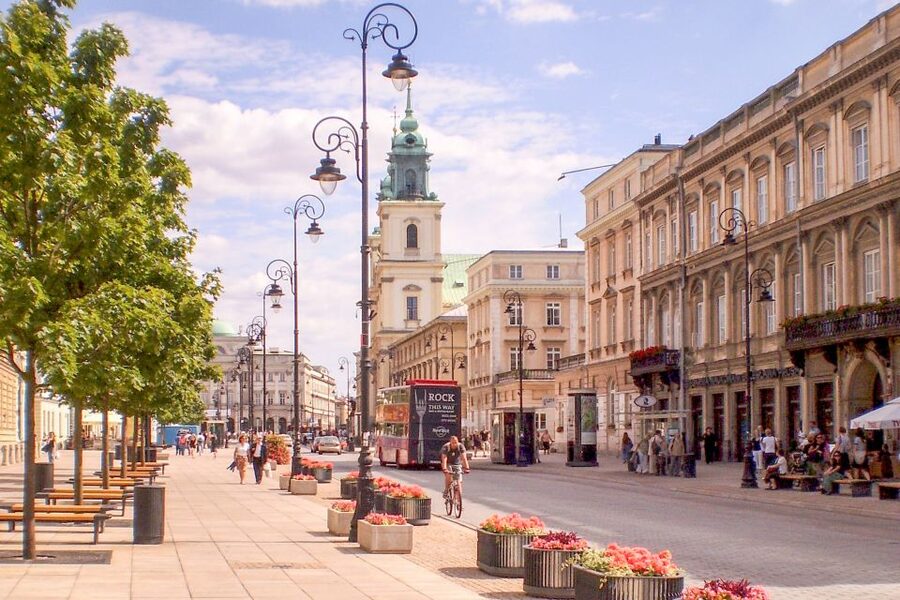
The tour follows Warsaw’s famous Royal Route, a north-south line linking historic residences, churches, monuments, and government buildings. Even from the bus, this is a useful introduction to how the city’s aristocratic and royal districts were arranged.
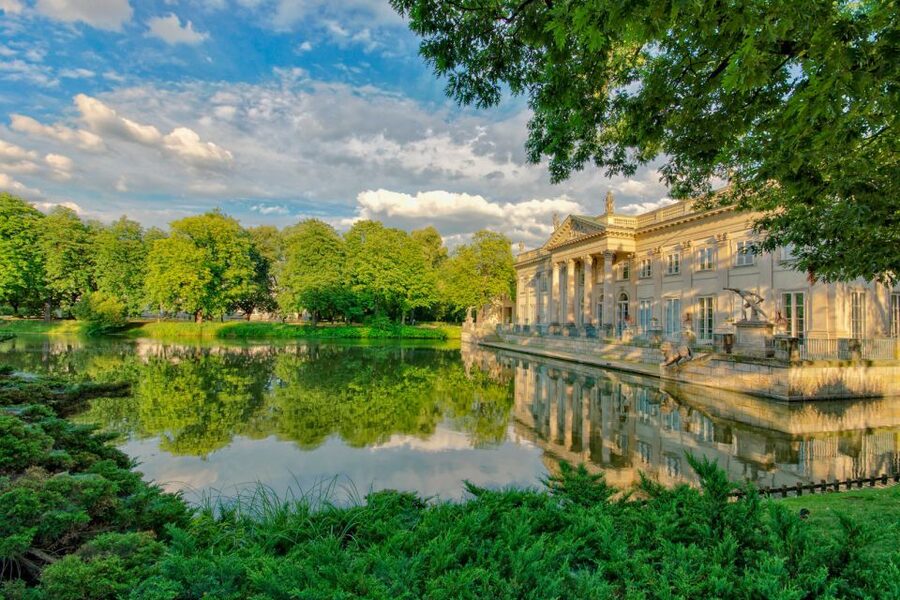
The route leads to Łazienki Park, the summer residence of Poland’s last king. The park adds a welcome change of pace after the traffic and city streets. One of your walks takes place here, so you can see the residence and its setting rather than simply passing it through a vehicle window.
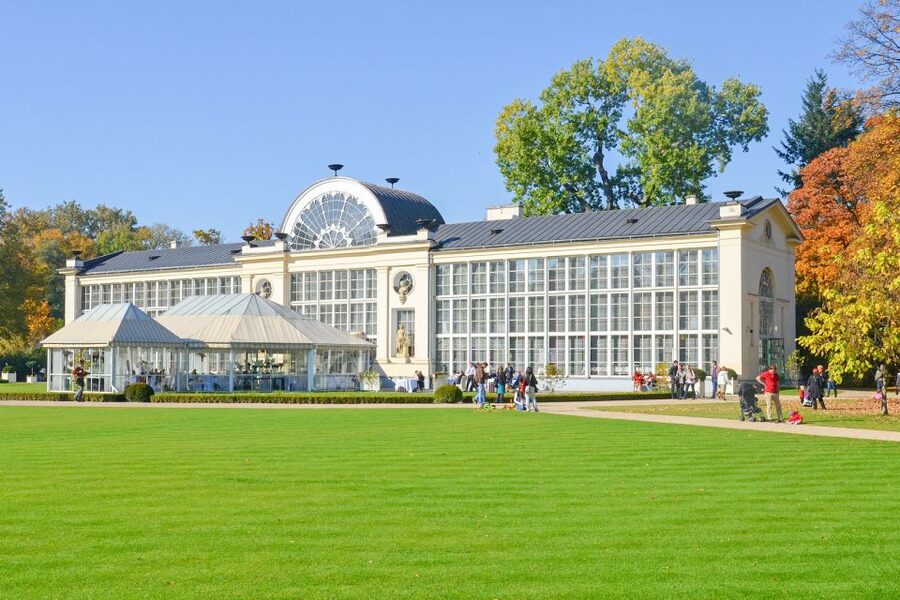
Allow yourself to slow down during this part. The park is one of the tour’s more relaxed sections, and the scenery can be especially pleasant when the weather is good. In rain or cold, the outdoor walk becomes less comfortable, so wear clothing suited to the forecast. One past visitor still found the park enjoyable in rainy weather, but that is a reminder to bring practical gear, not an invitation to ignore the weather.
The park visit also gives the guide room to explain Poland’s monarchy and the political world before the partitions and later upheavals. You should not expect a long, quiet garden visit. The tour has a fixed route and many more places ahead.
Walking through the rebuilt Old Town
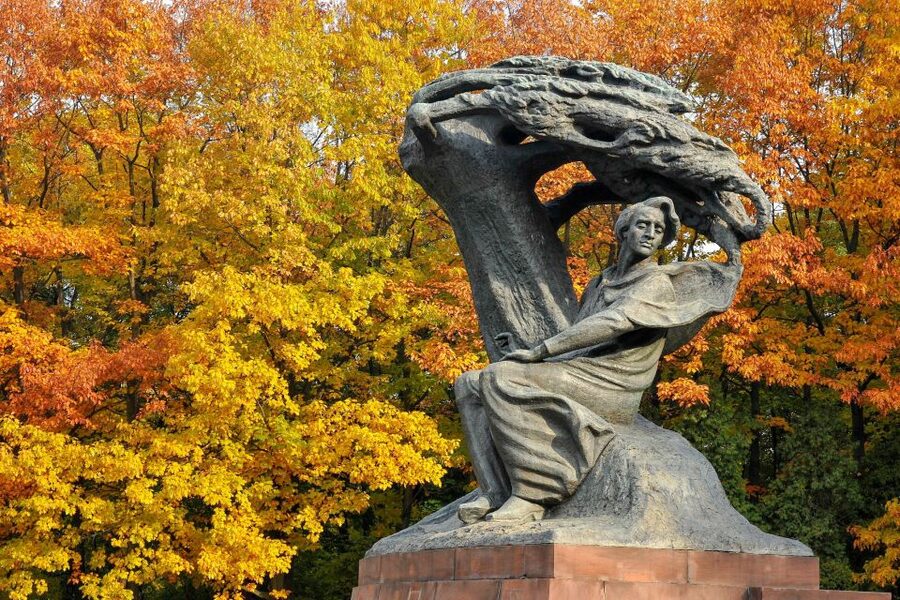
Warsaw’s Old Town is the visual heart of the tour. Its monuments are part of a UNESCO World Heritage site, and the walking section includes the Royal Castle, St. John’s Cathedral, and the tombs associated with the Jagiellonian and Vasa dynasties.
The important thing to understand is that much of Warsaw’s historic center was destroyed during the Second World War and rebuilt afterward. The Old Town is therefore not simply an untouched medieval quarter. It is also a remarkable example of a city reconstructing its historic identity.
Your guide can explain that contrast as you move between the square, castle area, cathedral, and old streets. This is where the walking format earns its keep. You can see the scale of the buildings and the relationship between the main monuments, rather than receiving a quick list of names from a bus seat.
The tradeoff is time. The Old Town section is not a leisurely photography walk. One past visitor felt there was not enough time for pictures, and another noted that the amount of information could be hard to process. If you want quiet time inside St. John’s Cathedral or a long look at the Royal Castle, plan to return on your own.
I suggest keeping your camera ready but listening first. The guide’s explanations about rebuilding and royal history are among the most useful parts of the route, and you can revisit the Old Town later for photographs, shopping, or a slower meal.
The former Jewish Ghetto and the weight of Umschlagplatz
The tour then turns to one of Warsaw’s most important and most difficult areas: the former Jewish Ghetto. This is not treated as a decorative sightseeing stop. The focus is on the places and memorials that explain the destruction of Warsaw’s Jewish community during the Nazi occupation.
You will see the Monument to the Heroes of the Ghetto and the area connected with the Polin Museum, the Museum of the History of Polish Jews. The museum itself is not entered, and admission is not included. Even so, seeing the building and memorial area with a guide gives you a useful starting point if you later decide to visit the museum independently.
The route continues to Umschlagplatz, the site where Jews were assembled for deportation to the death camps. This part requires attention and respect. The guide’s role is especially valuable here because the memorials can be easy to pass without understanding what happened at each location.
The tour does not turn this into a museum visit, and that is both a limit and a benefit. You receive a concise explanation of the sites without committing several hours indoors. But if Holocaust history is a main reason for your visit, you will want more time at the Polin Museum and other memorials after the tour.
The emotional tone depends partly on the guide. Several guides, including Leo, Olaf, and Christopher, have been praised for making difficult material clear while keeping the tour engaging. Good guiding matters here: the subject calls for care, accuracy, and a human voice rather than a rushed recital of dates.
Same base, a different kind of day:
- Warsaw: Chopin Concert in the Old Town
★ 4.8 · 2,287 reviews - Warsaw: Traditional Galar Cruise on The Vistula River
★ 4.6 · 1,640 reviews - Warsaw: Old Town Highlights Walking Tour in English
★ 4.7 · 1,516 reviews - Warsaw Concert: Chopin – Painted by Candlelights with Wine
★ 4.8 · 1,442 reviews
Monuments to war, resistance, and political memory

After the Ghetto area, the bus takes you to several major public memorials. These include the Tomb of the Unknown Soldier, the Monument of the Warsaw Uprising, and the Monument to the Victims of the Katyn Massacre.
Each reflects a different part of Poland’s twentieth-century experience. The Tomb of the Unknown Soldier represents national sacrifice. The Warsaw Uprising Monument recalls the 1944 revolt against German occupation. The Katyn Memorial addresses the massacre of Polish military officers and others by Soviet forces.
You may see some of these stops during short visits, while others may be explained from the bus or viewed from a distance. That is not a flaw in the route so much as a result of trying to cover a large part of Warsaw in three hours. Road closures, ceremonies, traffic, and city events can also force the guide to adjust the plan.
One past visitor described a day when blocked streets required improvisation. The guide managed it well, but some places could only be seen from farther away. Keep that possibility in mind if you want a detailed visit to every monument.
The benefit is breadth. By the end of this section, you will have seen how Warsaw remembers royal rule, Jewish life, military defeat, resistance, and national loss. You may not have stood at length beside every monument, but you will know which places deserve a return visit.
Praga, the Vistula, and a different side of the city
If traffic allows, the bus continues through Praga District. This gives you a look beyond the restored historic center and introduces a part of Warsaw with a grittier visual character.
The route includes the Monument of Brotherhood of Arms and a view from Dąbrowski Bridge. The bridge stop provides a different angle on the city and its river, a useful change after the concentrated history of the Old Town and Ghetto.
Praga is not guaranteed in the same way as the core stops because traffic conditions affect the route. You should see it as an added section rather than the main reason to book. If road conditions are favorable, it helps make the tour feel like a city tour rather than a narrow historic-center circuit.
This final drive also shows why the bus is central to the experience. A walking route covering all these districts would be tiring and would leave little time for explanation. The vehicle lets you sit, listen, and take in parts of Warsaw that are too far apart for a short walk.
What the guide adds to the experience
The strongest part of this tour is the guide. The vehicle and pickup are useful, but the route only becomes meaningful when someone connects the buildings and memorials.
Guides named Olaf, Leo, Alice, Christopher, Daria, Dorothy, Tadeusz, Peter, and Chris have all led versions of this experience. The style can vary, but the praised qualities are consistent: strong command of Warsaw’s past, energy, humor, and a willingness to answer questions.
Olaf is repeatedly described as warm, engaging, and able to make the city’s story easy to follow. Leo is praised for his command of Polish and Warsaw history. Christopher is noted for combining enthusiasm with clear explanations. Alice is described as accommodating, while Dorothy brought a mix of historical detail and modern city life.
English is the stated tour language. One past participant found a guide’s heavy accent difficult at times, so if you have trouble following spoken English in a moving group, stay close during the walks and ask for clarification. Headphones are not listed as included, and one visitor specifically felt they would have helped when the guide was speaking while the group walked.
The tour is interactive rather than silent transport. Bring questions. A guide who can respond to them may turn a standard overview into a much more useful introduction.
Is $58 a fair price?
At $58 per person, the value rests on coverage and convenience rather than admission tickets. Meals and museum entry are not included, and there are no museum visits during the tour. You are paying for hotel pickup and drop-off, an English-speaking guide, air-conditioned transport, and three walking sections.
I think the price is reasonable if you have limited time in Warsaw or want a structured first day. The tour links districts that would take more planning to visit independently, and the hotel transfer removes the need to navigate between them.
The value is weaker if you already know Warsaw well, prefer slow exploration, or plan to spend most of your day inside museums. In that case, a focused Old Town walk plus independent museum visits may suit you better.
The tour is also useful for people who want to see a lot without a long day on foot. There is still a reasonable amount of walking, and you need to keep up with the group, but the bus provides regular relief. A past visitor called the tour efficient and comfortable, while another wanted a longer version. That captures the tradeoff well: good coverage, limited time at each stop.
Who should book this Warsaw tour?
I would recommend it to first-time visitors, short-stay visitors, and anyone who wants a clear outline of Warsaw before exploring alone. It also suits people who want the difficult wartime sites explained rather than simply marked on a map.
Families and older visitors may appreciate the hotel pickup, air-conditioned bus, and mixed transport format, though everyone should be ready for the three walks. The activity is listed as wheelchair accessible, but you should still consider your own comfort with outdoor walking and changing historic surfaces.
History-focused visitors should see this as a beginning. The Ghetto memorials, Umschlagplatz, uprising sites, and Katyn Memorial deserve more time than a three-hour overview can provide. Use the tour to decide where you want to return.
The tour is less suitable if you dislike group pacing, need extensive photography time, or want to enter the Royal Castle, Polin Museum, or other museums during the same outing. No entrance fees are included, and the route focuses on exterior sights and guided explanation.
Free cancellation up to 24 hours before the start and reserve-now, pay-later booking make it easier to fit into an uncertain schedule. Check the available start times when booking, since the tour lasts three hours and pickup is included from your Warsaw hotel.
Final verdict: book it for context and coverage
Book this tour if you want to get your bearings fast and understand how Warsaw’s royal, Jewish, wartime, and modern stories connect. The mix of bus travel and short walks is practical, the hotel pickup saves time, and the guides are the main reason the route works.
Do not book it expecting a slow Old Town stroll or full museum experience. You will move at a firm pace, hear a lot, and sometimes see a monument from the bus or at a distance. For most first-time visitors, though, $58 buys a useful, well-rounded introduction and a good list of places to explore more deeply later.
FAQ
How long does the Warsaw historical tour last?
The tour lasts three hours.
What areas of Warsaw does the tour visit?
It visits the Royal Route, Łazienki Park, Warsaw’s Old Town, the former Jewish Ghetto, the Tomb of the Unknown Soldier area, and, traffic permitting, Praga District.
Is hotel pickup included?
Yes. Pickup and drop-off at your hotel in Warsaw are included.
What language is the tour conducted in?
The tour is conducted in English with a live English-speaking guide.
Are museum entrances included?
No. Museum entrance fees are not included, and there are no museum visits during the tour.
How much walking is involved?
The tour includes three walks. You should wear clothing and shoes suitable for the weather and be ready to maintain the group’s pace.
Is the tour wheelchair accessible?
Yes, the activity is listed as wheelchair accessible.
Can I cancel for a full refund?
Yes. You can cancel up to 24 hours in advance for a full refund.
Just added in Warsaw
- A unique walking tour of Jewish Warsaw — past and present★ 5.0 · 8 reviews
- Tour from Warsaw: Wolf’s Lair, Hitler’s HQ Zones I and II★ 5.0 · 32 reviews
- Wolf’s Lair Private Day Trip from Warsaw★ 5.0 · 50 reviews
- Wolf’s Lair & Treblinka Tour in 1 day from Warsaw★ 5.0 · 37 reviews
- Jewish Warsaw Walking Tour★ 5.0 · 95 reviews
- Warsaw: The Original Pub Crawl★ 4.5 · 97 reviews
- Warsaw: Gun Shooting Experience with Transfers★ 4.8 · 97 reviews
- Warsaw: Old and New Town Private Walking Tour★ 4.8 · 116 reviews
Historical Tours, compared.
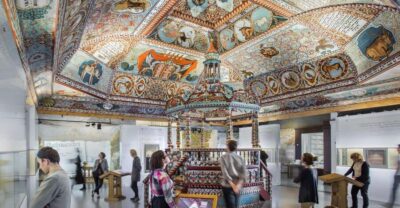
POLIN Museum of the History of Polish Jews Ticket
Read the review →
Gdańsk City Sights & History Guided Walking Tour in English
Read the review →


Small-Group Historical Guided Tour of Warsaw with pick up/drop off. Public Tour.
Read the review →Browse the lists this tour appears in