

Reviewed · CYCLING TOURS
Bike Tour of Krakow Old Town, Top Attractions and Nature
Krakow is compact enough to see by bike, yet spread out enough that walking can eat up much of your sightseeing time. This private ride links Main Market Square, Wawel Castle, and the Planty park belt before taking you toward quieter parts of the city. I like that the guide can adjust the pace instead of forcing every group into the same rigid ride.
I also like the way the route mixes famous sights with useful orientation. You see St Mary’s Basilica and the Cloth Hall, then learn how to place streets, gates, churches, and university buildings on the city map. The longer options add Kazimierz, the Vistula River, and Kosciuszko Mound, giving you a much broader look at Krakow.
The main thing to consider is cycling comfort. One French guest noted that Krakow is not always easy for bikes, and that is fair. Crowded squares, cobbled sections, pedestrians, and city traffic can make this less relaxing than a quiet countryside ride. Arrive 10 minutes early so the rental shop can set up your adult city bike.
Key points to know before booking
- The two-hour route covers Krakow’s essential center: Main Market Square, Planty, St Florian Gate, the Barbican, Jagiellonian University, Wawel Hill, and the Royal Route streets.
- The private format gives you a flexible pace: Your licensed guide can adapt the ride to your sightseeing interests and language.
- The four-hour option adds Krakow’s wartime and Jewish heritage: You reach Ghetto Heroes Square, Podgorze, and Kazimierz, along with the Vistula riverbank and Fort Benedict.
- The six-hour option reaches Kosciuszko Mound: This is the best choice if you want nature, quieter streets, the National Museum, and Cracovia’s stadium as well as the historic center.
- Bikes are included, but safety equipment is optional: Helmets, child seats, and children’s bikes must be requested when booking.
- The $120 price is easiest to justify for a private group: It buys a guide, bikes, route planning, and language support, but entrance tickets and food cost extra.
Starting at Main Market Square

Meet your guide in front of Cinema Under the Rams at Rynek Glowny 27. This puts you directly on Krakow’s Main Market Square, the natural place to begin a first visit. Arrive 10 minutes early, since you need time to collect and adjust the bikes.
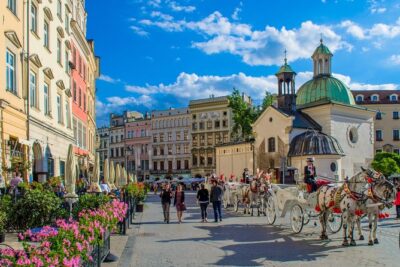
The square gives you an immediate lesson in Krakow’s scale and character. The Cloth Hall, or Sukiennice, occupies the center, with its Renaissance-style arcade and long trading history. The old Town Hall Tower rises nearby, while St Mary’s Basilica provides the most recognizable view.
St Mary’s is famous for its hourly trumpet call, played from the Gothic watchtower. The tune stops suddenly, a reminder of the medieval warning legend tied to the city. Your guide can provide the story and explain the buildings without asking you to stand through a long formal lecture.
A bike helps here, but it does not make the square empty. You will need to walk or move slowly in areas crowded with pedestrians. The guide’s role is especially useful at this point, helping you get your bearings while keeping the group together.
More old town tours in Kraków:
- Old Town Krakow & Wawel Castle Walking Tour
★ 5.0 · 1,508 reviews - Krakow: Bike Tour of Old Town, Jewish Quarter and the Ghetto
★ 4.9 · 1,155 reviews - Krakow: The Old Town Walking Tour
★ 4.8 · 794 reviews
Following Planty to the medieval gates
From the square, the route follows Planty, the green belt that circles Krakow’s Old Town. Planty occupies the space once used by the medieval fortifications, so this section lets you see how the city changed from a walled settlement into a modern urban center.
The route passes the Juliusz Slowacki Theatre, an ornate historic building with an important place in Krakow’s cultural life. You also reach the Barbican, a 15th-century defensive structure, and St Florian Gate, the medieval Gothic entrance tower.
These stops work well on a bike tour because they are close together but easy to miss when you wander without a plan. You get the broad story of Krakow’s defenses, then connect it to the streets beyond the old walls.
The Grunwald Monument and the Statue of Jan Matejko add more Polish history. Matejko was a major Polish historical painter, and the monument near the old city gate helps place him within the country’s national story. St Florian’s Basilica provides another architectural stop before the route turns toward the university and Wawel.
Jagiellonian University and the Royal Route
Jagiellonian University is one of the key stops on this central route. Its historic buildings represent one of Krakow’s strongest links to learning and public life. You will not be buying an entrance ticket as part of this experience, but the guide can point out the university buildings and explain their place in the city.
From there, you head toward Wawel Hill. This is the symbolic heart of Poland’s royal past, with Wawel Cathedral and the Royal Castle occupying the hill above the Vistula. The route gives you an efficient first look at the complex, though it does not include admission to the interiors.
That distinction matters. If you want to tour the castle rooms, cathedral interior, or other paid sights, you will need separate tickets and another visit. The bike tour is better for understanding where everything is and deciding what deserves your return time.
The ride through Kanonicza and Grodzka streets is one of the most atmospheric parts of the two-hour itinerary. These historic streets are lined with churches, palaces, museums, and old facades. Saints Peter and Paul Church is especially easy to recognize because of its ornate Baroque front.
I like this part of the tour for practical reasons. You see several important buildings without repeatedly stopping to consult a map, and you can mark Kanonicza and Grodzka for a slower walk later. The bike keeps the route moving, but you should not expect an extended interior visit at each church or monument.
What the two-hour tour does well

The basic tour is a strong choice if Krakow is part of a short city break. In two hours, you cover the central sights that first-time visitors most need to place: the market square, old city defenses, Planty, the university, Wawel, and the Royal Route.
The guide speaks your selected language from English, French, Russian, Italian, Spanish, or Polish. The group is private, which makes a real difference when you want to stop for a photo, ask about a church, or adjust the pace.
The tour also gives you a useful planning session without feeling like a planning session. Afterward, you know where to return for a museum, a castle interior, a cafe, or a longer walk. That was the practical benefit highlighted by Susanna from the United Kingdom, who found the tour a good way to understand Krakow and decide what to explore next.
Still, two hours is short. You get an overview, not a full study of the city. If you want Kazimierz, Podgorze, nature, and the outskirts, choose the longer route rather than trying to squeeze everything into the shortest option.
Same base, a different kind of day:
- From Krakow: Auschwitz-Birkenau Guided Tour & Hotel Pickup
★ 4.5 · 33,358 reviews - From Krakow: Auschwitz-Birkenau Guided Tour & Hotel Pickup
★ 4.5 · 29,340 reviews - Krakow: Auschwitz Guided Tour with Optional Hotel Pickup
★ 4.5 · 15,280 reviews - Krakow–Zakopane: Cable Car, Chocholow Baths, Cheese & Vodka
★ 5.0 · 10,720 reviews
The four-hour route reaches Kazimierz and Podgorze

The four-hour choice adds a more serious look at Krakow’s 20th-century history and Jewish heritage. You cycle along the Vistula riverbank toward Park Bednarski, a leafy urban park with the abandoned ruins of Fort Benedict.
Fort Benedict adds a less polished side of Krakow. The ruins are not as immediately famous as Wawel or St Mary’s Basilica, but they show how military structures survive at the edges of the city’s better-known story. The park also gives you a change of pace after the tight streets around Old Town.
The route continues to Ghetto Heroes Square in Podgorze. Here, the guide explains the Jewish Ghetto established during World War II and the difficult events connected with it. This is a place where a good guide matters. The square deserves a respectful stop and clear historical context, not a rushed photo break.
You then cross into Kazimierz, Krakow’s historic Jewish Quarter. The route includes the Old Synagogue, Remuh Synagogue, and Tempel Synagogue. These sites reflect different periods and religious traditions within the district, and seeing them together gives you a stronger sense of Kazimierz than simply visiting one restaurant street.
Again, entrance tickets are not included. The bike route is useful for orientation, but if you want to go inside the synagogues, museums, or other attractions, plan a separate stop and budget for admission.
The four-hour option suits you if you already know you want more than the postcard center. It also works well for anyone interested in wartime history, Jewish heritage, and the way Krakow’s districts connect along the river.
The six-hour ride and Kosciuszko Mound

The six-hour route covers the Old Town and Kazimierz, then carries on toward quieter areas surrounded by nature. You pass the National Museum and Cracovia’s Marshal Jozef Pilsudski Stadium before entering a park on the way to Kosciuszko Mound.
Kosciuszko Mound is an artificial hill built in 1820 to honor Tadeusz Kosciuszko, one of Poland’s major military heroes. It is a distinctive Krakow landmark because it is both a monument and a high viewpoint. The route makes room for a part of the city that many short visits miss.
The six-hour option is the most demanding choice. You are on a bike for much of the day, and the city’s uneven cycling conditions may become more noticeable over this distance. The benefit is a far wider picture of Krakow, from royal buildings and Jewish heritage to parks, river paths, sports facilities, and the city’s outer edges.
There is also time to stop for a pretzel or another local snack, at your own expense. That small break matters on a long ride. Bring a little cash or payment method for food, and do not assume the snack is included in the tour price.
Bikes, helmets, weather, and comfort

The tour supplies adult city bikes through a professional rental shop. The route is designed around normal urban cycling, rather than a specialized mountain or road bike experience.
Helmets and other safety equipment are not automatically included, but they are available on request. Children’s bikes and child seats can also be prepared if you provide the number and ages of children when booking. This is important for families, since the standard arrangement is adult bikes.
Krakow’s streets are not uniformly bike-friendly. You may encounter pedestrians, cobblestones, narrow sections, and busy areas. A confident urban cyclist will likely find the route manageable, while a nervous cyclist should speak up early and ask the guide to keep the pace comfortable.
The tour runs in all weather. Check the forecast and dress for the day, especially if you choose four or six hours. Rain can make surfaces less comfortable, and a long ride in poor weather is a different experience from a short overview.
What $120 per person really buys
At $120 per person, this is not a cheap way to rent a bike. You are paying for a private tour with a licensed guide, a prepared route, bike rental, language support, and the ability to adjust the pace to your group.
The value improves when several people share the private experience, especially if you care about asking questions or avoiding a large group. The guide can focus on your interests, such as Polish history, church architecture, Jewish heritage, local traditions, or city orientation.
The price is less attractive if you simply want to pedal around without commentary. It also does not cover castle, church, synagogue, or museum admission. Snacks and lunch are extra, with food only built into the six-hour schedule as free time rather than as a supplied meal.
The strong guide feedback supports the central value of the experience. Martin was specifically praised for explaining Krakow’s history and helping a guest decide what to explore later. A French guest also praised the guide, while noting the cycling conditions. Those two points capture the tour well: the human guidance is a strength, but the city itself can make riding feel uneven.
Who should choose this Krakow bike tour?

I would choose the two-hour ride if you have just arrived in Krakow and want a clear map of the center. It is also a good fit for a first morning, since you can use the guide’s suggestions to plan the rest of your stay.
Choose four hours if Kazimierz, Podgorze, World War II history, and Jewish heritage are high on your list. The extra time gives you a more varied route and avoids treating the city as only a medieval square and castle.
Choose six hours if you enjoy long bike rides and want Kosciuszko Mound and quieter green areas. It is the broadest version, but it asks more of your legs and your patience with urban cycling.
I would not choose this tour if you strongly dislike bikes, need a fully smooth and traffic-free route, or want extended indoor visits. The tour is for seeing many places and learning how they connect, not for spending an hour inside each major attraction.
The private format, guide quality, and route flexibility are the best reasons to book. The main caution is simple: Krakow is walkable, but it is not perfectly built for bicycles. Go in expecting an efficient city overview with some urban riding, not a leisurely path through empty streets.
Should you book it?
Book the two-hour tour if you want quick orientation and the major Old Town sights. Pick four hours for the most balanced mix of central Krakow, the river, Podgorze, and Kazimierz. Choose six hours only if you are comfortable cycling for much of the day and want Kosciuszko Mound added to the city story.
At $120 per person, the experience makes the most sense for a private group that values a licensed guide and personal pacing. Request helmets or child equipment ahead of time, arrive early for bike setup, and keep separate time and money for attraction tickets. With those expectations, this is a practical and informative way to see more of Krakow than you could comfortably cover on foot.
FAQ
Where does the Krakow bike tour meet?
You meet the guide in front of Cinema Under the Rams, at Rynek Glowny 27, 31-010 Krakow.
What does the two-hour bike tour include?
The two-hour route includes Main Market Square, the Cloth Hall, Town Hall Tower, St Mary’s Basilica, Planty, the Juliusz Slowacki Theatre, the Barbican, St Florian Gate, Jagiellonian University, Wawel Hill, Wawel Cathedral, the Royal Castle, Kanonicza Street, Grodzka Street, and Saints Peter and Paul Church.
What does the four-hour option add?
The four-hour route adds the Vistula riverbank, Park Bednarski, Fort Benedict, Ghetto Heroes Square, Podgorze, and Krakow’s historic Jewish Quarter, including the Old Synagogue, Remuh Synagogue, and Tempel Synagogue.
What does the six-hour option include?
The six-hour option includes the Old Town and Kazimierz routes, the National Museum, Cracovia’s Marshal Jozef Pilsudski Stadium, park areas, and Kosciuszko Mound. It also allows free time to buy a pretzel or another snack at your own expense.
Are bikes and helmets included?
Adult city bikes are included. Helmets and other safety equipment are optional and must be requested. Children’s bikes and child seats are also available on request if you provide the children’s ages and numbers when booking.
Are entrance tickets and food included?
Entrance tickets to attractions are not included. Lunch and snacks are also not included, although the six-hour route includes free time to buy a snack at your own expense.
More cycling tours in Kraków
- Complete Cracow Bike Tour (small group of maximum 15 people!)
★ 5.0 · 1,322 reviews - Highlights of Krakow Bike Tour – Small group
★ 5.0 · 662 reviews - Full Bike Tour – the Old Town, Jewish Qtr & the Ghetto NEW BIKES
★ 5.0 · 437 reviews - Krakow: Bike Tour of the Old Town, Kazimierz, and the Ghetto
★ 4.9 · 350 reviews
Just added in Kraków
- Wawel Castle, Old Town with St. Mary’s Church Guided Tour★ 5.0 · 3 reviews
- Wawel Castle, Old Town with St. Mary’s Church Guided Tour★ 5.0 · 5 reviews
- Wawel Castle, Cathedral, Old Town and St. Mary’s Basilica★ 4.8 · 13 reviews
- Wawel Castle, Cathedral, & Rynek Underground Tour with Lunch★ 4.5 · 10 reviews
- Wawel Castle & Cathedral Skip the Line Small Group Tour★ 5.0 · 3 reviews
- Wawel Castle and Cathedral Guided Tour★ 4.6 · 44 reviews
- Wawel Castle, Cathedral, Rynek Underground Tour with Lunch★ 5.0 · 3 reviews
- Wawel Castle and Cathedral Guided Tour★ 5.0 · 8 reviews
Cycling Tours, compared.
Complete Cracow Bike Tour (small group of maximum 15 people!)
Read the review →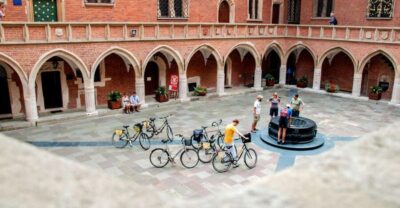
Bike Tour of Old Town, Jewish Quarter and the Ghetto
Read the review →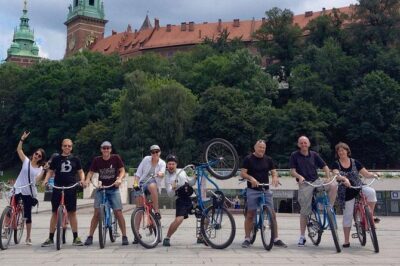
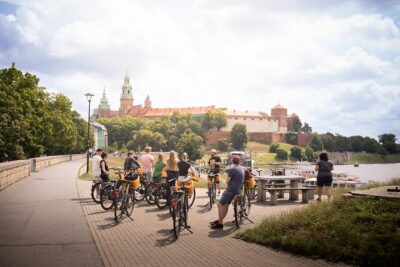
Full Bike Tour – the Old Town, Jewish Qtr & the Ghetto NEW BIKES
Read the review →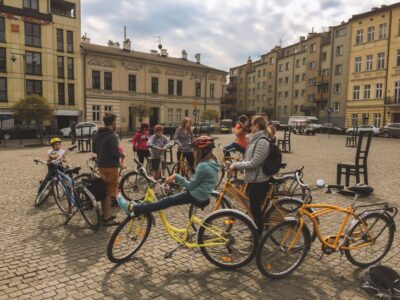
Bike Tour of the Old Town, Kazimierz, and the Ghetto
Read the review →
Half-Day Warsaw City Sightseeing Bike Tour for Small Group
Read the review →Browse the lists this tour appears in