
Reviewed · OLD TOWN TOURS
Gdańsk Old Town Private Walking Tour with Legends and Facts
Gdańsk’s story is unusually layered: medieval trade, ornate Hanseatic streets, wartime destruction, communist resistance, and modern rebirth all appear within a few blocks. This private walk brings those chapters together, starting at the Upland Gate and moving through the city’s grandest streets before reaching the Motława River and, on longer versions, the Solidarity sites.
I like the private format, which gives you room to ask about Polish politics, amber, architecture, or the city’s wartime past instead of following a fixed script. I also like the choice of length: a focused two or three-hour Old Town walk works well for a first look, while the longer route adds St. Bridget’s Church, the shipyard memorial, and the European Solidarity Centre.
The main consideration is that the advertised price of $107.89 per person can feel high for a short walk, especially for a small group. The value improves when you use the longer route and share the guide with family or friends. Be clear about your preferred length and pickup point before setting out.
Key points to know before you book
- The route begins at the Upland Gate: You enter the historic center through one of the city’s old defensive gateways.
- Neptune’s Fountain and Artus Court anchor the classic Old Town walk: These are the places to focus on if you have only a few hours.
- The private guide can adjust the pace: Guides including Marek, Kaja, Elwira, Thomas, and others have tailored walks around architecture, politics, food, shopping, and Polish history.
- The extended route reaches Solidarity landmarks: St. Bridget’s Church, the Fallen Shipyard Workers Monument, and the European Solidarity Centre add modern Polish history to the day.
- Pickup has a tight range: Your accommodation must be within 1.5 kilometers of the meeting point in Gdańsk Old Town for hotel pickup.
- The tour is offered in English: Some past guide assignments have also supported German, Italian, Danish, Norwegian, and French.
Starting at the Upland Gate
The meeting point is Highland Gate, or Brama Wyżynna, at Wały Jagiellońskie 2A. This is a sensible place to begin because the gate marks the old entrance into the medieval city and puts you close to the main sights.
Your guide starts with the city’s defensive edge, then helps you read Gdańsk as you walk. That matters here. The Old Town can look like a postcard collection of colorful façades, but the streets make more sense once you understand their former roles in trade, government, and civic life.
The opening stop is short, about 10 minutes. It is not a major sightseeing stop in itself, and there is no admission fee. Its value is orientation. You get the basic shape of the historic center before moving into the grand ceremonial streets.
More old town tours in Gdańsk:
- Gdańsk: Sightseeing EcoCruise around the Old Town of Gdansk
★ 4.6 · 719 reviews - Gdańsk: Old Town Private Walking Tour with Legends and Facts
★ 4.9 · 245 reviews - Gdansk Old Town 2-Hour Walking Tour
★ 4.5 · 94 reviews
Walking the Golden Gate to Long Market
From the Upland Gate, you continue toward the Golden Gate and Dluga Street. The route then opens into Long Market, the city’s most impressive public space and the part most first-time visitors want to see.
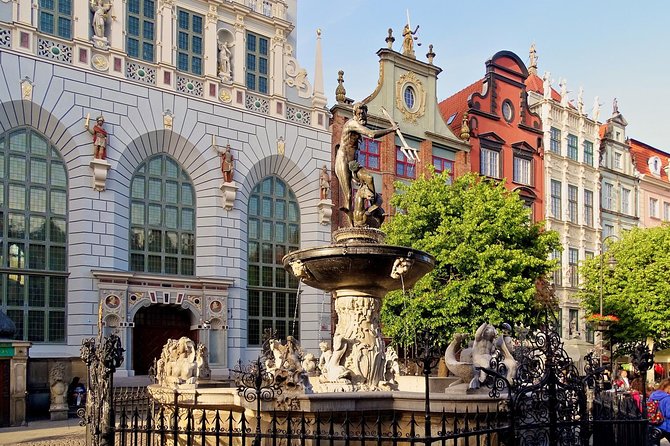
This is where the walk delivers its classic Gdańsk views. You pass the Town Hall, the Golden House, and Neptune’s Fountain, with elaborate merchant façades packed closely along the street. The guide can explain how the buildings reflect the city’s commercial past and why this central stretch mattered to local power and trade.
Plan on about an hour here. That is enough time to look up, take photographs, and ask questions without feeling pushed along. I would use this part of the walk to ask about the difference between Gdańsk’s Old Town and Main Town, since the names can confuse first-time visitors. The tour description uses both terms, and the route moves through the historic heart often called the Main Town in English.
This section is also where guide quality matters most. A list of façades is easy to provide. A good guide connects the buildings to people, commerce, politics, and everyday life. Past guide assignments have included Thomas, whose talks were praised for mixing architecture and politics with lighter facts, and Marta, whose enthusiasm for her hometown helped first-time visitors get their bearings.
Artus Court and the city’s merchant world
The next stop is Artus Court, or Dwór Artusa, a former meeting place for merchants and now part of the Gdańsk History Museum. The visit is listed at about 20 minutes, with admission included.
Artus Court adds substance to the grand façades outside. It was not simply a pretty civic building. It was tied to the city’s merchant class and public life, so it helps explain why Gdańsk’s central streets look more like the heart of a trading republic than a quiet provincial town.
Twenty minutes is enough for a guided introduction, but not for a slow museum visit. If you enjoy museum displays and local art, ask your guide how much time is available inside. On a shorter walk, this stop works best as a focused explanation rather than a full museum afternoon.
The Motława waterfront and Green Gate
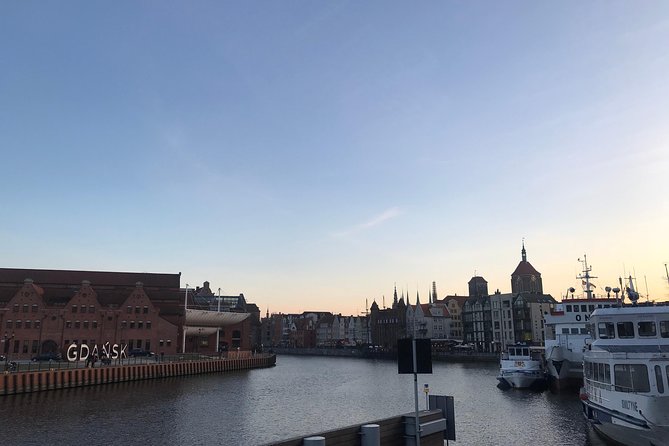
From Long Market, the route continues toward Green Gate and the Motława River embankment, known as Długie Pobrzeże. The walk beside the river gives you a change of pace after the dense architecture of the central streets.
The waterfront is one of the most photogenic sections of Gdańsk. You can look across the river, see the historic harbor setting, and better understand why trade shaped the city. The stop is short, around 10 minutes, and the admission note says any ticket is not included. The main appeal here is the view and the guide’s explanation, not a long indoor visit.
If you want a slower riverside experience, mention it early. Private touring gives you more room to pause, but the route has several major stops, and a few extra minutes by the water may need to come from somewhere else.
More walking tours in Gdańsk:
- Gdańsk City Sights & History Guided Walking Tour in English
★ 4.8 · 876 reviews - Main Town Gdańsk Walking Tour
★ 5.0 · 644 reviews - Discover Gdansk Walking Tour
★ 5.0 · 495 reviews - Gdansk Old Town Half-Day Private Walking Tour
★ 4.9 · 62 reviews
St. Mary’s Basilica and the Great Armoury
St. Mary’s Basilica is one of the tour’s strongest stops. This huge brick church is among the largest of its kind in the world, and the interior has a grand hall, an ornate altar, an organ set, and a royal chapel. Admission is listed as free, and the visit takes about 20 minutes.
The church is not just another church interior to check off. Its scale changes your sense of the city. After the narrow streets and packed façades, the interior gives you a broad, quiet space with a different kind of drama.
One guide, Margaret, made a point of getting a group to St. Mary’s in time for the clock show. If that feature matters to you, ask about the timing before the walk begins. Do not assume every departure will line up with it, especially since the walk can be adjusted and the duration varies.
The standard route ends near the Great Armoury, a Renaissance building described as one of the city’s finest examples of that style. This gives a shorter tour a satisfying finish: medieval defenses at the start, merchant streets in the middle, and a major architectural landmark at the end.
The extended walk across Wyspa Spichrzów
The longer version adds Wyspa Spichrzów, the former warehouse island on the Motława. Here you see old brick structures and warehouse ruins alongside redeveloped sections of the island.
This is a useful addition because it moves beyond the polished ceremonial center. Gdańsk’s trade depended on storage, shipping, and river access, and the island helps you see that working side of the city. The listed time is about an hour, and admission is included.
The route also reaches Ołowianka, where you can see the red-brick Baltic Symphony Hall. This portion is best for anyone who wants more than the famous postcard streets. It also adds walking distance, so comfortable shoes are a practical choice.
The long route can run up to six hours when combined with the other stops. That is a very different experience from the two-hour option. If your group includes children, older relatives, or anyone who prefers a relaxed pace, decide in advance how much of the extension you really want.
St. Bridget’s Church and its Solidarity story
St. Bridget’s Church is a particularly worthwhile addition for people interested in modern Polish history. It became a place of refuge for Solidarity leaders during martial law, and one of its large doors shows scenes connected with the Solidarity movement from August 1980 through the imposition of martial law in December 1981.
Inside, you can see religious objects and a notable amber altar. Amber is strongly associated with the Baltic region, so this stop connects local materials with religious art and recent political memory.
The listed visit lasts two hours, which makes this one of the most substantial parts of the extended route. That time suggests a serious look at the church and its story, not a quick doorway stop. If you are mainly interested in medieval architecture, the shorter Old Town route may suit you better. If you want to understand Gdańsk’s role in Poland’s struggle against communist rule, this is one of the most meaningful additions.
The Fallen Shipyard Workers Monument
The route then moves from the historic center toward the Monument to the Fallen Shipyard Workers of 1970. The monument commemorates workers killed during anti-communist riots.
This is a brief stop, about 30 minutes, but its importance is larger than its time slot suggests. The monument places Solidarity in a longer chain of labor unrest and state violence. It also shifts the tour from royal façades and merchant wealth to workers, protest, and political change.
The change in subject is one of the best reasons to choose the extended version. You are not simply seeing more buildings. You are moving through different ideas of what Gdańsk means: port, trading city, religious center, industrial workplace, and birthplace of a movement that helped reshape Poland.
The European Solidarity Centre
The final major addition is the European Solidarity Centre, a modern museum devoted to the Solidarity movement and the end of communist government in Poland. Admission is included, and the scheduled visit is about 30 minutes.
This museum is especially useful if you arrive knowing little about the movement. The guide can give you a framework before you enter, then help connect the displays to the monument and St. Bridget’s Church. A half-hour gives you an introduction, not enough time for every exhibit, so serious museum visitors may want to return independently if their schedule allows.
Several guide experiences have included the museum as a major highlight. That fits the route well. The museum supplies the political context that the older streets cannot, while the earlier stops show how that history is rooted in the city itself.
How the private format affects value
At $107.89 per person, this is not the cheapest way to see Gdańsk’s center. The price makes more sense when you consider the private guide, the possibility of pickup, and the longer route with included admissions at selected stops.
For one or two people booking a short walk, the cost may feel steep. For a family, staff group, or circle of friends, the private format can be better value than paying separately for several shorter activities. You also avoid the usual problem of a large group moving at one fixed pace.
The best value comes from using the guide actively. Ask for restaurant suggestions, amber-buying advice, architectural details, or a closer look at Polish politics. Marek has helped groups find local restaurants and bars, while another guide took time to explain how to distinguish genuine amber from imitation. Those useful local pointers can make the tour more valuable than a simple walk between monuments.
The average booking lead time is about 85 days, so popular dates may require planning. Free cancellation is available until 24 hours before the start time. The tour is private, and group discounts are offered.
Pickup, timing, and practical planning
Pickup is available only within Gdańsk Old Town, and your accommodation must be within 1.5 kilometers of the meeting point. If you provide the address while booking, the guide can meet you there. Otherwise, go to Highland Gate.
The tour is near public transportation, and most people can take part. Still, this is a walking experience with a route that may last several hours, so plan for weather and comfortable footwear.
Check your email the day before. Important meeting information may be sent then, and one negative experience involved confusion over a hotel pickup and a different meeting point. That problem appears to have been an exception among otherwise strong guide experiences, but it is a good reason to confirm the details rather than assume the pickup is automatic.
The advertised end point is back at the meeting point, while the route description also refers to finishing near the Great Armoury and then continuing farther on the extended version. Ask the operator to confirm the exact end point for your selected duration, especially if you have a train, restaurant booking, or museum reservation afterward.
Who should book this Gdańsk walk?
I would choose this tour for a first visit, especially if you want the main sights explained rather than simply photographed. It also suits people who enjoy asking questions and changing the emphasis as they go.
History fans should choose the longer option for St. Bridget’s Church, the shipyard monument, and the European Solidarity Centre. Architecture lovers may prefer the shorter route through the Golden Gate, Long Market, Artus Court, St. Mary’s Basilica, and the Great Armoury.
The guide roster is varied. Kaja has been described as prepared, humorous, and engaging. Elwira has guided first-time visitors through a full city introduction, and Marek has been flexible with timing and added local food suggestions. Other guide assignments have included Krzysztof, Joanna, Marta, Thomas, Margaret, and Michal.
One serious caution is language consistency. The tour is offered in English, and many guide experiences have been praised for clear explanations, but one poor experience involved English that was not strong enough, along with a late start and an unscheduled shop visit. If precise English or strict timing matters to you, confirm the guide and language before the day.
Should you book it?
Book this private walk if you want a flexible introduction to Gdańsk and value a guide who can connect medieval streets with the Solidarity era. For the best balance, I would choose a three or four-hour version, then extend to the museum and shipyard sites if modern Polish history interests you.
Skip it if you prefer exploring alone, want a full museum day, or are paying a high per-person price for only a short walk. Otherwise, the private format, strong guide selection, and broad range of sights make it a practical first-day choice. The key is to confirm the language, pickup point, duration, and final route before booking.
FAQ
Where does the tour begin?
It begins at Highland Gate, also called Brama Wyżynna, at Wały Jagiellońskie 2A in Gdańsk.
Is hotel pickup available?
Yes, but only in Gdańsk Old Town within 1.5 kilometers of the meeting point. Provide your accommodation address when booking if you want pickup arranged.
How long does the tour last?
The experience lasts approximately two to six hours, depending on the route selected.
Is the tour private?
Yes. Only your group participates in the activity.
What language is offered?
English is offered. The supplied information also includes past guide experiences in German, Italian, Danish, Norwegian, and French, but you should confirm the language for your booking.
Are admissions included?
Admission is listed as included for Artus Court, the Wyspa Spichrzów section, St. Bridget’s Church, and the European Solidarity Centre. The Motława River embankment note says admission is not included. Several outdoor sights have no admission charge.
Where does the tour end?
The activity information says it ends back at the meeting point. Because the route may finish near the Great Armoury or continue to the Solidarity sites, confirm the exact end point for your chosen version.
Can I cancel for a full refund?
Yes. You can cancel at least 24 hours before the start time for a full refund. Cancellations or changes made less than 24 hours before the start time are not accepted for a refund.
Just added in Gdańsk
- Gdansk, Gdynia, and Sopot: 8-Hour Private Sightseeing Tour★ 4.9 · 13 reviews
- Undercover City Games: Gdynia★ 5.0 · 34 reviews
- Private WW2 Tour of Westerplatte,Gdansk and Stutthof Including Lunch★ 5.0 · 12 reviews
- Whisky Tasting in Gdańsk★ 5.0 · 3 reviews
- Gdansk EVERYDAY Vodka Tasting Tour★ 5.0 · 6 reviews
- Westerplatte private tour led by Expert-Guide (door to door)★ 5.0 · 5 reviews
- Torun – City of Copernicus Private Tour★ 4.5 · 5 reviews
- TriCity Tour (Gdansk, Gdynia, Sopot) – PRIVATE (8h)★ 5.0 · 4 reviews
Old Town Tours, compared.

Bike Tour of Old Town, Jewish Quarter and the Ghetto
Read the review →


Sightseeing EcoCruise around the Old Town of Gdansk
Read the review →
Browse the lists this tour appears in