
Reviewed · CITY TOURS
Gdansk: Private Top City Tour by Electric Cart & Live Guided
Gdansk’s old center is packed with churches, gates, canals, and handsome brick buildings, but its modern story is just as important. This private electric-cart tour links the medieval Main Town with the shipyard where the Solidarity movement helped shake apart the socialist camp. I especially like the small private format and the way you can ask questions instead of listening to a fixed script.
I also like the weather protection, which matters in a northern Polish port city, and the included drink, with water, coffee, or beer available. The main tradeoff is time: 90 minutes covers a remarkable amount of ground, but many stops are brief viewing points rather than full visits. If you want long museum visits, you’ll need extra time on your own.
Key points about this Gdansk cart tour
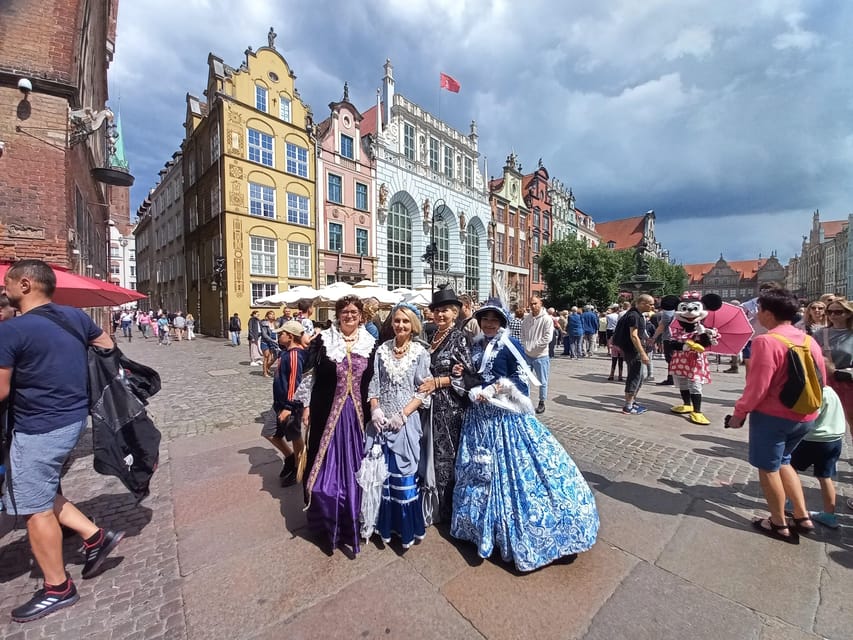
- See both sides of Gdansk: Medieval gates, churches, the Motława port, the shipyard, and Solidarity sites all fit into one route.
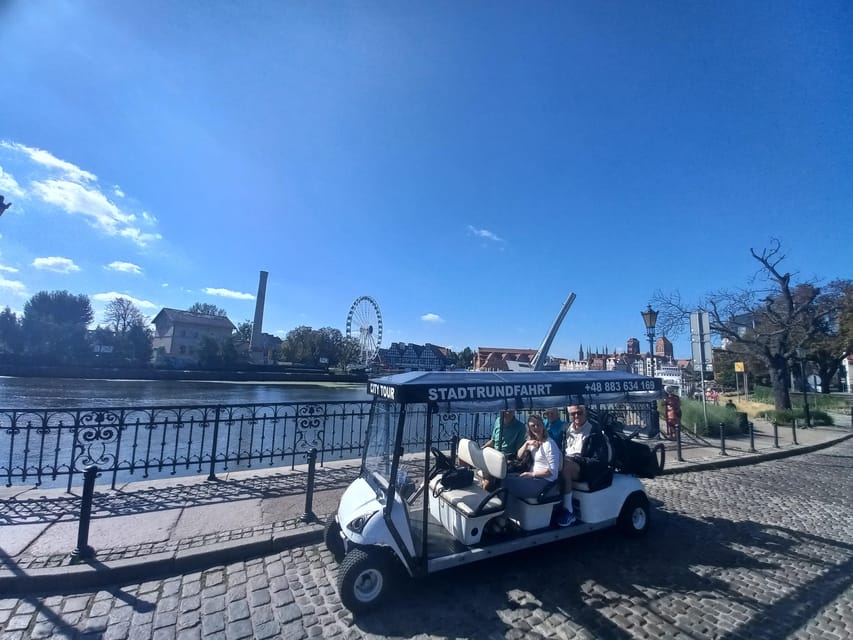
- Ride in a private electric cart: Your group has its own vehicle and live guide, with pickup available within 2 kilometers of Neptune’s Fountain.
- Expect quick sightseeing stops: Many landmarks receive two to five minutes of explanation, while St. Bridget’s Church gets a longer visit.
- Choose your language: Tours are offered in English, Spanish, Ukrainian, German, and Polish.
- Make use of the flexible format: The route can be customized, and the guide can answer questions throughout.
- Plan for all weather: The tour runs in rain or shine, with protective covering against rain and wind.
Why an electric cart works well in Gdansk
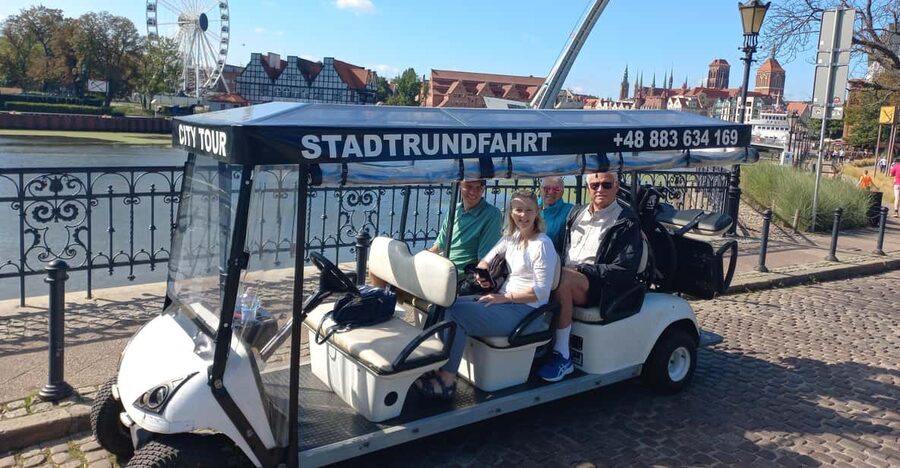
Gdansk’s historic center is compact, but its major sights are spread across several connected areas. A walking tour can cover the Old Town and Main Town well, yet reaching the shipyard and Solidarity sites takes more effort. The electric cart solves that problem without putting you on a large bus.
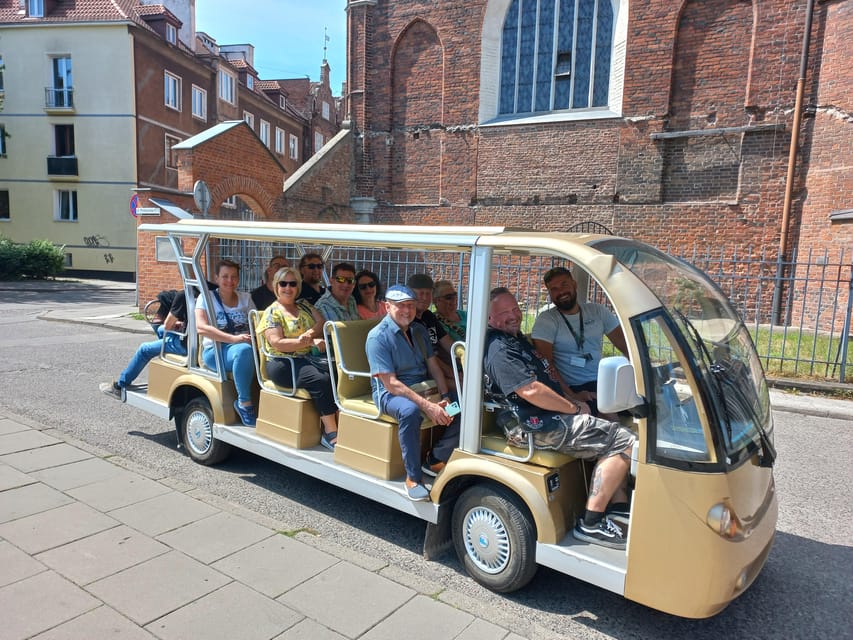
You sit close to the streets and buildings, so the ride feels more connected to the city than a coach tour. At the same time, you cover enough ground to see areas that would be awkward to reach on foot during a short visit.
The vehicle is protected against rain and wind. That does not make weather irrelevant, so wear clothing suited to the forecast, but it does make the tour practical in cooler months. A February outing was described as warm inside the cart, and another winter group rode through temperatures of about 3 degrees Celsius.
Because the tour is private, you can ask for clarification when a name, date, or political event catches your interest. Guides including Michał, Maciej, and Marti have been singled out for humor, enthusiasm, and easy communication in different languages. The exact guide depends on your booking, but the format gives you a direct connection to the person leading the tour.
A few more things to do in Gdańsk worth a look
- Gdańsk: Old Town Private Walking Tour with Legends and Facts
★ 4.9 · 245 reviews - Gdansk: Shared or Private City Tour Sightseeing By Golf Cart
★ 4.8 · 233 reviews - Highlights of Gdańsk, Gdynia and Sopot 1-day Private Tour
★ 4.9 · 59 reviews
Neptune’s Fountain and the heart of Main Town
The tour begins at Neptune’s Fountain, or with pickup from your hotel or another address within 2 kilometers of the fountain. This is a smart starting point because the fountain sits in the middle of Gdansk’s most famous ceremonial streets.
From here, the cart passes Artus Court, the Main Town Hall, the Green Gate, and Long Market. These buildings show Gdansk at its most polished, with decorative façades and a street plan shaped by centuries of trade and civic life.
You should think of this section as an introduction rather than a series of formal visits. The listed stops are short, often around two minutes, so your guide will point out what matters, explain the setting, and keep the cart moving.
Neptune’s Fountain is a natural place to get your bearings. Artus Court adds the story of merchant society and public gatherings, while the Main Town Hall represents city government. The Green Gate leads your attention toward the Motława, making the transition from civic center to waterfront clear.
Gates, armor, and medieval church towers
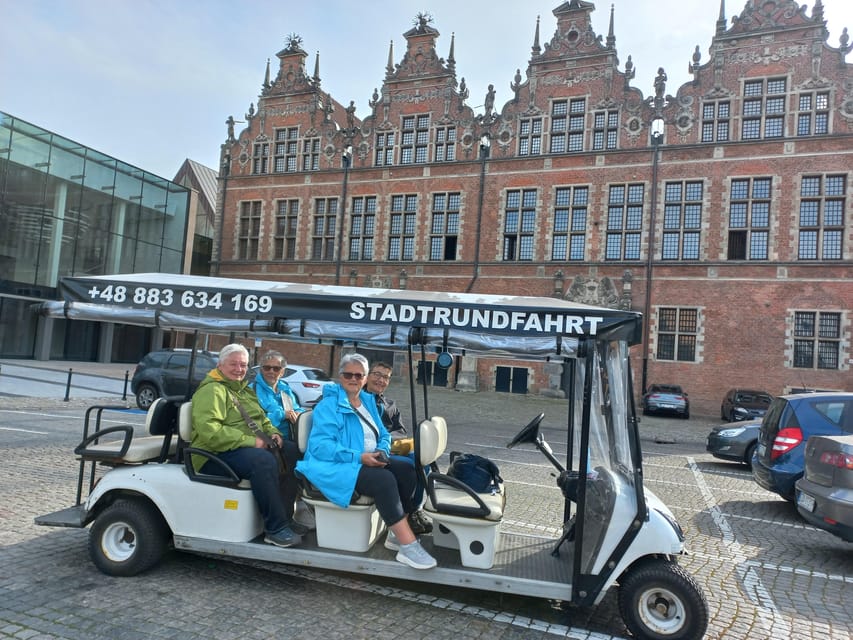
The route then moves through some of Gdansk’s most recognizable gateways. You see the Golden Gate, the Great Armoury, and the Upland Gate, with roughly five minutes set aside for each.
These stops help you read the city as a fortified trading center. The Golden Gate is one of the grand entrances into the historic core. The Great Armoury has an imposing decorative façade, and the Upland Gate marks another important approach into the old city.
The Basilica of St. Nicholas follows, along with the Royal Chapel and St. John’s Church. This part of the route gives you a quick look at the city’s religious variety and its dense concentration of historic churches.
The advantage is range. In a short time, you see several different architectural settings and learn how close together Gdansk’s major sights are. The limitation is equally clear: you will not have time to study every interior, artwork, or side chapel.
St. Mary’s Basilica, Gdansk’s great brick landmark
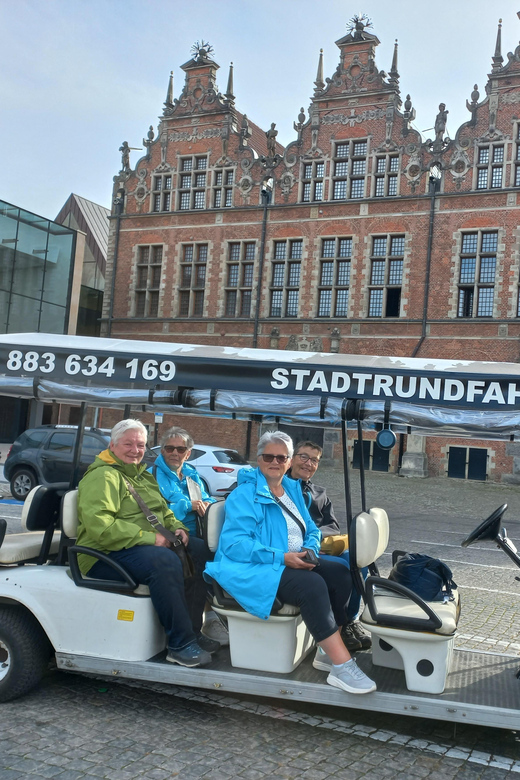
St. Mary’s Church receives special attention, and rightly so. It is presented as the largest church in the world built from red brick, a striking claim that helps explain its place in Gdansk’s identity.
The cart gives you an efficient introduction to the basilica and its role in the city. You should not expect this 90-minute tour to replace a full church visit, especially if you want to examine the interior at length or climb for views.
Still, seeing the building as part of the historic center is valuable. Its scale is easier to appreciate when your guide places it among the surrounding streets and towers. If this is one of your main reasons for booking, return later for more time inside.
The tour also includes St. Bridget’s Church, where the schedule allows a longer visit of about 10 minutes. This is the only entrance ticket specifically included in the package, and its amber altar is a major highlight. The stop gives you more than a passing look, though 10 minutes remains a brief visit for anyone interested in religious art.
Same base, a different kind of day:
- Gdansk: City Cruise on Historical Polish Boat
★ 4.8 · 2,913 reviews - Gdańsk: Sunset Cruise on a Historic Polish Boat
★ 4.9 · 977 reviews - Gdańsk City Sights & History Guided Walking Tour in English
★ 4.8 · 876 reviews - Gdansk: Firearm Shooting Experience with Instructor
★ 4.8 · 866 reviews
The old mills and a modern city break
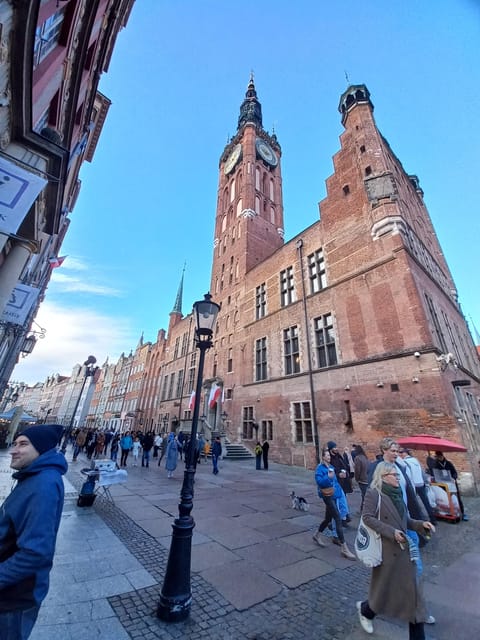
After the churches, the route reaches the Great Mill, the Millennium Tree, Forum Gdansk, and Katownia. This mix shows that Gdansk is not frozen in its medieval center.
The Great Mill recalls the city’s working and commercial past. Forum Gdansk, by contrast, represents the modern shopping and urban side of the city. The Millennium Tree provides another recognizable point along the route, while Katownia, the former torture chamber and prison complex, adds a darker note to the city’s civic history.
The guide gives each place only a few minutes. That works well if your goal is orientation. You can note which sites deserve a return visit and then explore them at your own pace after the tour.
The Motława waterfront and the old crane
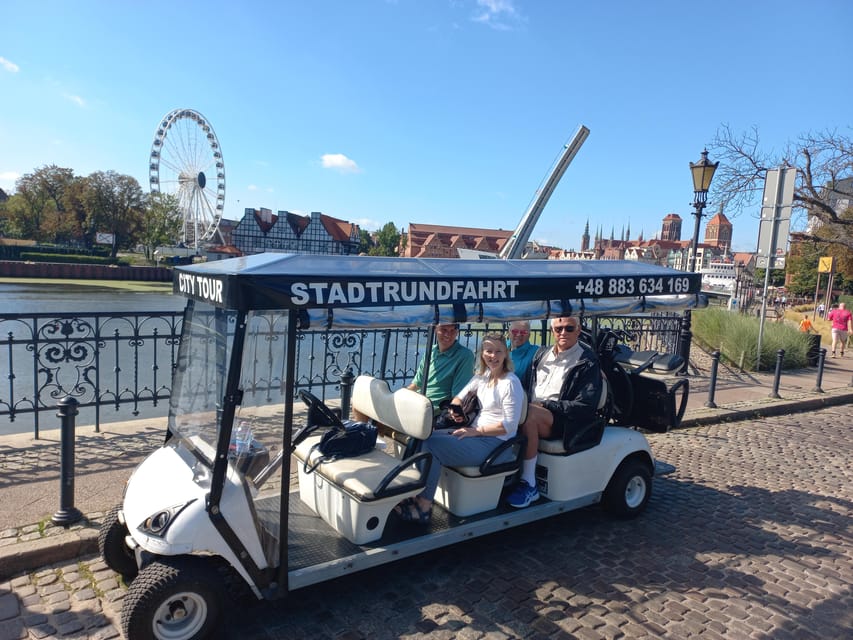
The route reaches the old port along the Motława River and stops near the historic crane, known as the Żuraw. This is one of Gdansk’s most memorable views, with the waterfront, old commercial buildings, and the crane creating a strong picture of the city’s maritime past.
The crane is a useful reminder that Gdansk grew through trade and shipborne commerce. The stop is listed at only about one minute, so expect a quick explanation and a glance rather than a long waterfront pause.
That brevity may disappoint photographers who want time to frame several shots. On the other hand, the electric cart lets you include the port without sacrificing the shipyard section later in the tour.
World War II and the Polish Post
The itinerary also passes the Museum of the Second World War and the Museum of the Polish Post. These are important places, but the cart tour treats them as exterior orientation points, not museum visits.
You’ll get a sense of where they are and why they matter in Gdansk’s twentieth-century story. The Polish Post stop lasts around four minutes, while the Second World War museum receives about two minutes.
If you want detailed wartime history, plan a separate visit. The museum of the Second World War can easily take much longer than this entire ride, and the Polish Post deserves its own time if that episode interests you. The value here is knowing where to return and fitting those locations into your mental map.
The shipyard and the beginning of a political change
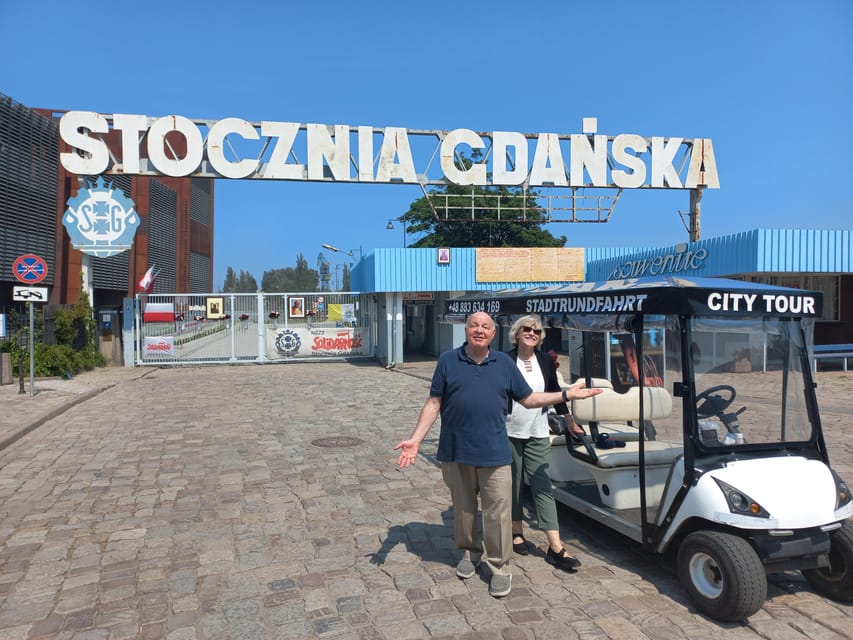
The most significant modern part of the route comes at the Monument to the Fallen Shipyard Workers of 1970, the European Solidarity Centre, and Gdansk Shipyard.
This is where the tour moves beyond attractive buildings and into the political story that shaped modern Europe. The shipyard is identified as the place where the fall of the socialist camp began, referring to the labor movement and Solidarity struggle that grew in Gdansk.
You stop for photos at the monument and Solidarity Centre, then visit the shipyard area. The shipyard portion lasts about five minutes, and the guide provides the essential setting and context.
I find this pairing of old and modern Gdansk particularly useful. The city is not only a collection of rebuilt façades and historic churches. Its shipyard connects the place to workers’ rights, political opposition, and the end of communist rule in Central and Eastern Europe.
The tour cannot cover that story in full. If the subject matters to you, use the cart ride as an introduction, then return to the European Solidarity Centre for a longer visit.
A fast route through Old City and Bunkier
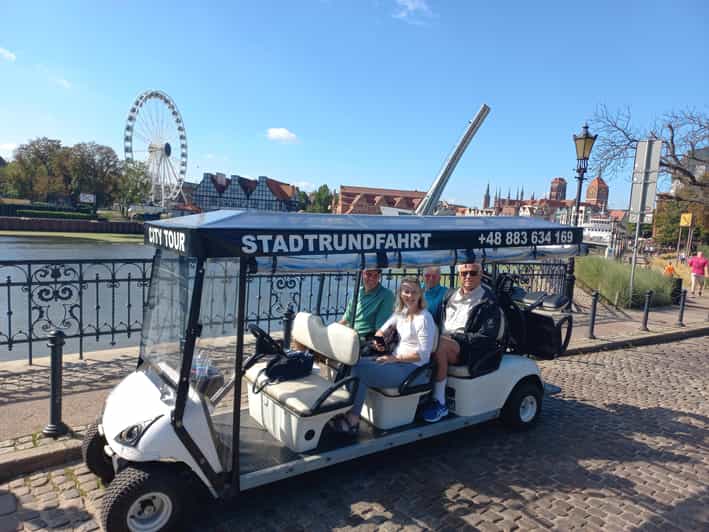
The final section includes Gdansk Old City, the Old City Hall, Hala Targowa Kupców Dominikańskich, and Bunkier before returning to the Main City.
The market hall gives you a glimpse of everyday commerce, while the Old City Hall and surrounding streets add another layer to Gdansk’s urban story. Bunkier closes the route with a more defensive and twentieth-century note.
These final stops are short, generally two to five minutes. You will see a lot, but the experience works best as a broad city introduction rather than a slow architectural walk.
What the $34 price gets you
At $34 per person, this is a reasonable choice if you value private transportation and a guide who can adjust the explanation to your group. The price includes the electric cart, live guide, pickup within the stated central radius, short photo stops, one drink, and the entrance ticket to St. Bridget’s Church.
The drink is a small touch, but you can choose water, coffee, or beer. That makes the outing feel less rigid, especially when the guide is willing to adapt the route or answer questions.
The value depends on your priorities. A solo visitor or couple pays more per person than a large private group, but you avoid sharing a vehicle with strangers. Families may find the private setup useful, especially since the lively explanations can hold children’s attention better than a long walking lecture.
The tour is also wheelchair accessible, and the operator accepts requests for personalized routes. Pickup is included from a hotel, lodging, or other point within 2 kilometers of Neptune’s Fountain, though restricted streets may require meeting at a nearby alternative location.
Timing, weather, and the July fair change
The tour lasts 90 minutes and runs rain or shine. You should arrive at the pickup point 10 minutes before the scheduled start, and you should dress for the day rather than assuming the cart will replace a coat or rain layer.
Traffic can cause a slight delay. The cart shares city streets with other vehicles, so the exact pace may change.
From July 27 through August 25, 2025, St. Dominic’s Fair brings access restrictions and route changes. The tour keeps its normal length and schedule, but you should expect a modified itinerary during that period.
Free cancellation is available up to 24 hours before departure, and you can reserve now and pay later. Those terms are useful when your Gdansk plans are still shifting.
Who should book this tour
I would choose this tour for a first visit, a short stay, or a day when you want a clear overview before exploring on foot. It also suits families, older visitors, and anyone who prefers not to walk continuously across the city.
The cart is a good answer to uncertain weather and limited time. It is also a practical option for people who want the shipyard and waterfront included without arranging separate transport.
You should choose something else if your main goal is museum time, detailed church interiors, or long photo stops. The route contains about 30 locations, so the schedule naturally favors short explanations and exterior views.
Should you book the Gdansk electric-cart tour?
Book it if you want a private, comfortable introduction that joins medieval Gdansk, the Motława port, and the Solidarity shipyard in one 90-minute ride. The live guide, language choices, included drink, and weather cover add real convenience for $34 per person.
Just set your expectations correctly. This is a fast orientation tour with selected access, not a day of museum visits. Use it to understand the city’s shape and story, then return to St. Mary’s Basilica, the European Solidarity Centre, or the Second World War museum when you have more time.
FAQ
How long does the Gdansk electric-cart tour last?
The tour lasts 90 minutes.
What languages are available?
Live guiding is available in English, Spanish, Ukrainian, German, and Polish.
Is the tour private?
Yes. The tour is offered as a private group experience.
Where does pickup take place?
Pickup is available from a hotel, lodging, or another chosen address in the historic city center within 2 kilometers of Neptune’s Fountain. You can also meet at Neptune’s Fountain.
What happens if my pickup address is on a restricted street?
If the address is in an area where the cart cannot enter, the guide will contact you and arrange a nearby pickup point.
Is the electric cart protected from bad weather?
Yes. The vehicles have protective covering against rain and wind, but the activity runs in all weather, so you should still dress appropriately.
Is the tour wheelchair accessible?
Yes, the activity is wheelchair accessible.
Is a drink included?
Yes. Each person can receive water, coffee, or beer.
Is entry to any church included?
Yes. The entrance ticket to St. Bridget’s Church is included.
Just added in Gdańsk
- Gdansk Sopot and Gdynia 3 Cities Private Full-Day Tour★ 5.0 · 56 reviews
- Highlights of Gdańsk, Gdynia and Sopot 1-day Private Tour★ 4.9 · 59 reviews
- Gdansk: Legendary Burger and Zywiec Beer at Hard Rock Cafe★ 4.2 · 32 reviews
- Malbork Castle Tour from Gdansk★ 4.5 · 52 reviews
- Gdansk: Polish Beer Tasting Tour★ 4.7 · 81 reviews
- From Gdansk: Malbork Castle Half-Day Private Tour★ 4.8 · 29 reviews
- Gdansk: Traditional Polish Food Private Tour★ 4.6 · 33 reviews
- Gdansk Private Bike Tour★ 5.0 · 21 reviews
City Tours, compared.




Gdańsk City Sights & History Guided Walking Tour in English
Read the review →
Extended City Sightseeing Tour – Eco Buggy Golf Cart
Read the review →
Private Tour: Warsaw City Sightseeing by Retro Fiat
Read the review →Browse the lists this tour appears in