
Reviewed · NOWA HUTA & COMMUNISM TOURS
Communist Warsaw: private tour by retro minibus with hotel pickup
Warsaw’s communist past is easiest to understand when you see how it reshaped the whole city. This private tour connects the Palace of Culture and Science, postwar Muranów, Praga, and the government quarter in a retro minibus, giving you the story while you move between districts.
I like the small private group, which means your guide can focus on your questions. I also like the hotel pickup and the chance to see more ground without spending three hours on foot. The main catch is that hotel transfers count toward the tour time, and the vintage minibuses may have no air conditioning or seat belts.
Key points at a glance
- The Palace of Culture opens the story: See Warsaw’s most famous Soviet-era building and learn why it still divides local opinion.
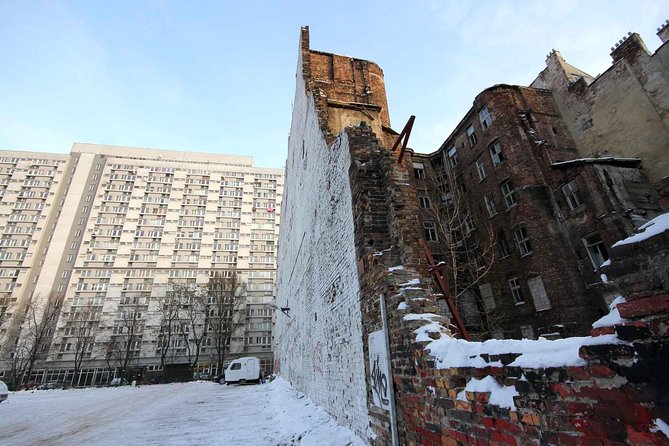
- Muranów reveals a planned postwar city: Walk through a residential district built on wartime ruins as a model socialist neighborhood.
- Praga shows the cost of neglect: Explore a district where informal trade and survival filled the gaps left by the state.
- A private minibus keeps the pace easy: Each vehicle takes up to eight people, with walking at the stops.
- Guide Tom brings the city together: He is praised for explaining communist history, buildings, and statues with clear detail.
- The three-hour schedule has limits: Faraway hotel pickups can shorten the time available at the four main stops.
Why this tour helps explain Warsaw
Warsaw can look modern at first glance. Its rebuilt Old Town, broad avenues, new towers, and restored facades can hide the sharp break caused by World War II and the communist decades that followed.
This tour gives you a useful framework. You see how Soviet influence, postwar rebuilding, socialist planning, state neglect, and political power changed different parts of the city in different ways.
I like that the tour does not treat communism as a single style of architecture. Instead, it shows several competing ideas. The Palace of Culture was a symbol of Soviet authority. Muranów was an attempt to design a new kind of neighborhood. Praga became a place where people found unofficial ways to get what the state could not provide. The government district mixed prewar modernism with monumental socialist realism.
That range gives the tour more bite than a simple drive past communist buildings. You are looking at urban planning, daily life, political messaging, and local memory at the same time.
Other communist-era tours around Warsaw:
- Private Tour: Warsaw’s Communist History by Retro Fiat
★ 5.0 · 115 reviews - Warsaw: Communism Tour in an Original Socialist Van
★ 4.9 · 75 reviews - Warsaw: Communist History Self-Driving Tour
★ 4.8 · 52 reviews
A retro minibus with a private guide
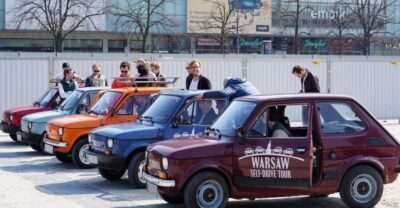
The vehicle is part of the experience, but it is mainly used to connect the stops. You will still walk at each location, so think of this as a sightseeing tour with short walks rather than a ride where you remain seated throughout.
Each minibus holds up to eight passengers, and the activity is private to your group. That is a strong point for couples, families, or friends who want to ask questions without sharing the guide with a large crowd.
The small format also matters in a city where the story changes quickly from one street to the next. Your guide can explain a building, statue, or neighborhood feature while it is still in front of you. Tom, one of the guides, is particularly good at connecting Warsaw’s buildings and monuments to the political period that produced them.
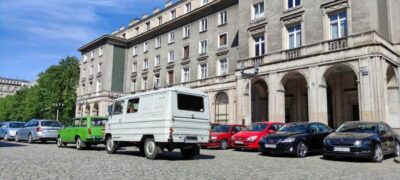
The vehicles are classic vintage minibuses. They have heating for winter, but they do not have air conditioning, and some do not have seat belts. Historic vehicles are permitted to operate this way under Polish law. I would choose comfortable clothes and sensible shoes, especially in warm weather or if you are sensitive to heat.
The Palace of Culture and Science: Warsaw’s most loaded landmark
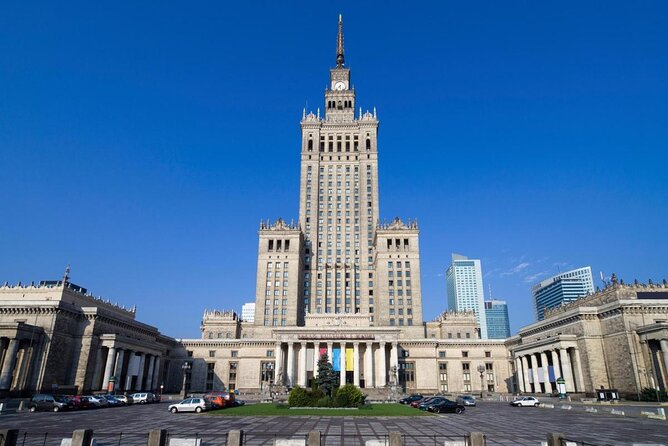
The tour begins at the Palace of Culture and Science, the building most closely associated with communist Warsaw. It was built between 1952 and 1955 as a gift from the Soviet Union, though that friendly word does not tell the whole story. The building was also a giant display of Soviet power in the center of the Polish capital.
Its scale remains difficult to ignore. The tower dominates the skyline, and its presence helps explain why many people in Warsaw have mixed feelings about it. Some see an important landmark and a useful public building. Others see a reminder of Soviet control and a political order imposed after the war.
Your stop here lasts about 20 minutes. The guide explains the building and its place in the city, but the tour does not include the terrace on the 30th floor. That detail matters if you were hoping for a high view of Warsaw. You are booking this stop for context and architecture, not for an observation-deck visit.
I like beginning here because the building gives you a clear question for the rest of the tour: was postwar reconstruction meant to restore Warsaw, or to create a different kind of city? The answer changes from district to district.
Muranów and the idea of a socialist neighborhood
Before the war, Warsaw was a capitalist European city filled with dense tenement housing. After 1945, the communist authorities and modernist architects treated the destruction as an opportunity to redesign the city.
Muranów became one result. Built in the late 1940s on wartime ruins, it was planned as a green residential district and a model socialist neighborhood. Its layout reflects a desire to move away from the crowded prewar tenement city and toward a more ordered form of daily life.
The 20-minute stop is short, but it introduces a useful contrast with the Palace of Culture. There, power is expressed through a huge single building. In Muranów, political ideas appear in the design of homes, open spaces, and streets.
You will walk through the area with the guide rather than simply view it from the minibus. Wear shoes that are comfortable for short periods on foot. The tour does not present Muranów as a perfect success story. Instead, it helps you see the neighborhood as an experiment in how architecture could shape society.
Other sightseeing runs by little car around Warsaw:
- Private Tour: Warsaw City Sightseeing by Retro Fiat
★ 5.0 · 562 reviews - Discover the Dark Side of Warsaw in Praga District by Retro Bus
★ 5.0 · 327 reviews - Warsaw: 2.5-Hour Dark Side – Praga District by a Retro Bus
★ 4.5 · 248 reviews - Private Tour: Warsaw’s Jewish Heritage by Retro Fiat
★ 5.0 · 208 reviews
The rebuilt Old Town and the road beneath it
Between the main stops, you pass through the Old Town area on the way to Praga. The rebuilt historic center is one of Warsaw’s most striking postwar achievements, but the tour places it within a wider infrastructure story.
Beneath the Old Town, a major traffic route was constructed with help from Soviet engineers involved in the Moscow metro. That detail shows how reconstruction involved more than restoring facades. Roads, tunnels, transport links, housing, and public buildings all had to be planned in a city badly damaged by war.
This section is passed from the vehicle rather than treated as a long walking stop. That is useful because it keeps the three-hour schedule moving. You get a glimpse of how old-looking Warsaw can rest on postwar engineering and political decisions.
Praga Północ and the everyday economy of survival
Praga offers a darker look at communist Warsaw. While some parts of the city received major investment, Praga was largely neglected by the state. Its courtyards and streets became associated with informal and illegal activity.
People exchanged foreign currency, traded Western music, and searched for goods that were difficult or impossible to obtain through official channels. These activities were not just colorful side stories. They show how residents adapted when the formal economy failed to meet ordinary needs.
The stop lasts about 30 minutes. It is one of the most useful parts of the tour because it shifts attention away from official monuments and toward daily life. Communist systems are often explained through leaders, party offices, and grand buildings. Praga shows what the system felt like at street level.
The area also adds balance. The tour does not suggest that every part of Warsaw experienced communism in the same way. Some districts were rebuilt as showcases. Others were left to manage with less money, fewer goods, and more unofficial exchange.
Śródmieście and the language of political architecture
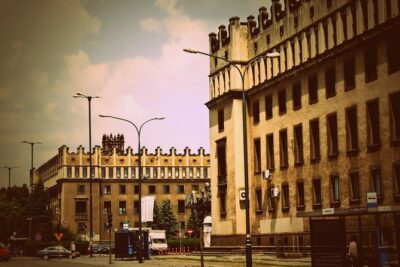
The final stop is in Śródmieście, Warsaw’s government district. Here, prewar modernist architecture meets the heavy formal style of socialist realism.
The contrast is worth paying attention to. Modernism often favors clean lines and functional design. Socialist realism uses monumental forms to project authority, confidence, and the importance of the state. Seeing the two styles close together makes the political shift easier to read.
This stop lasts about 45 minutes, the longest of the four main visits. That extra time allows the guide to explain buildings, statues, and the district’s political role without rushing through every detail.
One amusing detail concerns the new party headquarters. The leader of communist Poland reportedly refused to move into the building, saying it looked more like a capitalist bank than an office for a workers’ party. The story captures a basic tension in communist architecture: buildings meant to represent the working class often used expensive, imposing forms associated with power and wealth.
I particularly like ending here because the district pulls together the tour’s main themes. The city was not simply rebuilt after the war. It was given new symbols, new institutions, and new architectural messages.
What the $134.43 price means
At $134.43 per person, this is not the cheapest way to see Warsaw. The price makes more sense when you use the features included: a private activity, an English-speaking local guide, transportation in a vintage minibus, hotel pickup, hotel drop-off, and all fees and taxes.
For one or two people, the cost may feel high compared with a large group walking tour. For a private group of several people, the value improves because the vehicle and guide are reserved for your party. Group discounts may also be available.
The biggest value is the interpretation. You could pass the Palace of Culture, Muranów, Praga, and the government district on your own, but the connections between them are not always obvious. The guide explains why they look different and how they relate to the political period.
There is also a practical value for anyone who does not want a long walking tour. You still walk at the stops, but the minibus carries you across the city between them. That makes the experience easier for people who want to cover more ground without committing to a full day on foot.
Timing, pickup, and practical limits
The advertised duration is about three hours, but pickup and drop-off are included in that total. If your hotel is far from central Warsaw, the transfer can take a meaningful part of the schedule.
I would check the pickup location carefully before booking. If your hotel is not available in the selection box, send the address to the operator. For a distant hotel, meeting the guide in the city center may give you more time at the actual sights.
The tour is offered in English and can be booked for adults and children over 150 centimeters tall. Children under 150 centimeters need a booster seat under Polish law, so contact the operator in advance to check availability.
The activity is near public transportation, but the main convenience is the arranged pickup. You do not need to work out how to connect four separate districts by tram or taxi.
Free cancellation is available if you cancel at least 24 hours before the start time. Changes or cancellations made later are not accepted for a refund.
Who will get the most from this tour
I would choose this tour if you want political and architectural context rather than a general overview of Warsaw. It suits first-time visitors who have already seen the main historic center and want to understand what happened around it after the war.
It also fits people who prefer a private guide. You can ask about buildings, public memory, daily life, or the difference between official and unofficial economies. The small group makes those questions easier.
Families can consider it, provided children meet the height rules or a booster seat is confirmed. The vintage vehicle may also make the tour more appealing to children, though the subject matter is serious and the walking portions still require suitable footwear.
I would think twice if your main goal is a panoramic city view. The Palace terrace is not part of the tour. I would also reconsider it if you dislike older vehicles, warm interiors, or the possibility of riding without a seat belt.
Should you book Communist Warsaw by retro minibus?
Book it if you want a focused explanation of how communism changed Warsaw and you value private transport over a long walking route. The four stops give you a strong range: Soviet symbolism, planned housing, street-level survival, and government power.
The best reasons to choose it are the private format, the useful route across several districts, and the guide’s ability to connect buildings and statues to political history. Tom’s clear explanations are a good sign for anyone who wants more than dates and labels.
Skip it if you mainly want the Old Town, a viewpoint, or an inexpensive group excursion. Also remember that a faraway hotel can reduce sightseeing time, and the vintage minibuses are charming but not modern.
For the right visitor, this is a practical three-hour introduction to a difficult part of Warsaw’s story. You leave with a better sense of why the city looks the way it does, and why some of its most familiar buildings still carry strong political meaning.
FAQ
How long does the tour last?
The tour lasts about three hours, including hotel pickup and drop-off.
Is hotel pickup included?
Yes. Hotel pickup and drop-off are included. If your address is not available in the booking selection, send it to the tour operator.
Is the tour private?
Yes. Only your group participates in the activity.
How many people fit in each minibus?
Each vintage minibus accommodates up to eight passengers. A fleet of five minibuses is available.
Is the tour offered in English?
Yes. A professional English-speaking local guide leads the tour.
Does the tour visit the Palace of Culture observation terrace?
No. The tour stops at the Palace of Culture and Science, but the terrace on the 30th floor is not included.
Can children join the tour?
Adults and children over 150 centimeters can book instantly online. Children under 150 centimeters require a booster seat under Polish law, so contact the operator in advance to check availability.
Just added in Warsaw
- Warsaw Zoo Skip-the-Line Entry Ticket with Private Transport★ 4.8 · 3 reviews
- Warsaw Private Wilanow Palace & Garden Tour★ 4.6 · 30 reviews
- Warsaw: Vodka Tour★ 4.4 · 18 reviews
- Warsaw Wolf’s Lair with St. Lipka and Mamerki Private Guided★ 4.2 · 3 reviews
- Warsaw Uprising and WWII Old Town Walking Tour with Museum★ 4.7 · 15 reviews
- Warsaw Old Town UNESCO HERITAGE walking tour in English★ 4.5 · 23 reviews
- Warsaw: Private Vodka Tasting Night with Snacks and Pickup★ 5.0 · 7 reviews
- Warsaw: Skip-the-Line Royal Castle Guided Tour★ 4.9 · 79 reviews
Nowa Huta & Communism Tours, compared.
Legendary Private Nowa Huta Communism Tour with Crazy Guides
Read the review →
Nowa Huta: Steelworks Administration Buildings/Shelters Tour
Read the review →
Private Tour: Warsaw’s Communist History by Retro Fiat
Read the review →
Private Nowa Huta Adventure Tour in Communist Cars
Read the review →
Browse the lists this tour appears in