
Reviewed · WWII MEMORIAL & CAMP TOURS
Warsaw for WWII Buffs – private tour with hotel pickup
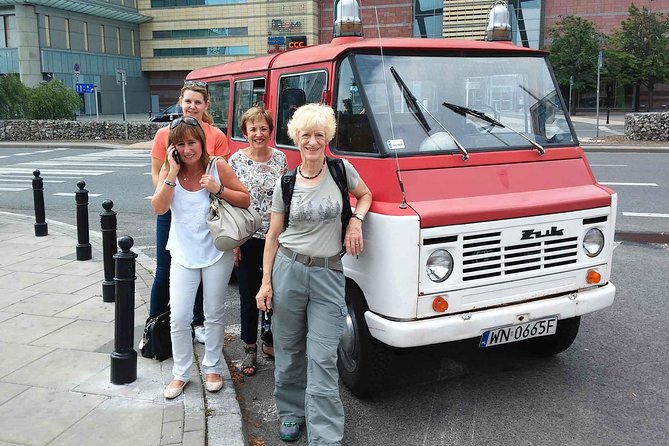
Warsaw’s WWII story is easiest to grasp from the back of a battered-looking Żuk minibus, moving between the places where the city’s past still shows through modern streets. This private tour covers the Warsaw Ghetto, the Ghetto Heroes Monument, Soviet deportations, and the 1944 Warsaw Uprising in about three hours.
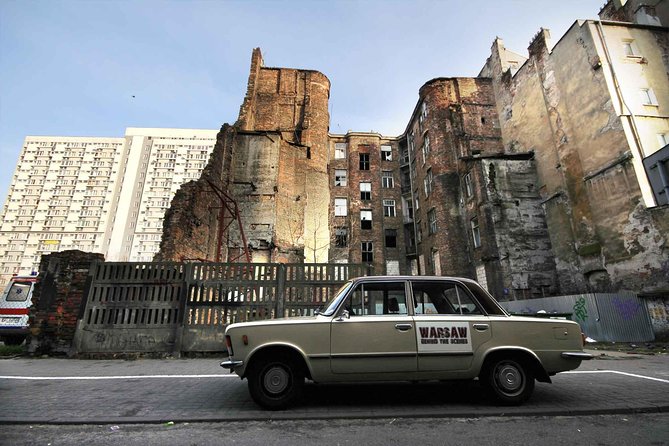
I like the personal guide format, especially because guides such as Tom, Marcin, Karol, Martin, and Konrad have tailored the conversation to individual interests rather than delivering a fixed lecture. I also like the access to less obvious sites, including surviving Ghetto Wall fragments and the ruined Waliców tenement.
The main caution is time. Three hours goes quickly, and the city’s wartime story is too large for a tidy package. The vintage vehicles are fun but may be warm, bumpy, or less comfortable for older passengers, and some historic minibuses do not have seat belts.
Key points to know before booking
- Travel in a historic Żuk minibus: The vehicle gives the tour a distinctly Polish feel, though it is not a modern luxury van.
- See surviving traces of the Warsaw Ghetto: The route includes Wall fragments, Chłodna Street, Waliców, and the Muranów district.
- Cover both Nazi and Soviet occupation: The story includes the 1939 German invasion, Soviet attacks and deportations, the Katyn massacres, and postwar communist rule.
- Use your private format well: Ask for more detail on the Ghetto Uprising, 1944 Uprising, Jewish Warsaw, Soviet repression, or postwar reconstruction.
- Keep expectations realistic: Most stops are outdoor memorials and street locations, with walking between the vehicle and each site.
- Central hotel pickup is included: Pickup and drop-off are available within 3 kilometers of the city center, but transfer time counts toward the three-hour tour.
Why a Żuk makes sense for Warsaw’s WWII story
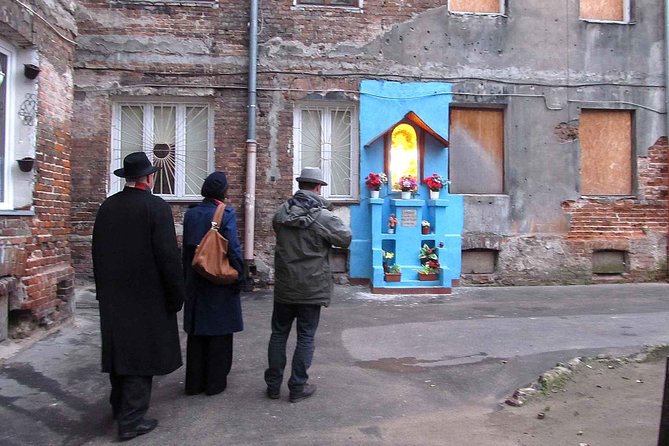
Warsaw is spread out enough that a walking tour cannot easily connect all the major WWII locations in one short outing. This tour uses the minibus to link sites across central Warsaw, then gets you out for short walks and explanations at each stop.
The retro Żuk is more than a prop. It connects the experience to Poland’s communist-era past, and the ride gives you a sense of local character before the serious history begins. A lovingly restored green Żuk has been used on some departures, while other bookings may use a different vintage minibus from the operator’s fleet.
You should not expect the comfort of a new passenger van. The vehicles hold up to eight people, and the operator has five minibuses. Some have no air conditioning, although all are heated in winter. The ride can be bumpy, and one passenger found getting in and out difficult. If that may be a concern for you, ask in advance which vehicle is planned.
The private setup is the real advantage. You can stop to ask why a particular memorial matters, compare the 1943 Ghetto Uprising with the 1944 Warsaw Uprising, or spend less time on subjects you already know. Guides have also adjusted routes for people who had already seen the main monuments.
Other wartime memorials reachable from Warsaw:
- World War 2 in Warsaw walking tour in English
★ 4.7 · 237 reviews - Wolf’s Lair & Treblinka Tour in 1 day from Warsaw
★ 5.0 · 37 reviews - Gdansk: Guided Round-Trip Cruise to Westerplatte
★ 4.3 · 865 reviews
Setting the scene: Poland in 1939
The opening portion gives you the political background needed for the rest of the tour. You hear about the German invasion of Poland in September 1939 and the Soviet attack on eastern Poland later that same month.
That double occupation shaped everything that followed. Warsaw was not simply a city under German rule. Polish civilians faced Nazi terror in the west and center of the country, while the Soviet occupation brought arrests, executions, and deportations in the east. The guide connects these events to the growth of the Polish resistance and to the difficult choices faced by ordinary people.
This section is useful even if you already know the broad timeline. Warsaw’s wartime story is often reduced to the Ghetto and the 1944 Uprising, but the opening explains why the city became a center of organized resistance and why postwar Polish memory remains complicated.
Expect the guide to use photographs or other visual aids on some departures. Tom, for example, has used images to show how streets and buildings looked during the war. That kind of comparison helps when you are looking at a rebuilt city where much of the original architecture is gone.
Waliców and the surviving Ghetto Wall
The tour then turns to the fate of Warsaw’s Jewish population. Before the war, Poland was home to about three million Jews, including roughly 300,000 in Warsaw. In 1940, Nazi authorities forced nearly half a million people into the Warsaw Ghetto.
At Waliców, you see one of the remaining fragments of the Ghetto Wall. It is not a grand monument with a broad plaza. The fragment survives between buildings and along old property lines, which makes it easy to miss without a guide. That is precisely why the stop matters.
The wall helps you picture the ghetto as a forced enclosure within the city, not as a distant camp separated from ordinary life. Streets, apartment buildings, and commercial areas once existed on both sides of the boundary. The guide explains how the wall divided families, neighborhoods, and daily routines.
Waliców also contains a ruined tenement that has been described as one of the last visible ghosts of the Ghetto. The building remains in poor condition, and its rough appearance carries more weight than a polished memorial could. You are looking at a physical remnant of a neighborhood that was later destroyed.
These stops are short, but they are among the most powerful parts of the route. Wear shoes you can walk in comfortably, since the minibus is mainly used to connect locations rather than carry you directly from one monument entrance to another.
Chłodna Street and the bridge above the road
Chłodna Street offers one of the clearest examples of how the Ghetto was organized and controlled. In 1941, the German authorities divided the Ghetto into two sections, with Chłodna used for east-west traffic.
A wooden bridge near Chłodna and Żelazna streets connected the two sections. It rose to the third floor of nearby buildings, allowing trams, German military transports, and cars to pass beneath it. Wartime photographs often show the bridge crowded with people, making it one of the most recognizable images of the Warsaw Ghetto.
Today, the original bridge is gone. You stand at the street level and use the guide’s explanation, photographs, and the surrounding layout to understand what once occupied the space above you. This is a good example of why a local guide adds value. Without the historical images, the street can look ordinary.
The stop is brief, around ten minutes, so it works best as part of the wider narrative. It is not a full museum visit, and there is little to see in isolation. Its importance comes from the explanation of how Nazi control shaped movement within the Ghetto.
A few more things to do in Warsaw worth a look
- Private Tour: Warsaw City Sightseeing by Retro Fiat
★ 5.0 · 562 reviews - Warsaw: Warsaw Ghetto Private Walking Tour with Hotel Pickup
★ 4.9 · 369 reviews - Private Tour: Warsaw’s Jewish Heritage by Retro Fiat
★ 5.0 · 208 reviews - Private Historical Tour of Warsaw by a Retro Fiat with Pickup
★ 5.0 · 190 reviews
Muranów, the Ghetto Heroes Monument, and POLIN
Muranów can look like a standard district of apartment blocks. Underneath that everyday appearance is the destroyed neighborhood of the former Ghetto. The area was rebuilt after the war, and the present streets sit over the remains of what had been a major Jewish district.
This is one of the tour’s most valuable ideas: Warsaw’s wartime past is not always visible as ruins. In Muranów, the absence of the old neighborhood is part of the story. Your guide helps you read the district as a place layered over destruction rather than as a collection of unrelated modern buildings.
The route continues to the Monument to the Ghetto Heroes and the nearby POLIN Museum of the History of Polish Jews. The tour visits the area around these sites, but admission to the museum is not included in the experience. If POLIN is important to you, plan separate time for an interior visit.
The monument area is tied to the first armed clashes of the 1943 Ghetto Uprising. It also represents later efforts at remembrance and dialogue among Polish, Jewish, and German communities. The guide can explain both the uprising itself and the changing ways Warsaw has remembered it.
Some departures have included the area around Mila 18, the former command bunker of the Ghetto Uprising. The site is especially meaningful because visitors can stand near ground connected directly to the final resistance. Ask about this location when booking or at the start of the tour if it is a priority, since the exact route can be adjusted for private groups.
The Monument to the Fallen and Murdered in the East
The tour then shifts from Nazi persecution to Soviet crimes. On September 17, 1939, the Soviet Union invaded eastern Poland, two weeks after Germany attacked from the west.
At the Monument to the Fallen and Murdered in the East, you learn about Poles deported to Siberian labor camps, people killed in executions, and victims of the Katyn massacres. The memorial was built after the collapse of the Soviet Union, when public discussion of these subjects became more open.
This stop matters because it prevents a one-sided view of Polish WWII history. The city suffered under both occupying powers, and the Soviet presence did not end Poland’s loss of independence in 1945. Instead, the Red Army’s arrival led into decades of communist rule.
If you are mainly interested in the Jewish history of Warsaw, this section may feel like a change of subject. I think it earns its place because it explains the wider experience of wartime Poland and the political tensions that continued long after the German occupation ended.
The Warsaw Uprising Monument and the city’s destruction
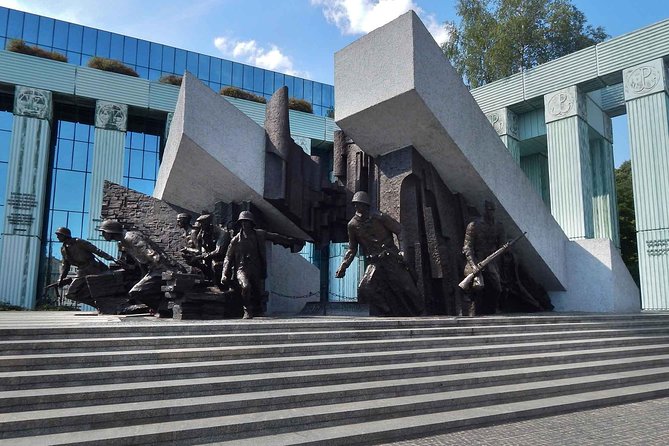
The final major chapter concerns the Warsaw Uprising of 1944. Polish resistance fighters tried to liberate the city before the arrival of the Red Army, hoping to establish an independent Polish government rather than accept Soviet control.
The uprising failed. Afterward, German forces systematically destroyed much of Warsaw, and Soviet troops entered the largely empty ruins in January 1945. The city then entered a new period under communist rule.
At the Warsaw Uprising Monument, the guide brings together the military event, the destruction of the city, and the political outcome. This is a useful closing point because it shows that liberation from Nazi Germany did not immediately mean a return to independence.
The monument also helps explain why Warsaw’s historic center can feel both old and new. Much of what you see was rebuilt after the war, including the Old Town. The tour does not treat reconstruction as a simple restoration project. It places the rebuilt city within the story of survival, memory, and political change.
Several guides, including Lucas, Tom, Karol, and Marcin, have been praised for answering questions beyond the basic timeline. That matters here, since the uprising raises difficult issues about strategy, Soviet inaction, civilian suffering, and the meaning of resistance.
How much history fits into three hours
Three hours is enough to give you a strong framework and see a wide range of sites. It is not enough to explore every location at length or enter several museums.
The pace is fairly brisk. Individual stops range from about ten to twenty-five minutes, and the vehicle carries you between them. You will get out repeatedly, but this is not a long walking tour. The route works well if you have a busy schedule or want an orientation before spending more time at POLIN, the Warsaw Uprising Museum, or other historical sites on your own.
I would book this early in your Warsaw stay if possible. The tour can give meaning to places you later see independently, and the guide may suggest museums or restaurants that fit your interests. It is also booked well ahead on average, roughly 55 days in advance, so leaving it until the last morning is not wise during a busy period.
The private format means you can ask for a heavier focus on one subject. WWII specialists may want more time on the Ghetto Uprising, Mila 18, or the 1944 Uprising. If your background is limited, ask the guide to slow down and explain the political timeline before adding detail.
Price, pickup, and practical comfort
At $169.38 per person, this is not the cheapest way to see Warsaw. The value depends heavily on group size. For one or two people, the private guide and vehicle make it a premium short tour. For a small family or group, the cost can compare more favorably with several separate taxis, a standard private guide, and the time needed to find these sites independently.
Pickup and drop-off are available at hotels, apartments, and Airbnb properties within 3 kilometers of central Warsaw. If your accommodation is farther away or difficult for a vehicle to reach, you will be given a nearby meeting point.
Remember that hotel transfers count toward the three-hour duration. If you stay outside the center, meeting downtown may give you more history and less driving. Ask about this before the day of the tour.
Wear comfortable shoes and clothing. The vehicles are historic, some do not have seat belts, and none are described as air-conditioned. In warm weather, the interior may be uncomfortable. In winter, heating is available.
Children over 150 centimeters can be booked online. Smaller children require a booster seat under Polish law, so contact the operator first to check availability. The activity is private, and only your group participates.
Cancellation is flexible up to 24 hours before the start time for a full refund. Changes or cancellations inside that window are not accepted.
Who should book Warsaw for WWII Buffs?
I recommend this tour most strongly if you want a clear WWII framework rather than a general city sightseeing ride. It suits history-focused visitors, families with older teenagers, and anyone who wants to connect memorials, ruins, photographs, and modern streets in one route.
You do not need to be a specialist. Guides such as Marcin have explained the period in a conversational way, answering questions without turning the experience into a classroom lecture. Teenagers can also respond well to the mix of stories, photographs, the unusual vehicle, and short walks.
I would hesitate if you need a smooth, air-conditioned vehicle, have difficulty climbing into a high step, or want long visits inside museums. I would also choose a longer experience if every stop must be explored in depth. One guide noted that three hours barely allowed room for everything he wanted to explain.
For most people, the best approach is to treat this as a strong introduction. Then use the rest of your Warsaw visit for POLIN, the Warsaw Uprising Museum, or a longer independent visit to the sites that affected you most.
FAQ
How long does the tour last?
The tour lasts approximately three hours, including hotel pickup and drop-off when that service is used.
Is the tour private?
Yes. Only your group participates in the activity.
What language is the tour offered in?
The tour is offered in English with a professional local English-speaking guide.
Where can pickup take place?
Pickup and drop-off are available from hotels, apartments, and Airbnb properties within 3 kilometers of central Warsaw. A nearby meeting point may be suggested if the address is farther away or inaccessible by car.
What type of vehicle is used?
Transport is provided in a retro Żuk minibus. Each minibus holds up to eight passengers, and the operator has a fleet of five vehicles.
Is the tour suitable for children?
Children over 150 centimeters can be booked online. Children under 150 centimeters require a booster seat under Polish law, so you should contact the operator in advance to check availability.
Does the tour enter the POLIN Museum?
The tour visits the area around the POLIN Museum and the Ghetto Heroes Monument. Museum admission is not included.
Can I cancel for a refund?
You can cancel up to 24 hours before the experience start time for a full refund. Cancellations or changes made less than 24 hours before the start time are not accepted.
Should you book it?
Book this tour if you want Warsaw’s WWII story explained by a local guide while you move efficiently between sites that are difficult to connect on foot. The surviving Ghetto Wall, Waliców ruins, Muranów, Soviet memorial, and Warsaw Uprising Monument create a serious and well-shaped route.
Just go in prepared for a vintage ride, short outdoor visits, and a lot of history in a small window. If you accept those limits, the private format and flexible guide make this one of the more useful short introductions to wartime Warsaw.
Just added in Warsaw
- A unique walking tour of Jewish Warsaw — past and present★ 5.0 · 8 reviews
- Tour from Warsaw: Wolf’s Lair, Hitler’s HQ Zones I and II★ 5.0 · 32 reviews
- Wolf’s Lair Private Day Trip from Warsaw★ 5.0 · 50 reviews
- Wolf’s Lair & Treblinka Tour in 1 day from Warsaw★ 5.0 · 37 reviews
- Jewish Warsaw Walking Tour★ 5.0 · 95 reviews
- Warsaw: The Original Pub Crawl★ 4.5 · 97 reviews
- Warsaw: Gun Shooting Experience with Transfers★ 4.8 · 97 reviews
- Best of Warsaw – private tour by retro minibus with hotel pickup★ 5.0 · 111 reviews
WWII Memorial & Camp Tours, compared.
Wolf’s Lair & Treblinka Tour in 1 day from Warsaw
Read the review →Browse the lists this tour appears in