
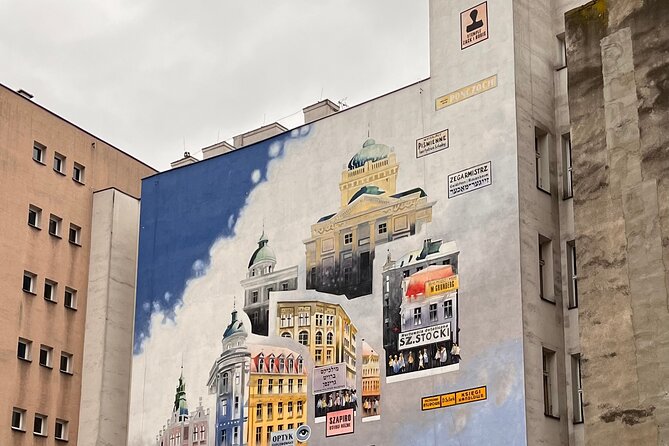
Reviewed · JEWISH QUARTER & GHETTO TOURS
Past Meets Present in Warsaw’s Jewish Ghetto
Warsaw’s former Jewish quarter is not a single museum visit. It is a city walk through streets, gardens, monuments, and empty spaces that carry the memory of a community destroyed during World War II. This tour connects those places in a clear route, from the Jewish Historical Institute to Umschlagplatz and the memorial at Mila 18.
I like the small maximum group of 10, which gives you a better chance to hear the guide and ask direct questions. I also like the route’s balance: it covers Jewish life before the war, the Warsaw Ghetto Uprising, and the memorial work that continues today. The main drawback is the walking. With several outdoor stops and no included coffee break, this is not a good fit if you have serious mobility problems.
Key points to know before you book
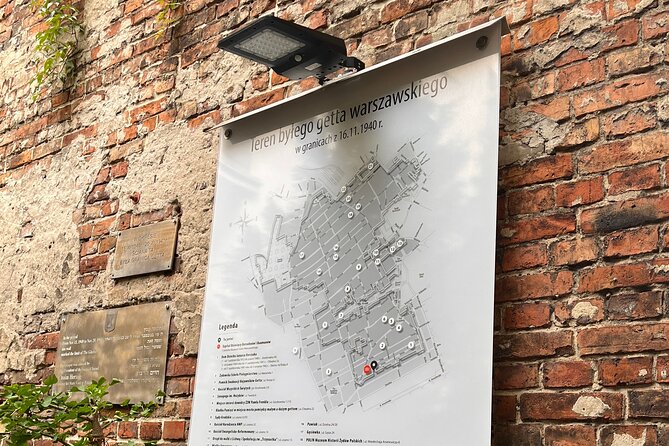
- Guide Mona brings a personal, thoughtful approach to the story of Warsaw’s Jewish community and the uprising.
- The route links seven important sites, including Nalewki Street, the Ghetto Heroes Monument, Mila 18, and Umschlagplatz.
- A group of no more than 10 people keeps the walk more personal than a large city tour.
- The tour takes about two and a half hours, with free admission at the listed stops.
- You finish at Willy Brandt Square, where you receive suggestions for a nearby coffee stop.
- The subject is painful but not softened, so expect an honest account of survival, loss, and resistance.
A walking tour through a vanished neighborhood
The former Jewish quarter can be hard to understand if you only visit one memorial. Modern Warsaw has been rebuilt, streets have changed, and much of the prewar neighborhood is gone. This route helps you connect separate points into one story.
The tour begins at the Monument of Słowacki, near Bankowy Square, and ends at Willy Brandt Square. The listed stops take about two hours and 30 minutes, though the actual pace may depend on the group and questions.
Your guide is Mona, who leads the tour in English. Her approach is especially suited to visitors who want more than dates and names. The feedback about her points to a gentle, personal manner combined with an honest discussion of the Warsaw Ghetto Uprising. One private tour was described as both heartbreaking and enlightening, which is a fair warning about the tone.
This is not a light sightseeing walk. It asks you to look closely at places connected to deportation, forced confinement, resistance, and death. At the same time, the route also shows how Warsaw remembers its Jewish past today.
Other Jewish-heritage walks around Warsaw:
- Warsaw: Warsaw Ghetto Private Walking Tour with Hotel Pickup
★ 4.9 · 369 reviews - Warsaw: Jewish History Guided Walking Tour in English
★ 4.7 · 324 reviews - Private Tour: Warsaw’s Jewish Heritage by Retro Fiat
★ 5.0 · 208 reviews
The Jewish Historical Institute and the city before the war
The first stop is the Jewish Historical Institute, known in Polish as Żydowski Instytut Historyczny. During the war, the building served as one of the centers of Jewish social life inside the Warsaw Ghetto. Today, it holds an important archive of Jewish documents.
The stop lasts about 15 minutes and does not include an admission charge. You should not expect a full museum visit here. Instead, the building provides a useful starting point for the larger story. It reminds you that the ghetto was not only a place of suffering. Before and during the occupation, Jewish life included organizations, cultural activity, social networks, work, and education.
That opening matters because the later memorials can otherwise reduce an entire community to its final years. The Jewish Historical Institute helps put people before the tragedy. It gives the walk a human beginning.
Nalewki and Długa, where commerce once filled the streets
The next stop brings you to the crossing of Nalewki and Długa streets. Nalewki was once the most active street in the northern Jewish quarter, lined with shops, small factories, workshops, and stalls.
You spend about 10 minutes here. There is no ticket, and the value comes from the explanation rather than from a single preserved building. The guide helps you picture a neighborhood shaped by trade and daily business, not just by wartime destruction.
This is one of the tour’s most useful corrections to a common mistake. It is easy to think of the ghetto only as a sealed place created by the Nazis. Before that, this part of Warsaw was a working district with its own patterns of commerce and social life.
You will need to use your imagination, since the route description does not promise a preserved street scene or interior visit. That can be frustrating if you want a large collection of original buildings. If you are willing to listen and picture the earlier streetscape, the stop adds important context.
Krasinski Garden, a quiet space outside the ghetto
The walk continues to Krasinski Garden, where you spend about 20 minutes. The park was a place of rest for Warsaw residents, but it was outside the ghetto during World War II.
That detail makes the garden more than a pleasant pause. Its location shows how close different parts of the city could be while living under sharply different rules. A public garden might be an ordinary place of calm for some people, while Jewish residents on the other side of the boundary faced confinement and persecution.
I also appreciate the change of setting here. After the denser urban points, a garden gives you a moment to pause and absorb the information. This is still a serious stop, but the open space can make the two-and-a-half-hour walk easier.
Do not mistake this for free time in a park. The guide uses it as part of the historical route. You should stay with the group and expect the discussion to remain focused on wartime Warsaw.
Same base, a different kind of day:
- Warsaw: Chopin Concert in the Old Town
★ 4.8 · 2,287 reviews - Warsaw: Traditional Galar Cruise on The Vistula River
★ 4.6 · 1,640 reviews - Warsaw: Old Town Highlights Walking Tour in English
★ 4.7 · 1,516 reviews - Warsaw Concert: Chopin – Painted by Candlelights with Wine
★ 4.8 · 1,442 reviews
The POLIN square and the Ghetto Heroes Monument
The tour then reaches the square at the POLIN Museum, home to the Monument to the Ghetto Heroes. The stop lasts about 30 minutes, making it one of the longer and more important parts of the walk.
This monument is one of Warsaw’s central places of remembrance for the Jews of the ghetto. It is also connected with the city’s annual daffodil tradition. On the anniversary of the Warsaw Ghetto Uprising, people place yellow daffodils at the monument.
That simple act gives the site a living connection to the past. You are not only looking at a monument from a distance. You are also seeing a place where present-day Warsaw continues to mark the uprising and honor those who fought and died.
The nearby POLIN Museum is not included as an admission stop on this tour. The route takes you to the square and monument, not through the museum’s galleries. If you want the museum’s full exhibition, plan that separately and allow additional time.
The guide’s role is especially important here. A large group can make a memorial feel rushed or impersonal. With no more than 10 people, you should have a better chance to pause, ask about the monument, and hear the story without competing with a crowd.
Mila 18 and the mound for the uprising’s leaders
At Mordechaja Anielewicza Street, the tour reaches the Anielewicz Mound at Mila 18. The stop lasts roughly 30 minutes.
The mound commemorates the deaths of leaders of the Warsaw Ghetto Uprising. Mordechaj Anielewicz was the leader associated with the uprising, and Mila 18 became one of its key points. This is among the most emotionally difficult stops because it links the physical place to the final days of resistance.
The tour does not present the uprising as a neat military victory. The story is about people fighting under impossible conditions, making choices shaped by survival, dignity, and the refusal to accept total control. That framing is one reason Mona’s calm style matters. The information can be painful, but a steady guide helps keep the discussion clear.
Give yourself room to be quiet here. You may want to ask questions, but you do not need to fill every pause. The stop is free, and the power comes from its meaning rather than from an elaborate structure or formal entry.
Umschlagplatz, the departure point for deportation
Umschlagplatz is the next major memorial, with about 15 minutes set aside. The monument marks the place where Jews were assembled and sent toward Treblinka extermination camp. Approximately 300,000 Jewish people died there.
This stop shifts the focus from armed resistance to deportation and mass murder. It is a stark part of the route, and you should expect the guide to speak plainly. The short time listed does not mean the site is unimportant. Memorial spaces often require less physical touring and more attention to the words and names connected with them.
For many visitors, this is the point where the scale of the crime becomes hardest to process. Earlier stops show a community, a neighborhood, and a resistance movement. Umschlagplatz shows the machinery of removal and death.
Because the tour remains outdoors, weather can affect your experience. Wear practical shoes and clothing suited to a walking tour. The operator specifically notes that the activity is not recommended for people with walking or mobility problems.
Willy Brandt Square and the meaning of the final stop
The final stop is the Willy Brandt Monument at Willy Brandt Square, also known as a memorial to Willy Brandt’s tribute to the murdered Jews of Warsaw and to all victims of World War II. The visit lasts about 15 minutes.
Brandt is remembered here for his tribute to the victims of the Warsaw Ghetto. Ending at this memorial gives the tour a wider frame. The route has moved through the Jewish quarter, the ghetto uprising, the deportations, and the city’s acts of remembrance. The final stop points toward responsibility and public memory beyond Poland itself.
The tour ends at the square, and Mona provides recommendations for a nearby coffee stop. Coffee and tea are not included, but that is a minor expense compared with the tour price. It also means you can decide whether you want a quiet break, more conversation, or to continue sightseeing.
Is $112.43 a fair price?
At $112.43 per person, this is not a budget walk. The price makes the most sense if you value a small group, a certified guide, and a focused route through places that can be difficult to interpret on your own.
All listed stops are free to enter, so you are paying mainly for the guide’s time, structure, and explanation. That is important here. The route is not built around ticketed attractions. Its worth depends on how well the guide connects streets, memorials, and historical events.
A group maximum of 10 improves the value. You are less likely to be lost at the back of a large crowd, and personal questions are more practical. The feedback about Mona’s personable manner also suggests that the experience can work well as a private or very small-group walk.
If your main goal is to enter museums, see interiors, or keep costs as low as possible, this may not be the best choice. If you want a guided introduction to Warsaw’s Jewish sites and prefer conversation over a self-guided map, the cost is easier to justify.
Group discounts may be available, which could help if you are booking for several people. Confirmation is sent within 48 hours, subject to availability, so do not wait until the last minute if your schedule is tight.
Who should take this walk?
I would recommend it to anyone visiting Warsaw who wants to understand how Jewish life, Nazi persecution, resistance, and remembrance fit together. It suits first-time visitors because the route gives you a strong starting point for further visits to the city’s museums and memorials.
It is also a good choice for families with older children or teenagers who can manage two and a half hours of walking and serious discussion. The guide’s ability to answer questions is useful if your group wants to talk about Jewish history, the uprising, or the moral choices faced by people under occupation.
You should think twice if you have mobility limits or find long outdoor walks difficult. The tour is near public transportation, but the activity itself is a walking route. Service animals are allowed, and most people can participate, but the operator does not recommend it for people with walking problems.
The subject matter also deserves consideration. This is a moving and sometimes brutal account. You will not get a cheerful overview of Warsaw. You will get a direct look at one of the city’s most important stories.
Practical details that affect your day
The tour is offered in English and includes a certified guide. It runs for about two hours and 30 minutes, with seven stops. Admission to the listed stops is free, and coffee or tea is not included.
The starting point is the Monument of Słowacki near Bankowy Square, at 00-142 Warsaw. The walk ends at Willy Brandt Square, at the address listed with Mordechaja Anielewicza, 01-999 Warsaw. Since the route begins and ends in different places, avoid planning a tight connection immediately afterward.
Free cancellation is available if you cancel at least 24 hours before the local start time. Cancellations made within 24 hours are not refunded, and late changes are not accepted.
The group limit is 10 people. That is small enough for a personal discussion but large enough that the experience may not feel like a one-on-one tour unless you book privately.
Should you book Past Meets Present in Warsaw’s Jewish Ghetto?
Book this tour if you want a guided, serious introduction to Warsaw’s Jewish past and the Warsaw Ghetto Uprising, especially if you value Mona’s personal style and a small group. The strongest parts are the thoughtful route, the time at the Ghetto Heroes Monument and Mila 18, and the way the walk connects ordinary city life with wartime destruction.
Skip it if you want a low-cost stroll, a museum-heavy outing, or very little walking. For everyone else, the tour offers a clear and respectful way to approach places that are easy to miss or misunderstand on your own. Allow time afterward for coffee, quiet, or a visit to the POLIN Museum if you want to continue the subject.
FAQ
How long does the tour last?
The tour lasts approximately two hours and 30 minutes.
Where does the tour begin?
The tour begins at the Monument of Słowacki near Bankowy Square, 00-142 Warsaw, Poland.
Where does the tour end?
The tour ends at Willy Brandt Square, near Mordechaja Anielewicza Street, 01-999 Warsaw, Poland. Recommendations for a nearby coffee stop are provided.
Is the tour offered in English?
Yes. The tour is offered in English.
How many people can join the tour?
The tour has a maximum of 10 participants.
Is admission to the stops included?
The listed stops have no admission charge. Coffee and tea are not included.
Can I cancel for a full refund?
Yes, if you cancel at least 24 hours before the experience start time. Cancellations made less than 24 hours in advance are not refunded.
Just added in Warsaw
- Warsaw Zoo Skip-the-Line Entry Ticket with Private Transport★ 4.8 · 3 reviews
- Warsaw Private Wilanow Palace & Garden Tour★ 4.6 · 30 reviews
- Warsaw: Vodka Tour★ 4.4 · 18 reviews
- Warsaw Wolf’s Lair with St. Lipka and Mamerki Private Guided★ 4.2 · 3 reviews
- Warsaw Uprising and WWII Old Town Walking Tour with Museum★ 4.7 · 15 reviews
- Warsaw Old Town UNESCO HERITAGE walking tour in English★ 4.5 · 23 reviews
- Warsaw: Private Vodka Tasting Night with Snacks and Pickup★ 5.0 · 7 reviews
- Warsaw: Skip-the-Line Royal Castle Guided Tour★ 4.9 · 79 reviews
Jewish Quarter & Ghetto Tours, compared.

Bike Tour of Old Town, Jewish Quarter and the Ghetto
Read the review →
Full Bike Tour – the Old Town, Jewish Qtr & the Ghetto NEW BIKES
Read the review →
Warsaw Ghetto Private Walking Tour with Hotel Pickup
Read the review →
Bike Tour of the Old Town, Kazimierz, and the Ghetto
Read the review →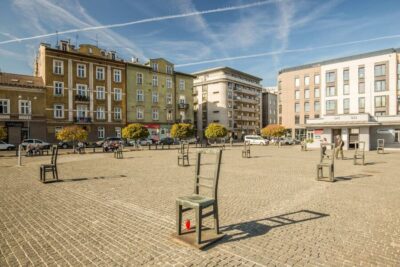
Browse the lists this tour appears in