
Reviewed · JEWISH QUARTER & GHETTO TOURS
Jewish Legacy in Warsaw. Private Tour with the best local specialist.
Warsaw’s Jewish past is written into ordinary streets, courtyards, memorials, and fragments of wall. This private tour links those places into one serious, moving half-day, from the surviving Nozyk Synagogue to the Umschlagplatz deportation site and the Mila 18 bunker memorial. The small group is the big advantage: with up to three people, you can ask questions and set the pace.
I like the door-to-door pickup around Warsaw, and I like the unusual closing stop in Praga, where you see streets used in Roman Polanski’s The Pianist. The main thing to keep in mind is that the POLIN Museum visit is only a quick look at the building and interior, not a full museum admission and gallery tour. The tour covers a lot of ground, so expect a compact overview rather than long, quiet time at every memorial.
Key points at a glance
- Nozyk Synagogue: See Warsaw’s oldest surviving synagogue, a rare functioning link with the city’s prewar Jewish community.
- Ghetto wall and Mila 18: Visit two of the most important remaining markers of Jewish resistance and survival.
- Umschlagplatz: Stand at the deportation site from which Jews were sent to Treblinka.
- Private format: The tour is limited to your own group of up to three people, with an English presentation.
- Praga finale: Visit film locations connected with The Pianist, with an optional look at the villa from The Zookeeper’s Wife.
- Flexible Warsaw pickup: Collection is offered throughout Warsaw at 9:00 a.m., which makes the start simple.
Why this tour matters in Warsaw
I find Warsaw’s Jewish story difficult to grasp from a map alone. The former ghetto was enormous, but much of it was destroyed during the Second World War and the Warsaw Uprising. Modern apartment blocks and broad streets now cover areas where hundreds of thousands of people once lived under Nazi rule.
That is why a walking or driving visit to several specific points can help. No single monument tells the whole story. The synagogue shows religious continuity. The wall fragment shows how sharply the ghetto was sealed off. Umschlagplatz recalls mass deportation. Mila 18 brings the story to armed resistance and its final moments.
This tour also includes places tied to memory after the war. Near the POLIN Museum, you pass the monument connected with Willy Brandt’s gesture of apology and reconciliation. The route is not limited to wartime suffering. It also points toward the Jewish life, culture, and remembrance that continue in Warsaw today.
Because this is a private activity, you do not have to adapt to a large coach group. That matters at memorials. You may want a few quiet minutes, or you may have questions about names, dates, and events. The guide can focus on your interests, at least within the tour’s fairly full schedule.
Other Jewish-heritage walks around Warsaw:
- Warsaw: Warsaw Ghetto Private Walking Tour with Hotel Pickup
★ 4.9 · 369 reviews - Warsaw: Jewish History Guided Walking Tour in English
★ 4.7 · 324 reviews - Private Tour: Warsaw’s Jewish Heritage by Retro Fiat
★ 5.0 · 208 reviews
Nozyk Synagogue and the surviving thread of Jewish Warsaw
The first listed stop is Nozyk Synagogue on Twarda Street. At about 20 minutes, this is a short visit, but it gives the day an important starting point.
It is described as the oldest synagogue still existing in Warsaw. Its survival during the Nazi period is linked to its location and use during the final chapter of the ghetto era. That makes the building more than a religious site. It is a physical survivor of a city whose Jewish quarter was largely destroyed.
You should not expect a long service or extended religious program. The value here is in seeing the building and placing it within the wider story. Ask the guide to explain what happened to the synagogue during the ghetto period and how it fits into present-day Jewish life in Warsaw.
I especially like beginning here rather than starting only with monuments. A synagogue gives the story a human and cultural base. Jewish Warsaw was not created by the Holocaust, and it did not begin with wartime persecution. The building helps place the later stops in a longer setting.
The POLIN Museum building and a useful expectation
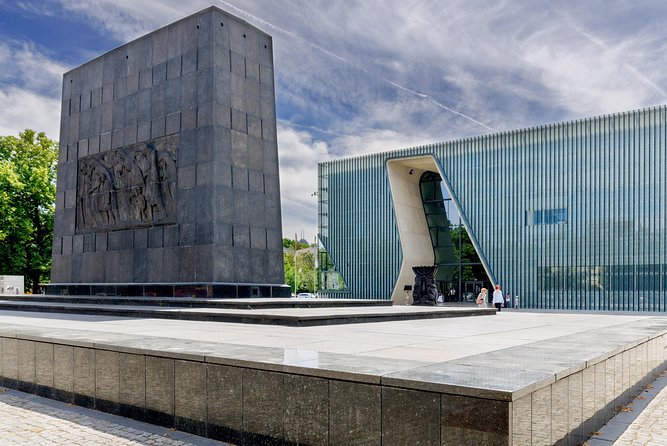
The tour then goes to the POLIN Museum of the History of Polish Jews. The scheduled visit lasts about 50 minutes and includes a look at the museum’s location and a quick view of the interior design.
This is an important distinction when you plan your day. You are not being promised a full museum visit with time for the permanent exhibition. POLIN is large enough to require substantial time on its own, so this tour’s short stop works best as an introduction to the institution and its setting.
The museum is one of the major places in Poland devoted to presenting Jewish life and history in a broad, serious way. Here, the emphasis of the tour is on the building, its design, and its role in bringing Jewish history into public view.
If you want to see the galleries in detail, plan a separate visit at another time. Trying to fit a complete museum experience into this route would make the day rushed. I see the brief POLIN stop as useful for orientation, especially if this is your first visit to Warsaw or your first serious look at Polish Jewish history.
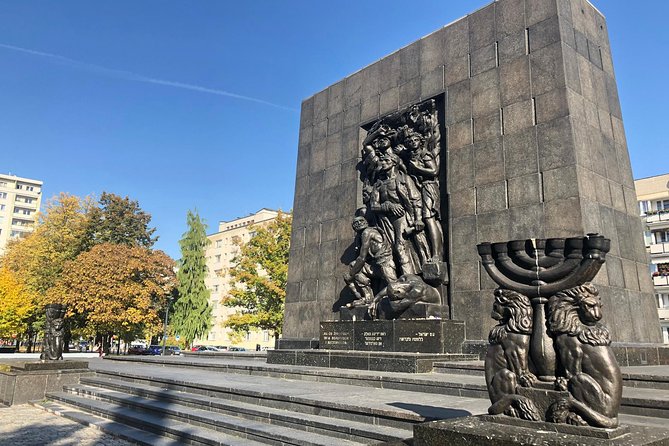
Near the museum, you also pass the Willy Brandt monument. It recalls the German chancellor’s act of kneeling before the Warsaw Ghetto Heroes Monument as a sign of apology and reconciliation. It is a brief pass-by rather than a scheduled long stop, but it adds a postwar layer to the route.
The ghetto wall fragment on Złota Street
The stop at the fragment of ghetto wall on Złota Street lasts around 20 minutes. This is one of the few remaining physical pieces of the wall that enclosed the Warsaw ghetto.
The fragment is easy to overlook if you do not know where it is. It is surrounded by the modern city, which can make the sight especially stark. You are not looking at a complete street or preserved district. You are looking at a remnant, and the guide’s explanation is what connects it to the far larger ghetto that once occupied this part of Warsaw.
The wall’s survival also raises a practical point about this tour. Many of the sites are modest in physical size. They are not grand ruins with obvious scale. You need the historical explanation to understand what is missing and why the small fragment matters.
I would use this stop to ask about the ghetto’s boundaries and the difference between the surviving fragment and the much larger area that once stood behind it. The scheduled 20 minutes is enough for a focused visit, but not for a long discussion unless the rest of the schedule shifts.
A few more things to do in Warsaw worth a look
- Private Tour: Warsaw City Sightseeing by Retro Fiat
★ 5.0 · 562 reviews - Private Historical Tour of Warsaw by a Retro Fiat with Pickup
★ 5.0 · 190 reviews - Warsaw for WWII Buffs – private tour with hotel pickup
★ 5.0 · 166 reviews - Warsaw: Ghetto, Jewish Cemetery & POLIN Museum Private Tour
★ 4.8 · 132 reviews
Umschlagplatz and the road to Treblinka
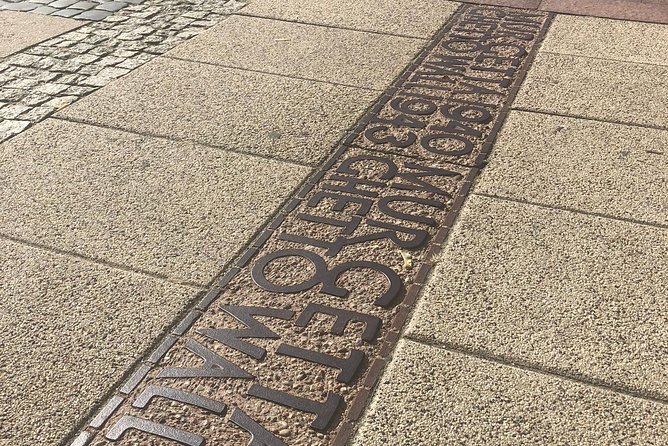
At the corner of Stawki and Dzika Streets, the tour reaches Umschlagplatz. The name refers to the cargo railroad terminal used in the ghetto. From here, Jews were deported to the Treblinka death camp.
This is one of the day’s hardest stops. The place is tied directly to the organized removal of people from Warsaw and their transport to their deaths. A 20-minute visit may feel short, but the site does not need a long list of attractions. Its importance comes from what happened there.
The guide can help you understand the function of the site within the ghetto system. It was not simply a railway stop. It was part of the process by which Jewish families were gathered, forced onto trains, and sent away under Nazi orders.
I would not plan this as a casual sightseeing morning. The route deals with deportation, murder, resistance, and destruction. If you are visiting with children or anyone sensitive to difficult historical subjects, consider the emotional weight before booking. The private format gives you some control over the pace, but it does not soften the subject.
Mila 18 and the story of resistance
The Mila 18 memorial marks the site of the largest bunker in the Warsaw ghetto. It is connected with Mordechaj Anielewicz, leader of the Jewish Fighting Organization, and nearly 30 other members who hid there.
The stop lasts about 20 minutes. Again, the physical memorial is not a vast preserved bunker that you enter. The meaning comes from knowing that this was a place of resistance and a final refuge during the ghetto uprising.
This part of the tour changes the focus. At Umschlagplatz, the emphasis is on deportation and helplessness. At Mila 18, you hear about organized opposition, difficult choices, and the people who tried to fight despite overwhelming odds.
I find this contrast important. A tour of the ghetto can become only a sequence of places where people were imprisoned and killed. Mila 18 reminds you that the story also includes resistance, leadership, and decisions made under impossible conditions.
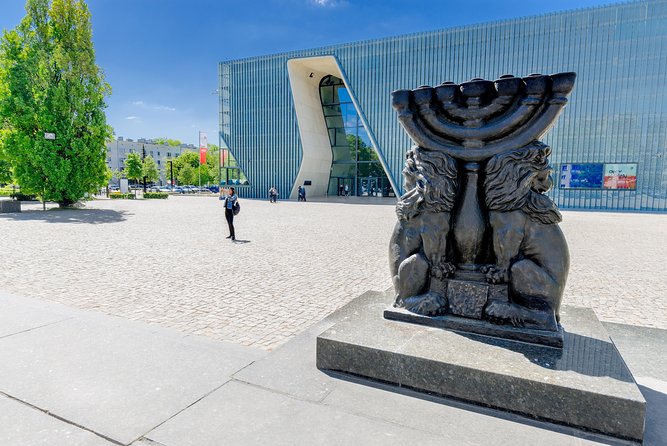
The nearby monument devoted to the heroes of the ghetto receives a longer stop of about 50 minutes. That gives you more time for explanation and reflection than at several of the smaller sites. The monument is a central place of remembrance, and the nearby Willy Brandt memorial adds another layer, showing how later generations have confronted the crimes of the Nazi period.
Chłodna Street and the divided ghetto
Chłodna Street offers a different kind of evidence. The tour stops for roughly 10 minutes at the location of the footbridge that linked the smaller ghetto section with the larger section.
The bridge is gone, but the street helps you picture the separation. Chłodna was described as one of the liveliest and most dangerous parts of the ghetto. That combination is worth considering. A street could be busy with daily life and still be governed by fear, hunger, confinement, and Nazi control.
This is the shortest stop on the route, so you should treat it as a visual explanation rather than a full site visit. The guide’s account matters here because the modern street does not automatically reveal what once occupied it.
I like this stop because it moves the story beyond monuments. You are seeing an ordinary urban road that once had a very different role. It can help you understand how the ghetto was divided and how people moved through a place designed to control them.
Praga, movie locations, and a change of tone
The final stop takes you to Praga Północ for about 40 minutes. The tour includes a selection of streets where Roman Polanski filmed scenes for The Pianist. It also offers a visit to the villa connected with The Zookeeper’s Wife, depending on your interest.
This gives the day a different ending. Instead of standing only at memorials, you see how Warsaw’s surviving streets have been used to represent the city’s wartime past in film. The stop is useful if you know the movies, but the guide can still explain why these streets were chosen as locations.
The villa visit is optional and depends on your interest. You should confirm the plan with the guide rather than assume it is guaranteed as part of every departure. The information provided does not specify an admission arrangement or a full interior tour, so think of it as an additional point of interest rather than the main reason to book.
Praga also broadens the tour geographically. Much of the Jewish legacy route is concentrated around the former ghetto and its memorials. Ending across the Vistula in Praga gives you a wider view of Warsaw’s wartime film setting and surviving urban fabric.
Price, group size, and the time involved
The listed cost is $361.23 for a private group of up to three people. For three people, that works out to about $120.41 each. For one person or a couple, the per-person cost is higher, but you are paying for a private experience rather than a seat on a large shared tour.
The value depends on how much you want personal attention. A private English-language specialist can answer questions as you go and adjust the explanation to your interests. That is particularly useful for a subject with many names, dates, locations, and connected events.
The scheduled stop times add up to about 230 minutes, or 3 hours and 50 minutes, before driving between locations. In practice, you should allow a substantial part of the day because the route includes sites across Warsaw and pickup at the start. The tour begins at 9:00 a.m.
Pickup is offered throughout Warsaw, which saves you the trouble of reaching a fixed meeting point. Mobile tickets are accepted, and the experience is offered in English. It is also near public transportation, though the supplied details do not state which lines or stops are closest.
The tour is generally suitable for most people, and service animals are allowed. Since the route is private, you can speak up if you need a little more time at a stop, though there is a lot to cover.
One serious practical caution deserves attention. A booking issue has been documented in which no guide appeared at the agreed pickup time, phone calls went unanswered, and the booking company later arranged a refund. The refund arrived within one business day in that case, but the missed tour was still a major problem. I would save the provider’s contact details, confirm the pickup shortly before 9:00 a.m., and keep the booking support number available on the morning of the tour.
Free cancellation is available if you cancel at least 24 hours before the start time. Changes or cancellations made less than 24 hours before departure are not accepted for a refund.
Who should book this private Warsaw tour?
I would choose this tour if you want a structured introduction to Warsaw’s Jewish legacy and prefer a private setting. It suits a couple, a small family, or a group of up to three friends who want to ask questions without following a large crowd.
It is also a good match if you want several important sites in one morning, including places that are easy to miss on your own. Nozyk Synagogue, the wall fragment, Chłodna Street, and the Mila 18 site each need context. The route connects them better than a random list of map pins.
I would think twice if your main goal is to spend several hours inside POLIN Museum. This experience only includes a brief look at the museum’s location and interior design. I would also reconsider if you want a relaxed sightseeing outing with little emotional weight. The subject is serious from the first major stop to the last memorial.
The uncertain guide-arrival report is another reason to confirm details before setting out. It does not erase the potential value of the tour, but it is important when your Warsaw schedule is tight.
Final verdict
I would book this tour for a focused, private introduction to Jewish Warsaw, especially if you have limited time and want transportation between a wide set of sites. The strongest parts are the clear progression from synagogue to ghetto wall, deportation site, resistance memorial, and film locations.
Book it with realistic expectations. You will receive a broad, place-based overview, not a full POLIN Museum visit or an extended seminar at every memorial. If that balance suits you, the private format and Warsaw-wide pickup make the $361.23 group price reasonable for up to three people. Confirm the morning pickup, bring your questions, and reserve separate time for POLIN if you want to explore its exhibitions properly.
FAQ
Where does the tour start?
The tour starts at 9:00 a.m., with pickup offered from locations throughout Warsaw.
Is the tour private?
Yes. Only your own group participates, with a maximum of three people.
Is the tour offered in English?
Yes. The experience is offered in English.
What does the tour cost?
The listed price is $361.23 per group of up to three people.
Does the tour include a full visit to POLIN Museum?
No. The scheduled stop includes a visit to the museum’s location and a quick look at its interior design. The supplied details do not describe a full gallery visit.
Which synagogue does the tour visit?
It visits Nozyk Synagogue on Twarda Street, described as the oldest existing synagogue in Warsaw.
Is the visit to the villa connected with The Zookeeper’s Wife guaranteed?
No. The villa visit is optional and depends on the interest of the group.
Can I cancel for a full refund?
Yes, if you cancel at least 24 hours before the experience’s start time. Cancellations or changes made less than 24 hours before the start are not refunded.
Just added in Warsaw
- Warsaw Zoo Skip-the-Line Entry Ticket with Private Transport★ 4.8 · 3 reviews
- Warsaw Private Wilanow Palace & Garden Tour★ 4.6 · 30 reviews
- Warsaw: Vodka Tour★ 4.4 · 18 reviews
- Warsaw Wolf’s Lair with St. Lipka and Mamerki Private Guided★ 4.2 · 3 reviews
- Warsaw Uprising and WWII Old Town Walking Tour with Museum★ 4.7 · 15 reviews
- Warsaw Old Town UNESCO HERITAGE walking tour in English★ 4.5 · 23 reviews
- Warsaw: Private Vodka Tasting Night with Snacks and Pickup★ 5.0 · 7 reviews
- Warsaw: Skip-the-Line Royal Castle Guided Tour★ 4.9 · 79 reviews
Jewish Quarter & Ghetto Tours, compared.

Bike Tour of Old Town, Jewish Quarter and the Ghetto
Read the review →
Full Bike Tour – the Old Town, Jewish Qtr & the Ghetto NEW BIKES
Read the review →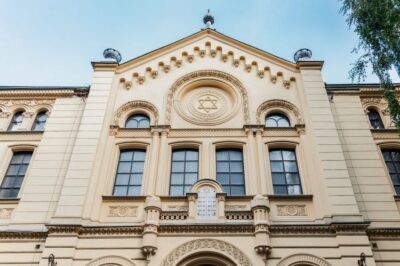
Warsaw Ghetto Private Walking Tour with Hotel Pickup
Read the review →
Bike Tour of the Old Town, Kazimierz, and the Ghetto
Read the review →
Browse the lists this tour appears in