
Reviewed · JEWISH QUARTER & GHETTO TOURS
Warsaw: Jewish History Guided Walking Tour in English
Warsaw’s Jewish story is not confined to a museum. It is under your feet, along streets where the old city was divided, communities were destroyed, and a young Jewish life is taking shape again. This 150-minute walk links the Nożyk Synagogue, Chłodna Street, Waliców Street, and other important places with the people and events behind them.
I like two things right away. First, the tour puts Jewish Warsaw before the Holocaust, so you see a city of artists, writers, actors, journalists, workers, and political activists, not only a place of suffering. Second, the guides, including Andrzej, Jacek, Aga, Luke, and Christopher, are praised for handling a painful subject with care, clarity, and occasional humor. The main drawback is simple: you are outside for the full two and a half hours, and the tour joins a general walking group rather than guaranteeing a small private experience.
Key points to know before you book
- Nożyk Synagogue is Warsaw’s only surviving pre-war synagogue, giving the walk a rare connection to the city that existed before 1939.
- Chłodna Street reveals how the ghetto was divided, including the former bridge that connected its two sections.
- Waliców Street helps explain both the ghetto border and the Warsaw Uprising, tying Jewish history to the wider wartime story.
- The tour covers culture as well as catastrophe, with attention to Jewish artists, writers, actors, journalists, and political life.
- Guides use stories, photos, maps, and questions to make vanished streets easier to understand.
- Cold or wet weather matters, since the entire 150-minute experience takes place outdoors.
Why this walk matters before you visit the ghetto sites
Many tours of Warsaw’s Jewish history begin with the German occupation and the Holocaust. This one aims to set the clock back several centuries first. That choice matters.
Before the Second World War, Warsaw was the second-largest Jewish city in the world. Jewish residents took part in the city’s public life, worked in many trades, and joined other Warsaw residents in resistance to occupying powers during the 19th century. They also participated in Polish uprisings.
The interwar period is especially important. Jewish Warsaw had a cultural life filled with writers, actors, artists, and journalists. It was not a separate footnote to Polish history. It was part of the city’s daily life, arguments, ambitions, music, publishing, theater, and politics.
I find this framing far more useful than simply moving from one memorial to another. When you understand the scale and variety of the community that existed before the war, the destruction becomes easier to grasp. You are not only hearing how many people died. You are learning what was lost.
The tone is serious, but it is not designed to flatten Jewish life into a single story of victimhood. Guides also discuss survival, courage, resistance, and the Jewish community that exists in Warsaw today. That balance is one of the tour’s strongest features.
More walking tours in Warsaw:
- Warsaw: Old Town Highlights Walking Tour in English
★ 4.7 · 1,516 reviews - Warsaw: Old Town Guided Walking Tour
★ 4.9 · 599 reviews - Half-Day Polish Food Walking Tour with Guide and Dinner
★ 4.5 · 381 reviews
Grzybowski Square and the easy-to-find meeting point
The tour begins beside All Saints Church at Grzybowski Square. Look for the yellow umbrella. That simple marker is useful in central Warsaw, particularly if you are arriving in a busy period or joining a larger group.
Grzybowski Square is a fitting starting point because it places you near the former Jewish area while also showing how much of Warsaw has changed. The tour is not just a parade of surviving buildings. Much of the pre-war city was destroyed, rebuilt, or transformed, so the guide’s explanation is essential.
You should arrive ready to listen while standing and walking. Hotel pickup is not included, and the meeting point is fixed at the church. The activity is offered in English with a live guide.
Nożyk Synagogue, the clearest surviving link to pre-war Warsaw
Nożyk Synagogue is the tour’s most direct physical connection to Jewish Warsaw before the war. It is described as the only surviving pre-war synagogue in Warsaw, which gives it unusual weight on a route where many original structures no longer exist.
The guide explains the synagogue within the wider story of Jewish religious and civic life. You get more than a photograph of an old building. You learn why survival itself is significant in a city so heavily altered by war.
One practical point is worth keeping in mind: the tour clearly includes seeing Nożyk Synagogue, but entering the building is not guaranteed as part of the walking experience. Some people have hoped to go inside and found that the outdoor explanation was the main focus. If interior access is essential to you, check the arrangements after booking rather than assuming it is included.
Even from outside, the stop helps anchor the walk. It gives you a real structure to look at while the guide describes the city that surrounded it. Some guides also bring photos and maps, which can help you compare the present street with the pre-war view.
Chłodna Street and the bridge between two parts of the ghetto
Chłodna Street is one of the tour’s most powerful stops because it explains the physical division of the Warsaw ghetto. The former bridge here connected two sections that were otherwise separated by a major road.
That detail turns an abstract map into something you can picture. People living in one section needed the bridge to reach the other. The road below continued to function outside the ghetto, while those above moved through a tightly controlled and dangerous space.
There is no need to expect a complete original scene. Much of the wartime city is gone, and this is one of the tour’s challenges. You may be looking at an ordinary modern street while trying to imagine the bridge, the crowds, the restrictions, and the fear.
This is where a strong guide makes a real difference. The best guides do not simply recite dates. They help you understand how the city worked, using location, maps, photographs, and clear explanation. They also leave room for questions, which is helpful when the site itself cannot tell the story.
Other Jewish-heritage walks around Warsaw:
- Warsaw: Warsaw Ghetto Private Walking Tour with Hotel Pickup
★ 4.9 · 369 reviews - Private Tour: Warsaw’s Jewish Heritage by Retro Fiat
★ 5.0 · 208 reviews - Warsaw: Ghetto, Jewish Cemetery & POLIN Museum Private Tour
★ 4.8 · 132 reviews - Warsaw: Jewish Heritage & Holocaust Walking Tour
★ 4.7 · 119 reviews
Waliców Street, the ghetto border, and the Warsaw Uprising
Waliców Street adds another layer to the route. It once marked part of the ghetto border, and the guide connects it with the Warsaw Uprising.
That link is valuable because Jewish history in wartime Warsaw did not happen in isolation from the city’s wider struggle. The walk shows how Jewish experience, Polish resistance, occupation, and the destruction of Warsaw overlap, while still treating each story on its own terms.
The street also reinforces a hard truth about historical walking tours in Warsaw: many important places now look ordinary. A road, a gap between buildings, or a surviving fragment may carry enormous meaning even when there is little to see at first glance.
I appreciate tours that do not pretend every location is visually dramatic. Here, the interpretation supplies what the buildings cannot. You are asked to pay attention to the guide, not just take pictures.
A history of people, not only dates and ruins
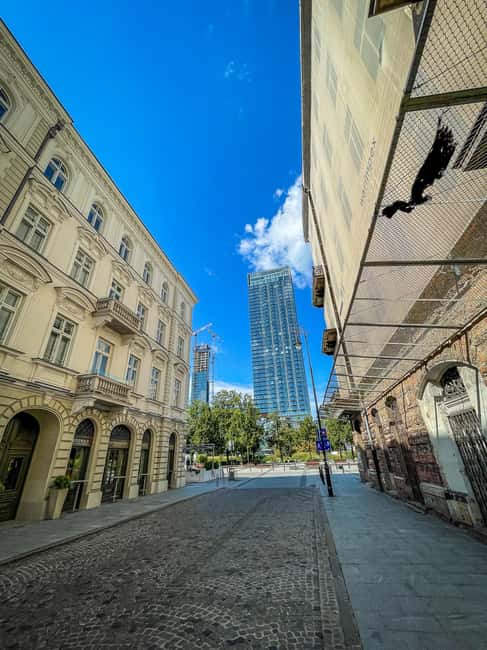
The tour’s strongest educational choice is its attention to Jewish life during prosperous and difficult periods. You hear about people who shaped Warsaw’s culture and public life, rather than encountering the community only through its destruction.
The interwar years receive particular attention. Hundreds of Jewish artists, actors, writers, and journalists lived in Warsaw, creating a cultural world that was unusually active and varied. This helps you see why the Holocaust was not only a mass killing. It was also the destruction of families, institutions, professions, neighborhoods, languages, friendships, and creative work.
The guides also discuss the role of Jewish residents in earlier struggles against occupying powers. That makes the history more connected to the story of Poland as a whole. Jewish residents were not passive outsiders waiting for events to happen to them. They took part in the city’s political and social life.
This broader approach is well suited to first-time visitors who know the basic outline of the Warsaw ghetto but want to understand the setting around it. It also works for people who already have some background and want a more local, street-level explanation.
How the guides handle a painful subject
Guide quality is central here. The best sessions are shaped by clear English, strong command of the subject, and a willingness to answer questions rather than rush through a script.
Several guides are singled out by name in the supplied feedback. Andrzej is described as engaging and willing to run the tour even with a very small group. Jacek is praised for his pace and ability to involve everyone. Aga is noted for factual, direct explanations. Luke is remembered for passion, humor, and personal connection. Christopher receives especially strong praise for his insight into Warsaw and for pointing out details that another ghetto tour had missed.
You should not expect identical delivery every time. This is a general walking tour, so the guide and group shape the atmosphere. Some guides use humor carefully to prevent the subject from becoming emotionally unmanageable. Others take a more factual approach. One guide is noted for asking before sharing particularly difficult details, which is a considerate habit on a tour covering persecution and mass death.
The good guides make the tour feel human without turning it into entertainment. They also encourage questions. That matters because many visitors arrive with family connections, religious questions, or incomplete knowledge of Polish and Jewish history.
Photos, maps, and the problem of a rebuilt city
Warsaw requires more imagination than some historic cities. The war erased or damaged much of the built environment, and later rebuilding changed the appearance of the streets.
A guide who carries old photographs and maps can bridge that gap. You may see a present-day intersection and then view the same place before the war, during the occupation, or after destruction. That contrast gives the route a visual structure.
Not every group will receive exactly the same set of materials, but photos and maps have been used on the walk. They are particularly helpful at Chłodna Street and along former borders, where the physical remains alone cannot show how the area once looked.
Pay attention to the guide’s position as the group moves. In a larger group, it can become difficult to hear if the guide starts walking before finishing a point. Staying near the guide helps, especially on busy streets or when the group is spread out.
Two and a half hours on foot: pace, weather, and group size
The duration is 150 minutes. That is long enough to build a connected story, but short enough to fit comfortably into a day of Warsaw sightseeing.
The pace is generally described as manageable, and the route allows time for explanation and questions. One useful sign is that some people have wanted the tour to continue longer, while another person felt the experience ended early because of a group issue. That suggests the time usually passes quickly, but the final length can depend on how the group moves and interacts.
The whole tour takes place outdoors. In winter, dress very warmly. Freezing conditions have not stopped the tour from being worthwhile, but they can make it harder to concentrate. In milder weather, comfortable shoes and a coat suited to walking are still sensible.
There is no scheduled café break mentioned. One person specifically wished for a chance to warm up, so do not count on an indoor pause. If the forecast is poor, plan a hot drink before or after the walk.
The tour joins the general walking tour. The price covers the reservation fee and the guide’s payment, not a private group arrangement. If you prefer a smaller, private tour, you can contact the provider after booking to ask about organizing one.
Is $26 good value?
At $26 per person, this is good value if you want context rather than a quick list of monuments. The fee pays for a 150-minute guided walk in English, with a route covering several major locations and a subject that is difficult to understand from signs alone.
The value comes from the interpretation. Nożyk Synagogue is meaningful on its own, but the guide explains why it matters. Chłodna Street is just a present-day road without the story of the bridge and the divided ghetto. Waliców Street becomes more significant when connected to the ghetto border and the Warsaw Uprising.
This is not the right choice if you want a private guide, a guaranteed synagogue visit inside, or a museum-style presentation with seats and display cases. It is a strong choice if you want a serious introduction to Jewish Warsaw at a modest price.
Free cancellation up to 24 hours before the start and the option to reserve now and pay later make it easier to fit into a changing itinerary. Starting times vary, so check availability when selecting your date.
Who should book this Warsaw walking tour?
I would recommend it to first-time visitors who want to understand Warsaw beyond the rebuilt Old Town. It is also useful for anyone with an interest in Jewish history, the Holocaust, Polish resistance, or the cultural life of interwar Europe.
You do not need extensive background knowledge. The route is explained in accessible English, and guides make room for questions. Several people with limited prior understanding found the subject approachable, while others with more experience still found new details.
The walk may be especially meaningful if you have a family connection to Warsaw or Jewish Poland. At the same time, you should be prepared for an emotionally heavy subject. The guide may discuss persecution, death, and terrible wartime events directly.
If you need a slower, seated, indoor experience, choose a museum or private tour instead. If you can walk for two and a half hours and want the city itself to be your classroom, this is a worthwhile introduction.
Should you book it?
Book this tour if you want a human and historical explanation of Jewish Warsaw, not just a checklist of memorials. The strongest guides connect everyday city streets with pre-war culture, ghetto life, resistance, destruction, and the Jewish community’s future.
Dress for the weather, stay close enough to hear, and keep your expectations realistic about what survives. You will see important places, but many of the most meaningful parts of the tour are carried by the guide’s stories, maps, photos, and ability to explain what is no longer visible.
At $26, the combination of length, location, and subject makes this a solid choice. I would book it early in a Warsaw stay, when the walk can give useful context to later visits around the city.
FAQ
How long is the Jewish History Guided Walking Tour?
The tour lasts 150 minutes, or two and a half hours.
What language is the tour offered in?
The tour is conducted in English by a live guide.
Where does the tour meet?
Meet next to All Saints Church at Grzybowski Square. Look for the yellow umbrella.
Is hotel pickup included?
No. Hotel pickup and drop-off are not included.
Which major places does the tour visit?
The route includes Nożyk Synagogue, Chłodna Street, the site of the former bridge that connected parts of the ghetto, and Waliców Street.
Can I go inside Nożyk Synagogue?
The tour includes seeing Nożyk Synagogue, but interior entry is not guaranteed in the provided activity details. Check with the provider if entering the synagogue is important to you.
Is this a private tour?
No. The tour joins a general walking group. You can contact the provider after booking to ask about arranging a smaller private tour.
What is included in the price?
The price includes a local guide and the walking tour.
Can I cancel or pay later?
You can cancel up to 24 hours in advance for a full refund. The reserve now and pay later option lets you book without paying immediately.
Just added in Warsaw
- A unique walking tour of Jewish Warsaw — past and present★ 5.0 · 8 reviews
- Tour from Warsaw: Wolf’s Lair, Hitler’s HQ Zones I and II★ 5.0 · 32 reviews
- Wolf’s Lair Private Day Trip from Warsaw★ 5.0 · 50 reviews
- Wolf’s Lair & Treblinka Tour in 1 day from Warsaw★ 5.0 · 37 reviews
- Jewish Warsaw Walking Tour★ 5.0 · 95 reviews
- Warsaw: The Original Pub Crawl★ 4.5 · 97 reviews
- Warsaw: Gun Shooting Experience with Transfers★ 4.8 · 97 reviews
- Segway Tour Warsaw: Full Tour – 3-Hours of Magic!★ 5.0 · 102 reviews
Jewish Quarter & Ghetto Tours, compared.

Bike Tour of Old Town, Jewish Quarter and the Ghetto
Read the review →
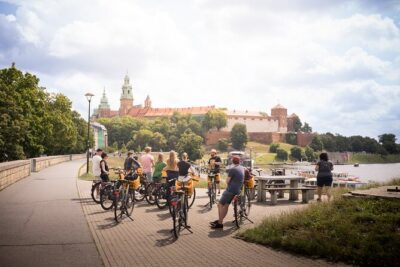
Full Bike Tour – the Old Town, Jewish Qtr & the Ghetto NEW BIKES
Read the review →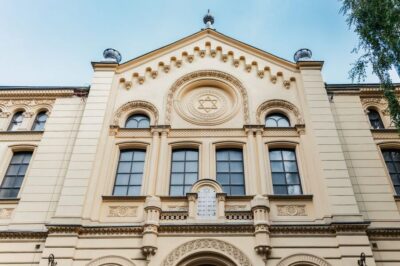
Warsaw Ghetto Private Walking Tour with Hotel Pickup
Read the review →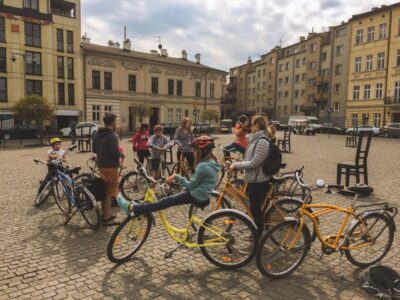
Bike Tour of the Old Town, Kazimierz, and the Ghetto
Read the review →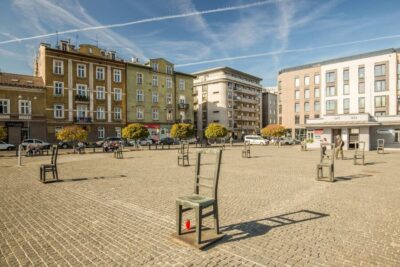
Browse the lists this tour appears in